State Key Laboratory of Genetic Resources and Evolution, Kunming Institute of Zoology, Chinese Academy of Sciences, Kunming, Yunnan, 650223, China.
Kunming College of Life Science, University of Chinese Academy of Sciences, Kunming, Yunnan, 650204, China.
Parasit Vectors. 2018 Mar 20;11(1):202. doi: 10.1186/s13071-018-2786-8.
Giardia spp. are flagellated protozoan parasites that infect humans and many other vertebrates worldwide. Currently seven species of Giardia are considered valid.
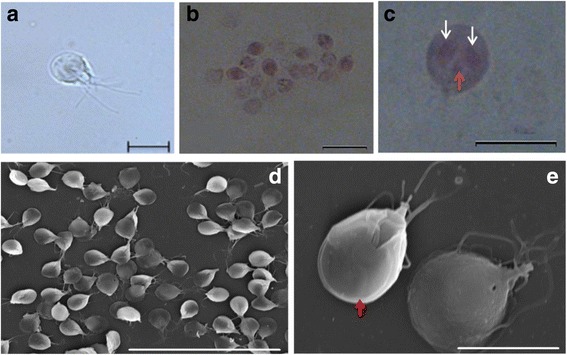
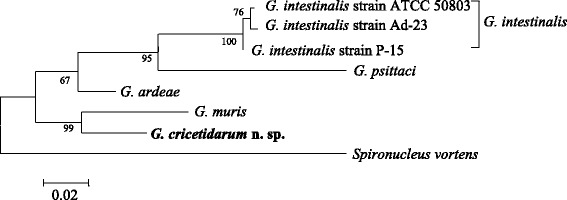
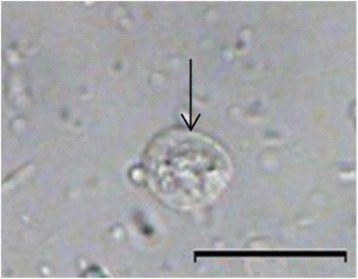
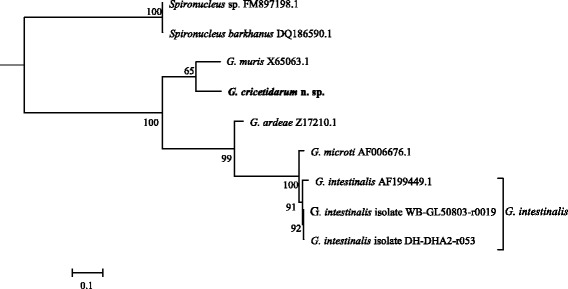
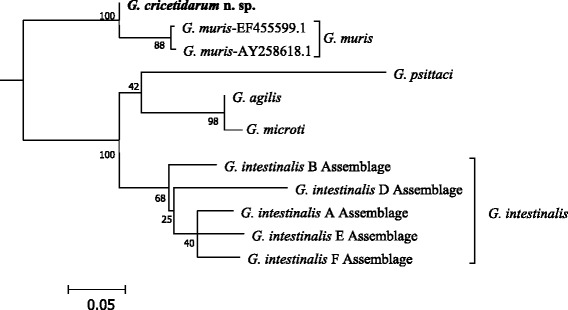
Here, we report a new species, Giardia cricetidarum n. sp. in hamsters. Trophozoites of G. cricetidarum n. sp. are pear-shaped with four pairs of flagella and measure on average 14 μm (range 12-18 μm) in length and 10 μm (range 8-12 μm) in width. The trophozoites of the new species are generally larger and stouter than those of most of the other Giardia spp. and exhibit the lowest length/width ratio (c.1.40) of all recognized Giardia species. Cysts of G. cricetidarum n. sp. are ovoid and measure on average 11 μm (range 9-12 μm) in length and 10 μm (range 8-10 μm) in width and are indistinguishable from the cysts of other Giardia species. Molecular phylogenetic analyses based on beta-giardin, small subunit rRNA, and elongation factor-1 alpha loci all demonstrated that G. cricetidarum n. sp. is genetically distinct from all currently accepted Giardia spp. Investigation of the host range indicated that the new species was only found in hamsters (including Phodopus sungorus, P. campbelli and Mesocricetus auratus), while all the other described mammal-parasitizing species (G. muris, G. microti and G. intestinalis) each infect multiple hosts. Cross-transmission studies further demonstrated the apparent host specificity of G. cricetidarum n. sp. as it only infected hamsters. Trophozoites were found in high numbers in hamster intestines (5 × 10 - 5 × 10) and was rarely detected co-infecting with other Giardia spp. in the common hamster, suggesting it has some advantages in parasitizing hamsters.
This study has identified a new species of Giardia, which appears to be specific to hamsters, and together with the three other mammal-parasitizing Giardia species with different host ranges, may be able to be used as a model system for the study of evolutionary divergence of host parasitism strategies in Giardia.
贾第虫属是一种鞭毛原生动物寄生虫,可感染全球人类和许多其他脊椎动物。目前,已有七种贾第虫属被认为是有效的。
本文报告了一种新的贾第虫属物种,即仓鼠贾第虫(Giardia cricetidarum n. sp.)。仓鼠贾第虫(G. cricetidarum n. sp.)的滋养体呈梨形,有四对鞭毛,平均长度为 14μm(范围 12-18μm),宽度为 10μm(范围 8-12μm)。与大多数其他贾第虫属的滋养体相比,新种的滋养体通常更大更粗壮,且具有所有公认的贾第虫属中最低的长/宽比(约 1.40)。仓鼠贾第虫(G. cricetidarum n. sp.)的包囊呈卵球形,平均长度为 11μm(范围 9-12μm),宽度为 10μm(范围 8-10μm),与其他贾第虫属的包囊无法区分。基于β-微管蛋白、小亚基 rRNA 和延伸因子 1α 基因座的分子系统发育分析均表明,仓鼠贾第虫(G. cricetidarum n. sp.)在遗传上与所有目前被接受的贾第虫属物种不同。对宿主范围的研究表明,该新种仅存在于仓鼠中(包括黑线毛足鼠、坎贝尔仓鼠和金黄仓鼠),而其他描述的哺乳动物寄生种(G. muris、G. microti 和 G. intestinalis)均可感染多种宿主。交叉感染研究进一步证实了仓鼠贾第虫(G. cricetidarum n. sp.)的明显宿主特异性,因为它仅感染仓鼠。在仓鼠肠道中大量发现滋养体(5×10-5×10),很少与其他贾第虫属共同感染,这表明它在寄生仓鼠方面具有一些优势。
本研究鉴定了一种新的贾第虫属物种,该物种似乎专门感染仓鼠,与其他三种具有不同宿主范围的哺乳动物寄生贾第虫属一起,可能可作为研究贾第虫属宿主寄生策略进化分歧的模型系统。