Ramalho José C, Pais Isabel P, Leitão António E, Guerra Mauro, Reboredo Fernando H, Máguas Cristina M, Carvalho Maria L, Scotti-Campos Paula, Ribeiro-Barros Ana I, Lidon Fernando J C, DaMatta Fábio M
Plant Stress & Biodiversity Group, Linking Landscape, Environment, Agriculture and Food Unit (LEAF), Departamento de Recursos Naturais, Ambiente e Território, Instituto Superior de Agronomia, Universidade de Lisboa, Oeiras, Portugal.
Departamento de Ciências da Terra (GeoBioTec), Faculdade de Ciências e Tecnologia, Universidade NOVA de Lisboa, Caparica, Portugal.
Front Plant Sci. 2018 Mar 6;9:287. doi: 10.3389/fpls.2018.00287. eCollection 2018.
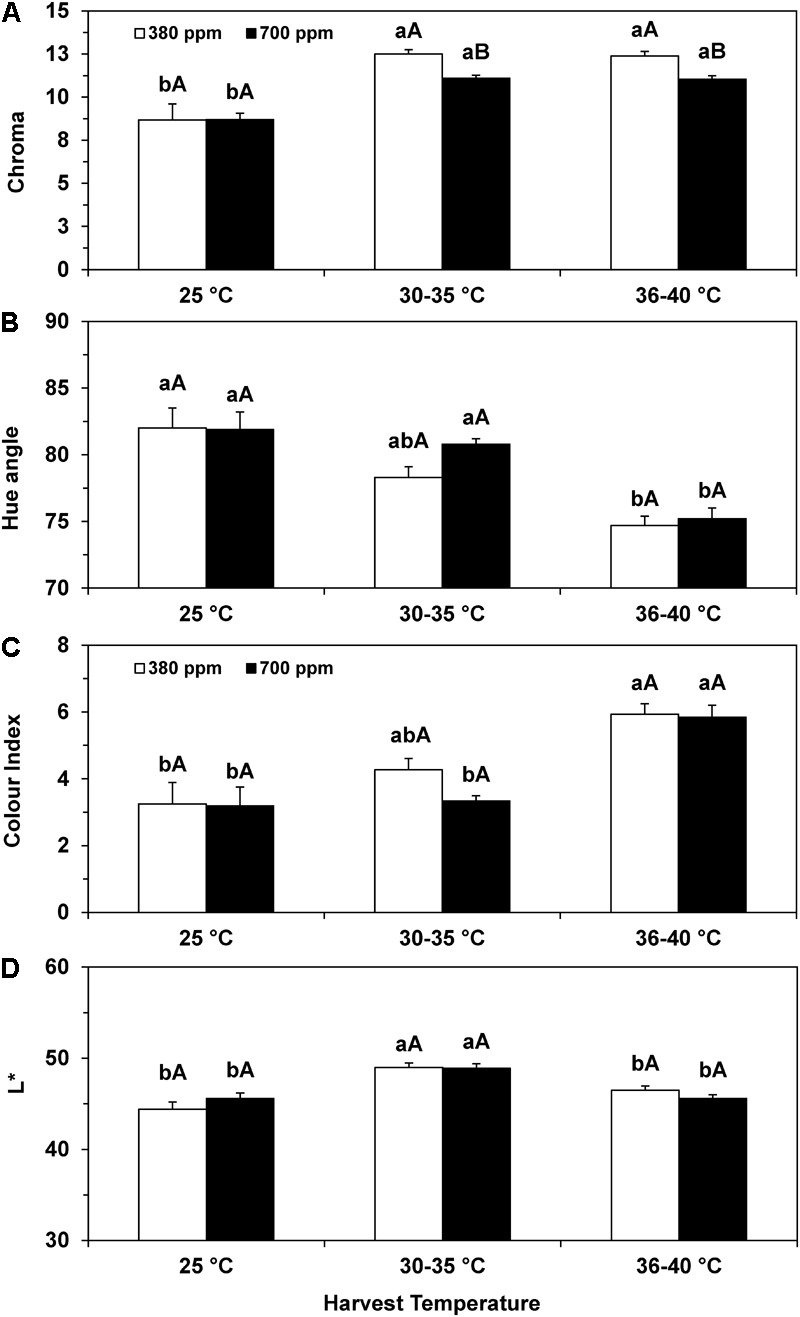
Climate changes, mostly related to high temperature, are predicted to have major negative impacts on coffee crop yield and bean quality. Recent studies revealed that elevated air [CO] mitigates the impact of heat on leaf physiology. However, the extent of the interaction between elevated air [CO] and heat on coffee bean quality was never addressed. In this study, the single and combined impacts of enhanced [CO] and temperature in beans of cv. Icatu were evaluated. Plants were grown at 380 or 700 μL CO L air, and then submitted to a gradual temperature rise from 25°C up to 40°C during ca. 4 months. Fruits were harvested at 25°C, and in the ranges of 30-35 or 36-40°C, and bean physical and chemical attributes with potential implications on quality were then examined. These included: color, phenolic content, soluble solids, chlorogenic, caffeic and -coumaric acids, caffeine, trigonelline, lipids, and minerals. Most of these parameters were mainly affected by temperature (although without a strong negative impact on bean quality), and only marginally, if at all, by elevated [CO]. However, the [CO] vs. temperature interaction strongly attenuated some of the negative impacts promoted by heat (e.g., total chlorogenic acids), thus maintaining the bean characteristics closer to those obtained under adequate temperature conditions (e.g., soluble solids, caffeic and -coumaric acids, trigonelline, chroma, Hue angle, and color index), and increasing desirable features (acidity). Fatty acid and mineral pools remained quite stable, with only few modifications due to elevated air [CO] (e.g., phosphorous) and/or heat. In conclusion, exposure to high temperature in the last stages of fruit maturation did not strongly depreciate bean quality, under the conditions of unrestricted water supply and moderate irradiance. Furthermore, the superimposition of elevated air [CO] contributed to preserve bean quality by modifying and mitigating the heat impact on physical and chemical traits of coffee beans, which is clearly relevant in a context of predicted climate change and global warming scenarios.
气候变化大多与高温相关,预计会对咖啡作物产量和咖啡豆品质产生重大负面影响。最近的研究表明,大气中[CO]浓度升高可减轻热量对叶片生理的影响。然而,大气中[CO]浓度升高与热量对咖啡豆品质的相互作用程度从未得到研究。在本研究中,评估了[CO]浓度升高和温度对Icatu品种咖啡豆的单一和综合影响。植株在380或700 μL CO₂ L空气浓度下生长,然后在约4个月的时间里从25°C逐渐升温至40°C。果实分别在25°C以及30 - 35°C或36 - 40°C范围内采收,随后检测对品质可能有影响的咖啡豆物理和化学属性。这些属性包括:颜色、酚类含量、可溶性固形物、绿原酸、咖啡酸和香豆酸、咖啡因、胡芦巴碱、脂质和矿物质。这些参数大多主要受温度影响(尽管对咖啡豆品质没有强烈负面影响),而受[CO]浓度升高的影响很小,甚至几乎没有影响。然而,[CO]浓度与温度的相互作用强烈减弱了一些由热量导致的负面影响(如总绿原酸),从而使咖啡豆的特性更接近在适宜温度条件下获得的特性(如可溶性固形物、咖啡酸和香豆酸、胡芦巴碱、色度、色相角和颜色指数),并增加了理想特性(酸度)。脂肪酸和矿物质库保持相当稳定,仅因大气[CO]浓度升高(如磷)和/或热量而有少量变化。总之,在水分供应不受限制和光照适度的条件下,果实成熟后期暴露于高温下并不会严重降低咖啡豆品质。此外,大气[CO]浓度升高通过改变和减轻热量对咖啡豆物理和化学特性的影响,有助于保持咖啡豆品质,这在预测的气候变化和全球变暖情景下显然具有重要意义。