Hao Kun, Liu Xiaogang, Wang Xiukang, Fei Liangjun, Liu Lihua, Jie Feilong, Li Yilin, Yang Qiliang, Shan Yunhui
Faculty of Modern Agricultural Engineering, Kunming University of Science and Technology, Kunming, China.
State Key Laboratory of Eco-Hydraulic in Northwest Arid Region, Xi'an University of Technology, Xi'an, China.
Front Plant Sci. 2022 Apr 29;13:848524. doi: 10.3389/fpls.2022.848524. eCollection 2022.
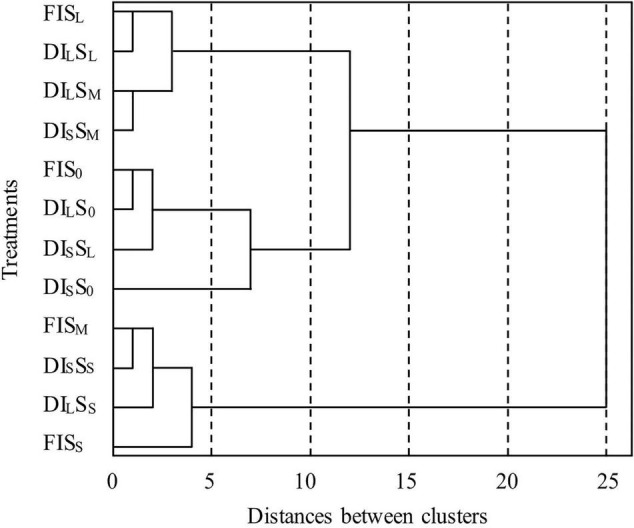
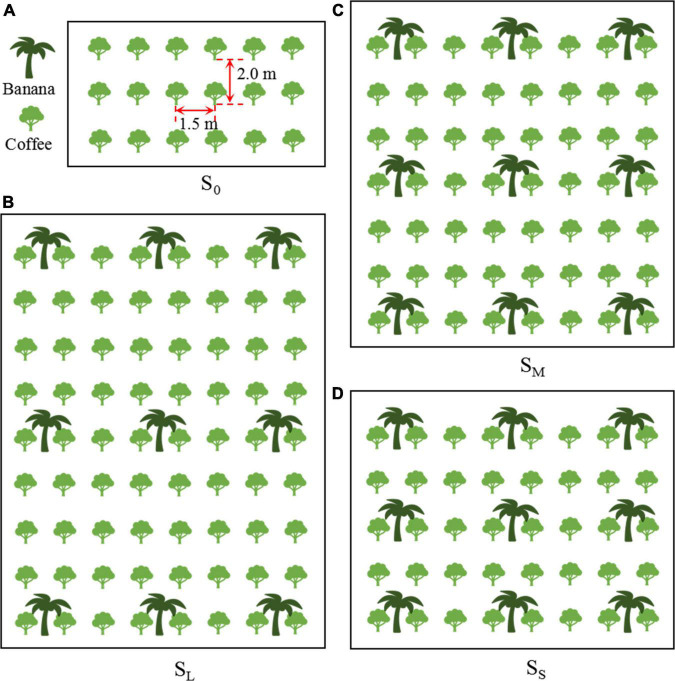
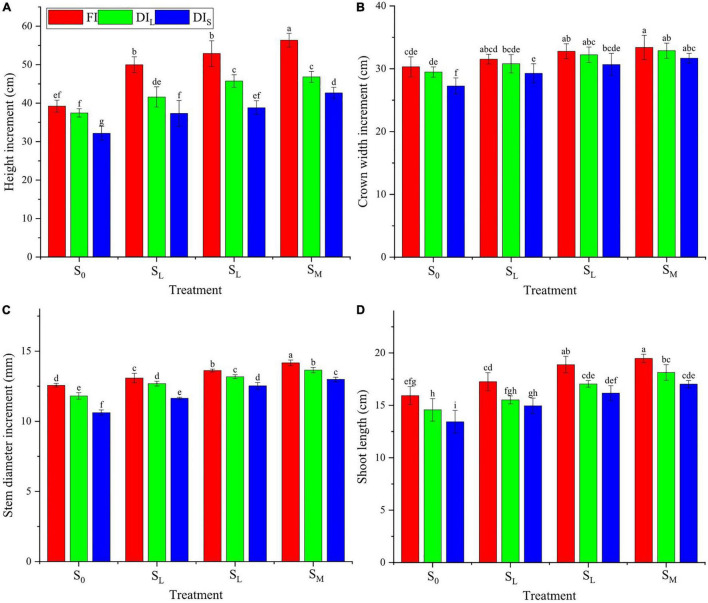
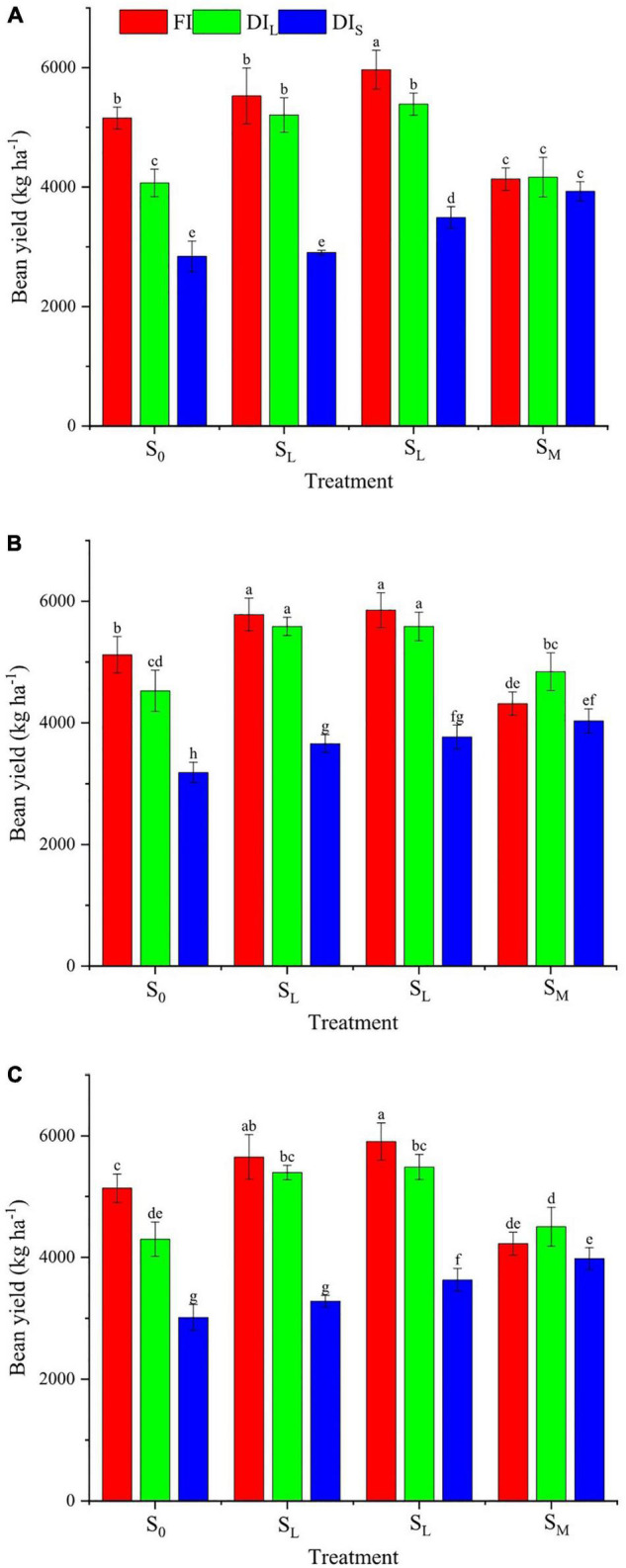
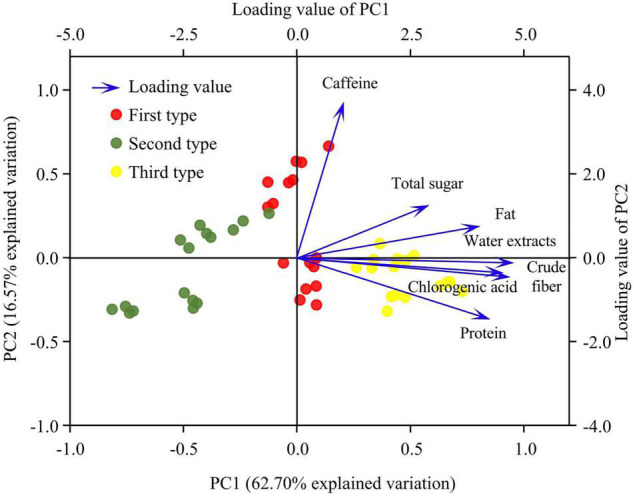
Reasonable water and light management technology can improve economic benefits, coffee yield, and quality. We used cluster analysis and principal component analysis to evaluate and optimize the water and light management technology with high coffee yield, quality, and economic benefits in a subtropical monsoon climate region of China. The experiment was arranged in a randomized complete block design with two factors (3 irrigation levels × 4 shade cultivation treatments) replicated four times during 2016-2017. The irrigation levels consisted of full irrigation (FI) and two deficit irrigations (DI : 75% FI, DI : 50% FI). The shade cultivation treatments consisted of no shade cultivation (S) and three shade cultivation modes (S : intercropping with four lines of coffee and one line of banana; S : intercropping with three lines of coffee and one line of banana; S : intercropping with two lines of coffee and one line of banana). The results showed that the effects of irrigation level and shade cultivation mode on growth, crop yield, most of the photosynthetic characteristics, and nutritional quality were significant ( < 0.05). Regression analysis showed that the leaf radiation use efficiency () showed a significant negative exponential relation or logistic-curve variation with photosynthetically active radiation (). The bean yield increased with an increase of the shade degree when water was seriously deficient, whereas it first increased and then decreased with an increase of the shade degree under FI and DI . Based on both cluster analysis and principal component analysis, the FIS treatment resulted in the highest comprehensive quality of coffee, followed by the FIS treatment; the DI S treatment obtained the lowest quality. Compared with the FIS treatment, the FIS treatment increased the 2-year average bean yield and net income by 15.0 and 28.5%, respectively, whereas the FIS treatment decreased these by 17.8 and 8.7%, respectively. To summarize, FIS treatment significantly improved the nutritional quality of coffee, and FIS treatment significantly increased the dry bean yield and economic benefits of coffee. The results of the study could provide a theoretical basis for water-saving irrigation and shade cultivation management of coffee in a subtropical monsoon climate region of China.
合理的水分与光照管理技术能够提高经济效益、咖啡产量及品质。我们运用聚类分析和主成分分析,对中国亚热带季风气候区具有高咖啡产量、品质和经济效益的水分与光照管理技术进行评估与优化。试验采用随机完全区组设计,有两个因素(3种灌溉水平×4种遮荫栽培处理),在2016 - 2017年重复4次。灌溉水平包括充分灌溉(FI)和两种亏缺灌溉(DI₁:75% FI,DI₂:50% FI)。遮荫栽培处理包括不遮荫栽培(S)和三种遮荫栽培模式(S₁:四行咖啡与一行香蕉间作;S₂:三行咖啡与一行香蕉间作;S₃:两行咖啡与一行香蕉间作)。结果表明,灌溉水平和遮荫栽培模式对生长、作物产量、大部分光合特性及营养品质的影响显著(P < 0.05)。回归分析表明,叶片辐射利用效率(LUE)与光合有效辐射(PAR)呈显著负指数关系或逻辑曲线变化。在水分严重亏缺时,咖啡豆产量随遮荫度增加而增加,而在FI和DI₁条件下,咖啡豆产量随遮荫度增加先增加后降低。基于聚类分析和主成分分析,FIS₁处理的咖啡综合品质最高,其次是FIS₂处理;DI₂S处理的品质最低。与FIS处理相比,FIS₁处理使两年平均咖啡豆产量和净收入分别提高了15.0%和28.5%,而FIS₃处理则分别降低了17.8%和8.7%。综上所述,FIS₁处理显著提高了咖啡的营养品质,FIS₂处理显著提高了咖啡豆干产量和咖啡的经济效益。该研究结果可为中国亚热带季风气候区咖啡的节水灌溉和遮荫栽培管理提供理论依据。