Sharda Anish, Flaumenhaft Robert
Division of Hemostasis and Thrombosis, Department of Medicine, Beth Israel Deaconess Medical Center, Harvard Medical School, Boston, USA.
F1000Res. 2018 Feb 28;7:236. doi: 10.12688/f1000research.13283.1. eCollection 2018.
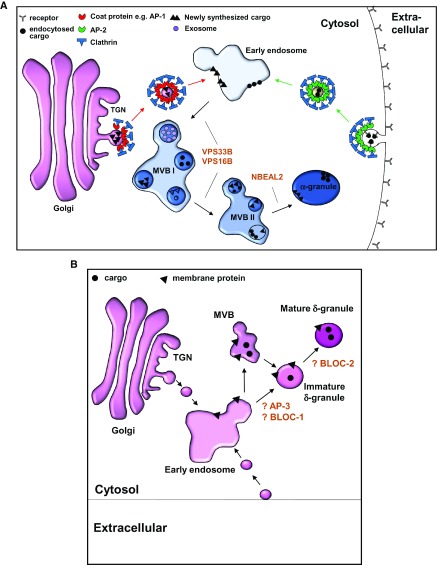
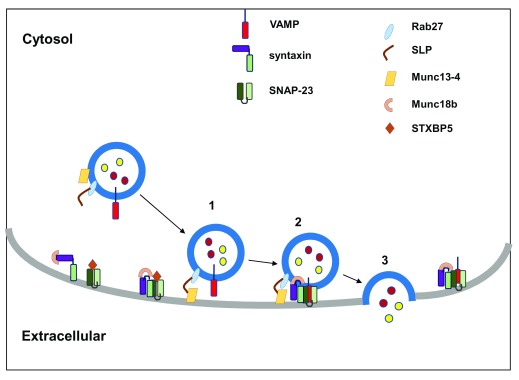
Platelet granules are unique among secretory vesicles in both their content and their life cycle. Platelets contain three major granule types-dense granules, α-granules, and lysosomes-although other granule types have been reported. Dense granules and α-granules are the most well-studied and the most physiologically important. Platelet granules are formed in large, multilobulated cells, termed megakaryocytes, prior to transport into platelets. The biogenesis of dense granules and α-granules involves common but also distinct pathways. Both are formed from the -Golgi network and early endosomes and mature in multivesicular bodies, but the formation of dense granules requires trafficking machinery different from that of α-granules. Following formation in the megakaryocyte body, both granule types are transported through and mature in long proplatelet extensions prior to the release of nascent platelets into the bloodstream. Granules remain stored in circulating platelets until platelet activation triggers the exocytosis of their contents. Soluble -ethylmaleimide-sensitive factor attachment protein receptor (SNARE) proteins, located on both the granules and target membranes, provide the mechanical energy that enables membrane fusion during both granulogenesis and exocytosis. The function of these core fusion engines is controlled by SNARE regulators, which direct the site, timing, and extent to which these SNAREs interact and consequently the resulting membrane fusion. In this review, we assess new developments in the study of platelet granules, from their generation to their exocytosis.
血小板颗粒在分泌小泡中,无论其内容物还是生命周期都独具特色。血小板含有三种主要的颗粒类型——致密颗粒、α颗粒和溶酶体——尽管也有其他颗粒类型的报道。致密颗粒和α颗粒是研究最多且在生理上最为重要的。血小板颗粒在被转运到血小板之前,在大型的多叶细胞(称为巨核细胞)中形成。致密颗粒和α颗粒的生物发生涉及共同但也不同的途径。两者均由高尔基体网络和早期内体形成,并在多囊泡体中成熟,但致密颗粒的形成需要与α颗粒不同的运输机制。在巨核细胞体内形成后,两种颗粒类型在长的前血小板延伸部分中运输并成熟,然后新生血小板才释放到血液中。颗粒一直储存在循环血小板中,直到血小板激活触发其内容物的胞吐作用。位于颗粒和靶膜上的可溶性N - 乙基马来酰亚胺敏感因子附着蛋白受体(SNARE)蛋白,提供了在颗粒生成和胞吐过程中实现膜融合的机械能。这些核心融合引擎的功能由SNARE调节因子控制,SNARE调节因子指导这些SNARE相互作用的位点、时间和程度,从而控制由此产生的膜融合。在本综述中,我们评估了血小板颗粒研究的新进展,从其生成到胞吐作用。