Altalbawy Farag M A, Mukhlif Bilal Abdul Majeed, Hussen Ahemad, Mohammed Jaafaru Sani, S Renuka Jyothi, Singh Arshdeep, Mishra Shakti Bedanta, Chauhan Ashish Singh, Astaneh Mohammad Ebrahim, Fereydouni Narges
Department of Chemistry, University College of Duba, University of Tabuk, Tabuk, Saudi Arabia.
Medical Laboratory Techniques Department, College of Health and Medical Technology, University of Al-maarif, Anbar, Iraq.
Regen Ther. 2025 Jun 26;30:278-298. doi: 10.1016/j.reth.2025.06.008. eCollection 2025 Dec.
Chronic wounds such as diabetic foot ulcers, venous leg ulcers, and pressure ulcers often remain trapped in the inflammatory phase due to oxidative stress, protease overactivity, and impaired cellular responses, particularly in diabetic conditions. These wounds require advanced therapeutic strategies beyond conventional care. Regenerative medicine-especially platelet-rich plasma (PRP)-based interventions-has emerged as a promising approach for enhancing wound repair.
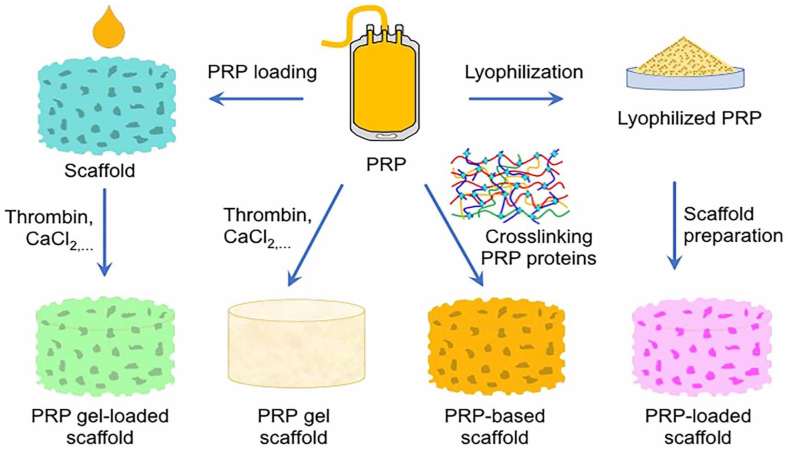
This review examines recent developments in PRP-loaded scaffolds, focusing on their biological mechanisms, structural advantages, and clinical applications. It synthesizes findings from key studies that integrate PRP with natural and synthetic biomaterials, often combined with bioactive agents like adipose-derived stem cell exosomes.
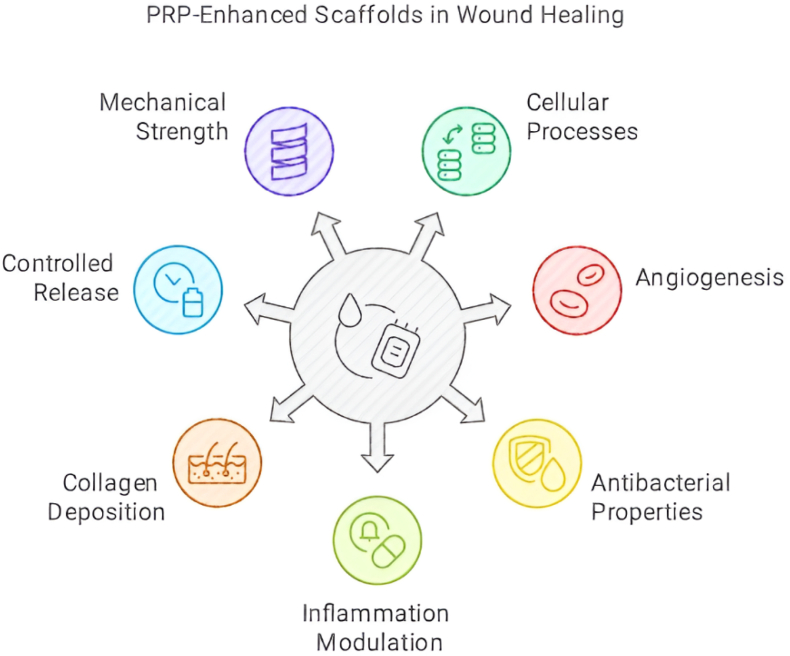
PRP-containing scaffolds promote wound healing through multiple pathways: enhancing cell proliferation, migration, angiogenesis, and extracellular matrix remodeling; reducing inflammation via M2 macrophage polarization; and facilitating collagen deposition. Their antibacterial properties and controlled release of growth factors such as VEGF and TGF-β1 further support tissue regeneration. Additionally, scaffold composition improves mechanical strength, elasticity, and growth factor bioavailability. Innovations such as GelMA/SFMA hydrogels and COL/PRP-ADSC-exos composites have shown superior outcomes in preclinical models.
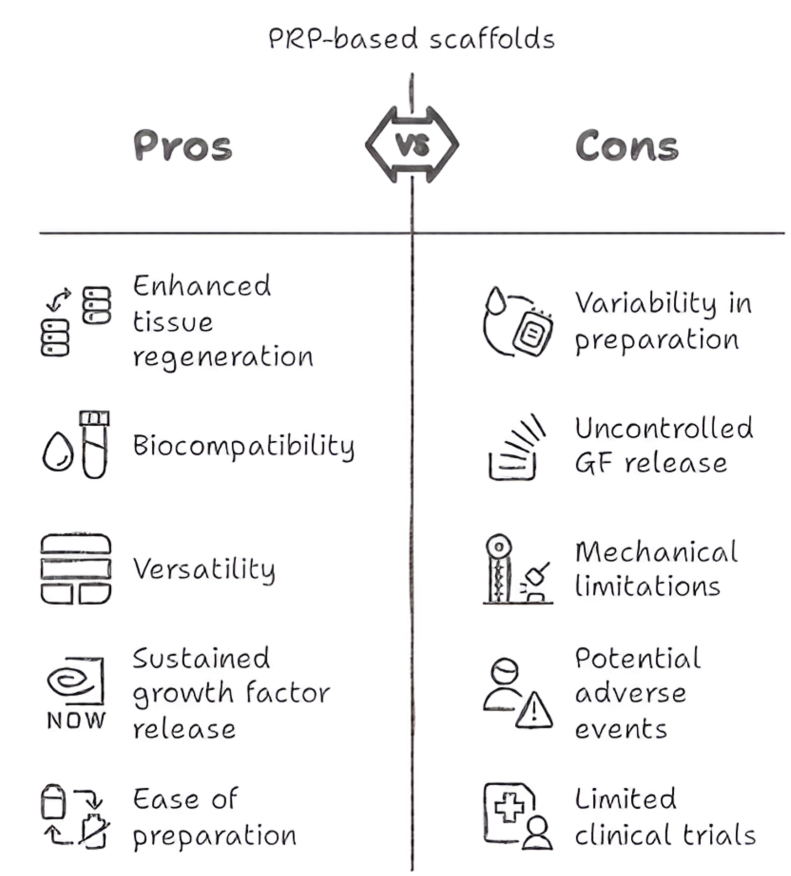
PRP-based scaffolds offer a multifunctional platform for chronic wound treatment by combining biological activity with structural support. Despite existing challenges such as variability in PRP preparation and limited clinical data, ongoing research and emerging technologies hold strong potential to standardize and enhance these therapies for future clinical translation.
糖尿病足溃疡、下肢静脉溃疡和压疮等慢性伤口常因氧化应激、蛋白酶活性过高以及细胞反应受损而停滞在炎症阶段,在糖尿病情况下尤为如此。这些伤口需要超越传统护理的先进治疗策略。再生医学——尤其是基于富血小板血浆(PRP)的干预措施——已成为促进伤口修复的一种有前景的方法。
本综述探讨了负载PRP的支架的最新进展,重点关注其生物学机制、结构优势和临床应用。它综合了关键研究的结果,这些研究将PRP与天然和合成生物材料相结合,通常还与脂肪干细胞外泌体等生物活性剂联合使用。
含PRP的支架通过多种途径促进伤口愈合:增强细胞增殖、迁移、血管生成和细胞外基质重塑;通过M2巨噬细胞极化减轻炎症;促进胶原蛋白沉积。它们的抗菌特性以及VEGF和TGF-β1等生长因子的控释进一步支持组织再生。此外,支架组成改善了机械强度、弹性和生长因子的生物利用度。诸如GelMA/SFMA水凝胶和COL/PRP-ADSC-exos复合材料等创新在临床前模型中已显示出优异的效果。
基于PRP的支架通过将生物活性与结构支撑相结合,为慢性伤口治疗提供了一个多功能平台。尽管存在诸如PRP制备的变异性和临床数据有限等现有挑战,但正在进行的研究和新兴技术具有强大的潜力,可将这些疗法标准化并加以改进,以便未来进行临床转化。