Hoebe Eveline, Wille Coral, Hagemeier Stacy, Kenney Shannon, Greijer Astrid, Middeldorp Jaap
Department of Pathology, VU University Medical Center, 1081 HV Amsterdam, The Netherlands.
McArdle Laboratory for cancer research, Department of Oncology, University of Wisconsin School of Medicine and Public Health, Madison, WI 53705-2275, USA.
Cancers (Basel). 2018 Mar 17;10(3):76. doi: 10.3390/cancers10030076.
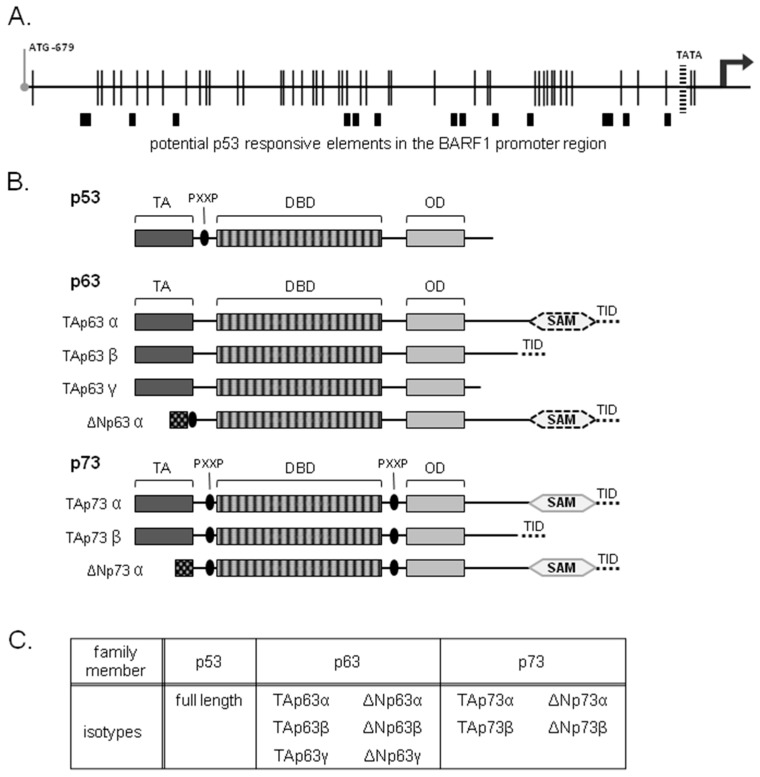
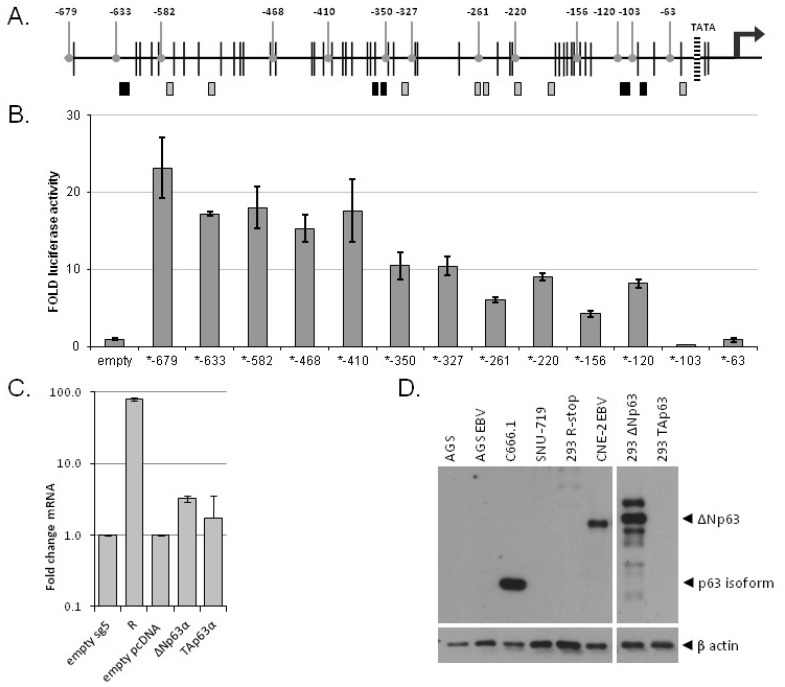
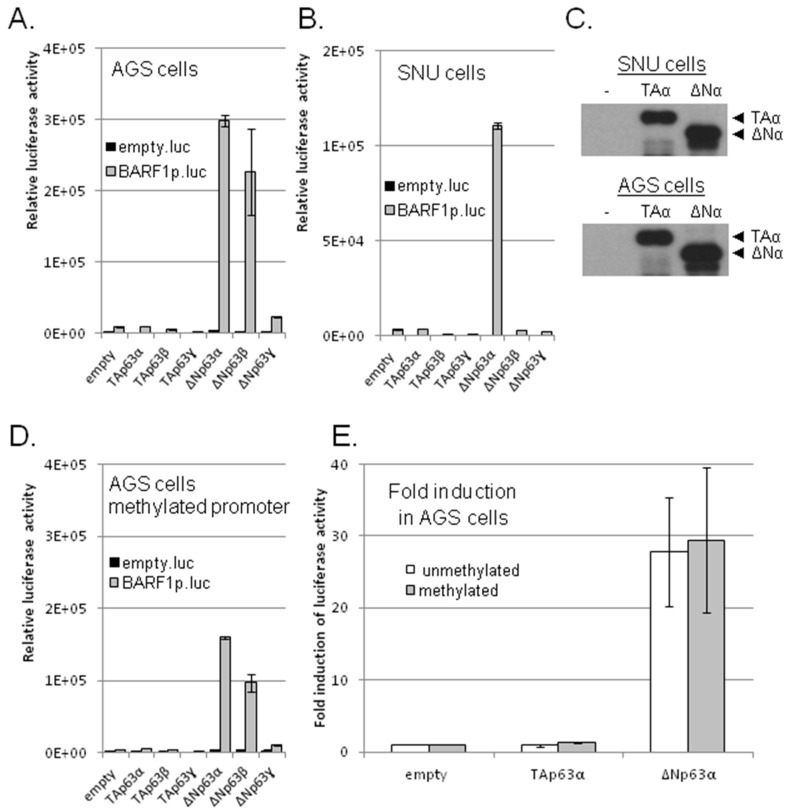
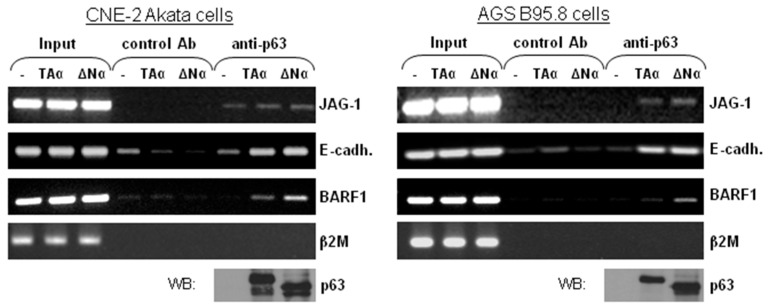
Epstein-Barr Virus (EBV) BamHI-A rightward frame 1 (BARF1) protein is considered a viral oncogene in epithelial cells and has immune-modulating properties. During viral lytic replication BARF1 is expressed as an early gene, regulated by the immediate early EBV protein R. However, in viral latency BARF1 is exclusively expressed in epithelial tumors such as nasopharyngeal (NPC) and gastric carcinoma (GC) but not in lymphomas, indicating that activation of the BARF1 promoter is cell type specific. Undifferentiated NPC is characterized by high expression of ΔNp63 isoforms of the epithelial differentiation marker p63, a member of the p53 family of transcription factors. Transcription factor binding site analysis indicated potential p53 family binding sites within the BARF1 promoter region. This study investigated ability of various p53 family members to transactivate the BARF1 promoter. Using BARF1 promoter luciferase reporter constructs we demonstrate that only p63 isoform ΔNp63α is capable of transactivating the BARF1 promoter, but not the TAp63 isoforms, p53 or p73. Direct promoter binding of ΔNp63α was confirmed by Chromatin Immune Precipitation (ChIP) analysis. Deletion mutants of the BARF1 promoter revealed multiple ΔNp63 response elements to be responsible for BARF1 promoter transactivation. However, ΔNp63α alone was not sufficient to induce BARF1 in tumor cells harboring full EBV genomes, indicating that additional cofactors might be required for full BARF1 regulation. In conclusion, in EBV positive NPC and GC, BARF1 expression might be induced by the epithelial differentiation marker ΔNp63α, explaining BARF1 expression in the absence of lytic reactivation.
爱泼斯坦-巴尔病毒(EBV)的BamHI-A向右框1(BARF1)蛋白在上皮细胞中被认为是一种病毒癌基因,具有免疫调节特性。在病毒裂解复制过程中,BARF1作为早期基因表达,受EBV立即早期蛋白R调控。然而,在病毒潜伏期间,BARF1仅在上皮性肿瘤如鼻咽癌(NPC)和胃癌(GC)中表达,而在淋巴瘤中不表达,这表明BARF1启动子的激活具有细胞类型特异性。未分化的NPC的特征是上皮分化标志物p63(p53转录因子家族成员)的ΔNp63异构体高表达。转录因子结合位点分析表明BARF1启动子区域内存在潜在的p53家族结合位点。本研究调查了各种p53家族成员反式激活BARF1启动子的能力。使用BARF1启动子荧光素酶报告构建体,我们证明只有p63异构体ΔNp63α能够反式激活BARF1启动子,而TAp63异构体、p53或p73则不能。通过染色质免疫沉淀(ChIP)分析证实了ΔNp63α与启动子的直接结合。BARF1启动子的缺失突变体显示多个ΔNp63反应元件负责BARF1启动子的反式激活。然而,单独的ΔNp63α不足以在携带完整EBV基因组的肿瘤细胞中诱导BARF1表达,这表明完整的BARF1调控可能需要其他辅助因子。总之,在EBV阳性的NPC和GC中,BARF1表达可能由上皮分化标志物ΔNp63α诱导,这解释了在没有裂解再激活的情况下BARF1的表达。