Huang Yu-Hao, Lin Chin, Yang Jia-Hwa, Lin Leou-Chyr, Mou Chih-Yuan, Chiang Kwo-Tsao, Lee Man-Gang, Chang Hsien-Feng, Chang Hsueh-Lu, Su Wen, Yeh Shih-Jen, Chang Hung, Wang Chih-Chien, Su Sui-Lung
Graduate Institute of Medical Sciences, National Defense Medical Center, No.161, Min-Chun E. Rd., Sec. 6, Neihu, Taipei, 114, Taiwan, Republic of China.
School of Public Health, National Defense Medical Center, No.161, Min-Chun E. Rd., Sec. 6, Neihu, Taipei, 114, Taiwan, Republic of China.
BMC Musculoskelet Disord. 2018 Mar 21;19(1):87. doi: 10.1186/s12891-018-2006-x.
Differences between staged bilateral total knee replacement (TKR) and simultaneous bilateral TKR have been investigated, but few studies have investigated differences in the functional improvements resulting from these methods. Therefore, this study investigates the different functional improvements between staged bilateral total knee TKR and simultaneous bilateral TKR.
Among 144 potential bilateral TKR patients who were included in this study, 93 (64.6%) patients selected unilateral TKR and 51 (35.4%) selected bilateral TKR. Functional improvements were assessed using the Western Ontario and McMaster University osteoarthritis index (WOMAC) and the Medical Outcomes Trust Short Form-36 (SF-36), and patients were interviewed pre-operatively and after 6 months. A generalized equation was used to test for differences in functional improvements.
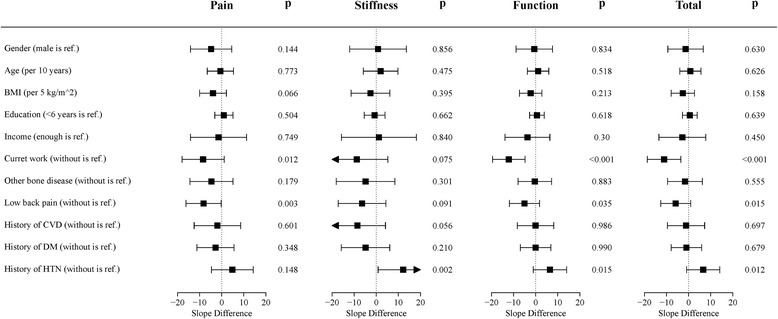
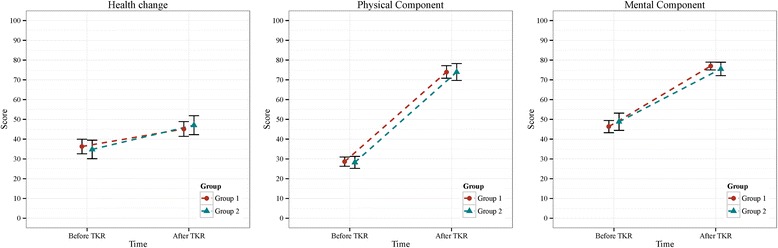
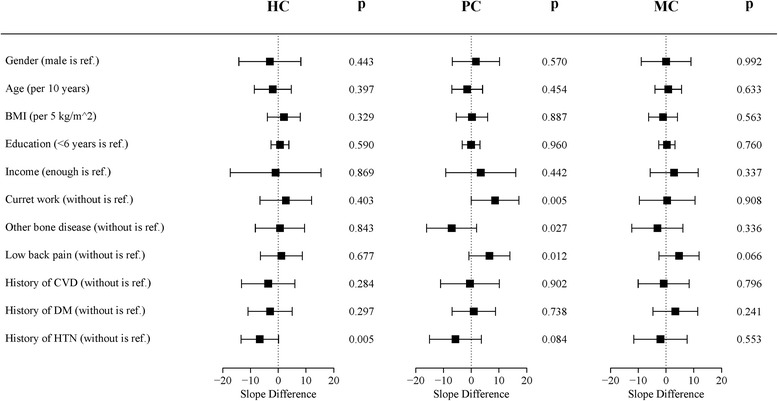
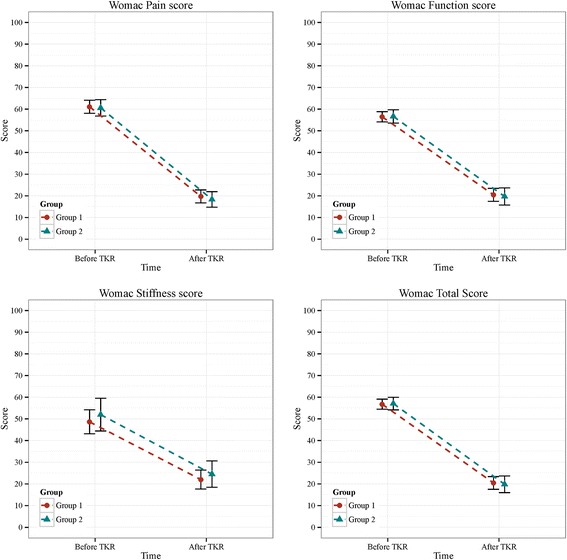
After TKR, pain, stiffness, function and total WOMAC scores were significantly reduced in both groups, with mean changes from - 26.6 to - 41.4 and from - 27.5 to - 42.2.The mean health change of SF-36 scores, physical component and mental component scores changed to 45.2 ± 18.2, 74.0 ± 15.4 and 77.0 ± 9.6, respectively, in Group 1 and 47.1 ± 17.1, 74.0 ± 15.2 and 75.5 ± 12.1, respectively, in Group 2. Unilateral and simultaneous bilateral TKR produce similar functional improvements, although current work status may be a novel impact factor.
No differences in functional improvements were identified between patients who selected unilateral versus bilateral TKR, indicating no recommendation for one procedure over the other.
已对分期双侧全膝关节置换术(TKR)和同期双侧TKR之间的差异进行了研究,但很少有研究调查这些方法在功能改善方面的差异。因此,本研究调查分期双侧全膝关节TKR和同期双侧TKR在功能改善方面的不同。
在本研究纳入的144例潜在双侧TKR患者中,93例(64.6%)患者选择单侧TKR,51例(35.4%)选择双侧TKR。使用西安大略和麦克马斯特大学骨关节炎指数(WOMAC)和医学结局信托简短健康调查量表(SF-36)评估功能改善情况,并在术前和术后6个月对患者进行访谈。使用广义方程检验功能改善的差异。
TKR术后,两组的疼痛、僵硬、功能和WOMAC总分均显著降低,平均变化分别为-26.6至-41.4和-27.5至-42.2。SF-36评分的平均健康变化、身体成分和精神成分评分在第1组分别变为45.2±18.2、74.0±15.4和77.0±9.6,在第2组分别变为47.1±17.1、74.0±15.2和75.5±12.1。单侧和同期双侧TKR产生相似的功能改善,尽管目前的工作状态可能是一个新的影响因素。
选择单侧与双侧TKR的患者在功能改善方面未发现差异,这表明不推荐一种手术方式优于另一种。