Tewarie Lachmandath, Chernigov Nikolay, Goetzenich Andreas, Moza Ajay, Autschbach Rüdiger, Zayat Rashad
Department of Thoracic and Cardiovascular Surgery, RWTH University Hospital, Aachen, Germany.
Ann Thorac Cardiovasc Surg. 2018 Jun 20;24(3):139-146. doi: 10.5761/atcs.oa.17-00244. Epub 2018 Mar 22.
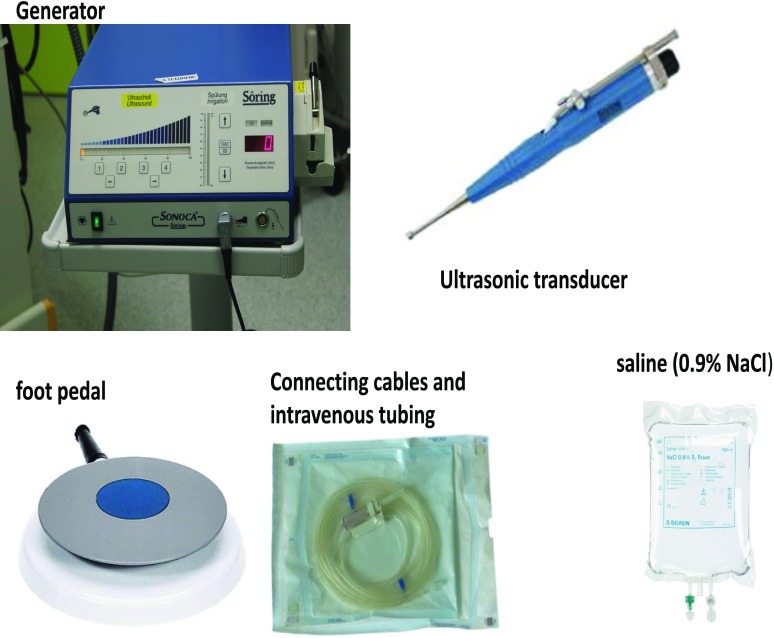
To assess whether a combined treatment of low-frequency (25 kHz) ultrasonic-debridement systems followed by vacuum-assisted wound closure (VAC) produces a better outcome in deep sternal wound infections (SWIs) compared to that of VAC alone.
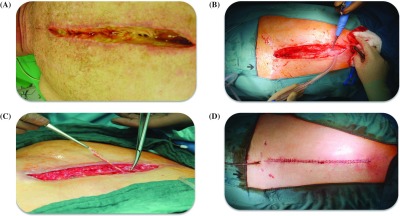
We evaluated 45 consecutive patients (25 males) between January 2013 and December 2016, in whom deep SWI was treated with a combination of low-frequency ultrasonic debridement system followed by vacuum-assisted closure (group A, n = 23) or with only vacuum-assisted closure therapy (group B, n = 22). Our final step in both groups was a secondary wound closure with a musculocutaneous flap.
In both groups, a similar variety of bacteria were isolated. The time between eradication and secondary wound closure was significantly shorter in group A (7.3 ± 4.8 vs. 19.9 ± 17.2 days, p = 0.001). After a third debridement session, 95.7% of microbiological cultures were negative in group A versus 54.5% in B ( p = 0.001). Duration of antibiotic treatment ( p = 0.003) and hospitalization time ( p = 0.0001) were significantly shorter in group A.
The use of low-frequency ultrasonic debridement system is an effective, less invasive technique to combat wound infection. In combination with vacuum-assisted closure therapy, we documented good mid-term results in our patients.
评估与单纯负压封闭引流(VAC)相比,低频(25千赫)超声清创系统联合负压封闭引流(VAC)治疗深部胸骨伤口感染(SWI)是否能产生更好的效果。
我们评估了2013年1月至2016年12月期间连续的45例患者(25例男性),其中深部SWI采用低频超声清创系统联合负压封闭引流治疗(A组,n = 23)或仅采用负压封闭引流治疗(B组,n = 22)。两组的最后一步都是采用肌皮瓣进行二期伤口闭合。
两组分离出的细菌种类相似。A组根除感染至二期伤口闭合的时间明显短于B组(7.3±4.8天对19.9±17.2天,p = 0.001)。在第三次清创后,A组95.7%的微生物培养结果为阴性,而B组为54.5%(p = 0.001)。A组抗生素治疗时间(p = 0.003)和住院时间(p = 0.0001)明显更短。
使用低频超声清创系统是一种有效、侵入性较小的对抗伤口感染的技术。与负压封闭引流治疗相结合,我们记录了患者良好的中期结果。