Kozmacs Carla, Hollmann Britta, Arnold Wolfgang H, Naumova Ella, Piwowarczyk Andree
Department of Prosthodontics and Dental Technology, School of Dentistry, Witten/Herdecke University, Alfred-Herrhausen-Straße 44, 58455 Witten, Germany.
Private Practice, 50670 Köln, Germany.
Dent J (Basel). 2017 Nov 14;5(4):30. doi: 10.3390/dj5040030.
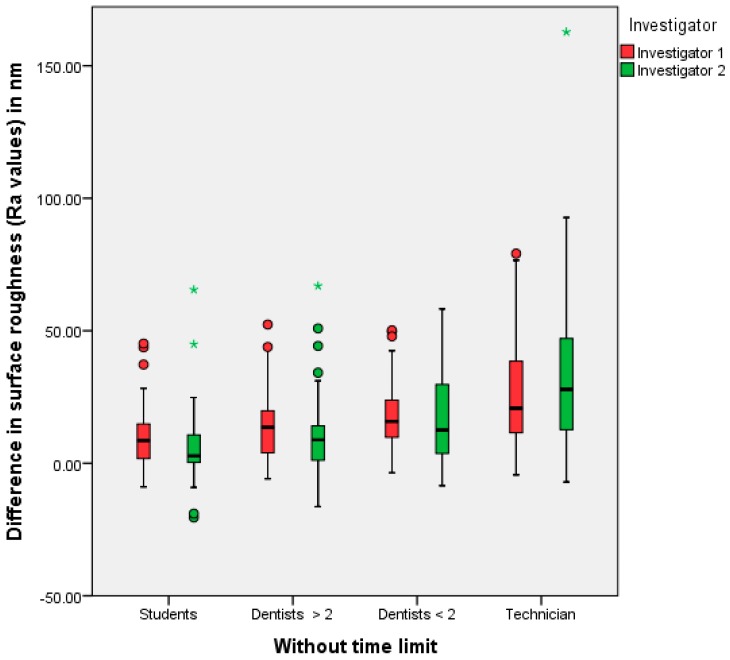
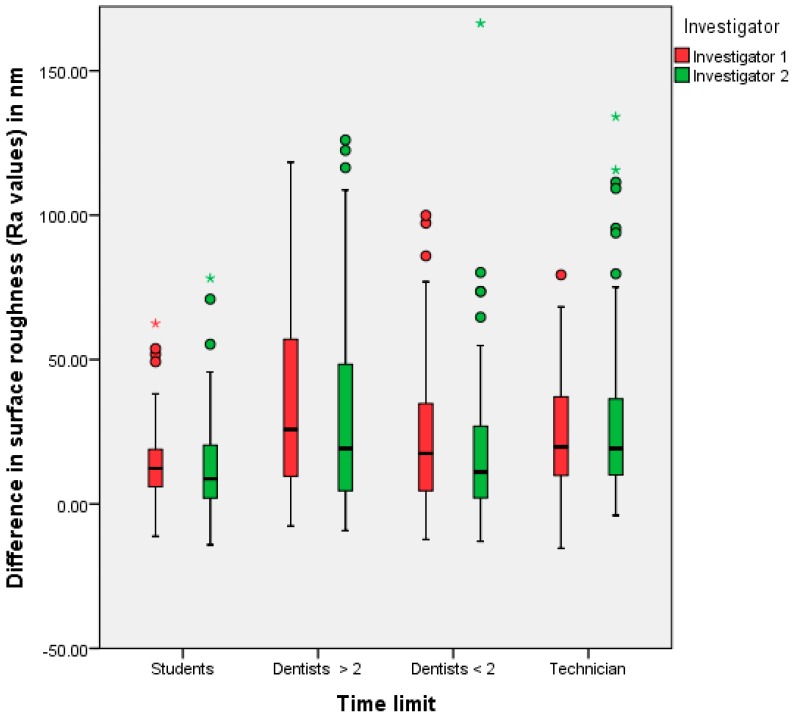
This pilot study evaluates the surface roughness of monolithic zirconia crowns after chairside polishing by different dental practitioner groups. Four practitioner groups (group I: dental clinical students ( = 6); group II: dentists < 2 years post-qualification experience ( = 6); group III: dentists > 2 years post-qualification experience ( = 6) and group IV: dental technicians ( = 6)) were asked to polish two CAD/CAM-fabricated full-contour zirconia crowns (48 in total). A two-step zirconia polishing kit was used in both trials. The first trial (T1) was conducted without a time limitation. In the second trial (T2), the polish was restricted to 15 seconds for each polisher. Two blinded investigators (I1 and I2) analyzed the surface roughness (Ra) before and after polishing (Alicona measuring system). No statistically significant difference in surface roughness was found between the polishing results of the dental practitioner groups. Major difference in surface finish was achieved by dental technicians, with a median value of 25.4 nm (interquartile range 10.15-35.26 nm) for I1 in T1. The lowest difference was achieved by dental students, with a median value of Ra = 6.72 nm (interquartile range 4.7-17.9 nm) in T1. In T2, experienced dentists showed the highest difference in surface finish, with a median value of 41.35 nm (interquartile range 7.77-54.11). No significant correlation was found between polishing time and polishing results. The polishing of monolithic zirconium dioxide crowns can be performed with the present polishing set directly chairside after occlusal adjustment, regardless of the practitioner's experience level.
这项前瞻性研究评估了不同牙科从业者组在椅旁抛光后整体式氧化锆全冠的表面粗糙度。四个从业者组(第一组:牙科临床学生(n = 6);第二组:资格认证后工作年限小于2年的牙医(n = 6);第三组:资格认证后工作年限大于2年的牙医(n = 6);第四组:牙科技师(n = 6))被要求对两个计算机辅助设计/计算机辅助制造(CAD/CAM)制作的全轮廓氧化锆全冠进行抛光(共48个)。在两项试验中均使用了两步法氧化锆抛光套件。第一次试验(T1)没有时间限制。在第二次试验(T2)中,每位抛光者的抛光时间限制为15秒。两名盲法研究者(I1和I2)在抛光前后分析表面粗糙度(Ra)(Alicona测量系统)。牙科从业者组的抛光结果在表面粗糙度上未发现统计学上的显著差异。牙科技师获得的表面光洁度差异最大,在T1中I1测量的中位数为25.4 nm(四分位间距10.15 - 35.26 nm)。牙科学生获得的差异最小,在T1中Ra的中位数为6.72 nm(四分位间距4.7 - 17.9 nm)。在T2中,经验丰富的牙医表面光洁度差异最大,中位数为41.35 nm(四分位间距7.77 - 54.11)。未发现抛光时间与抛光结果之间存在显著相关性。无论从业者的经验水平如何,整体式二氧化锆全冠在咬合调整后可直接在椅旁使用现有的抛光套件进行抛光。