Liu Daihong, Duan Shanshan, Zhou Chaoyang, Wei Ping, Chen Lihua, Yin Xuntao, Zhang Jiuquan, Wang Jian
Department of Radiology, Southwest Hospital, Third Military Medical University (Army Medical University), Chongqing, China.
Department of Endocrinology, The Third Affiliation Hospital of Chongqing Medical University, Chongqing, China.
Front Aging Neurosci. 2018 Mar 6;10:55. doi: 10.3389/fnagi.2018.00055. eCollection 2018.
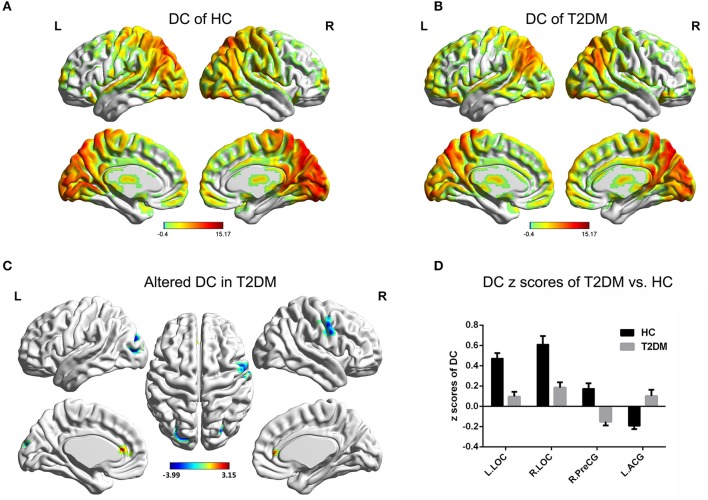
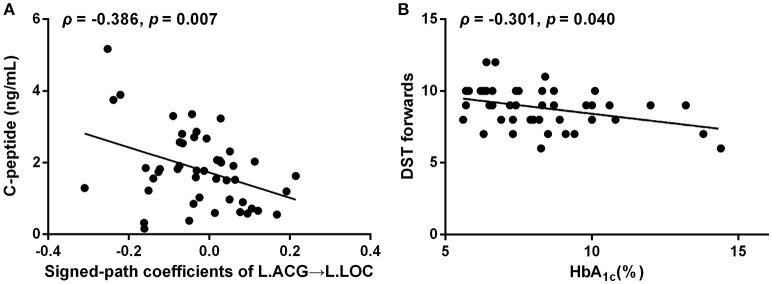
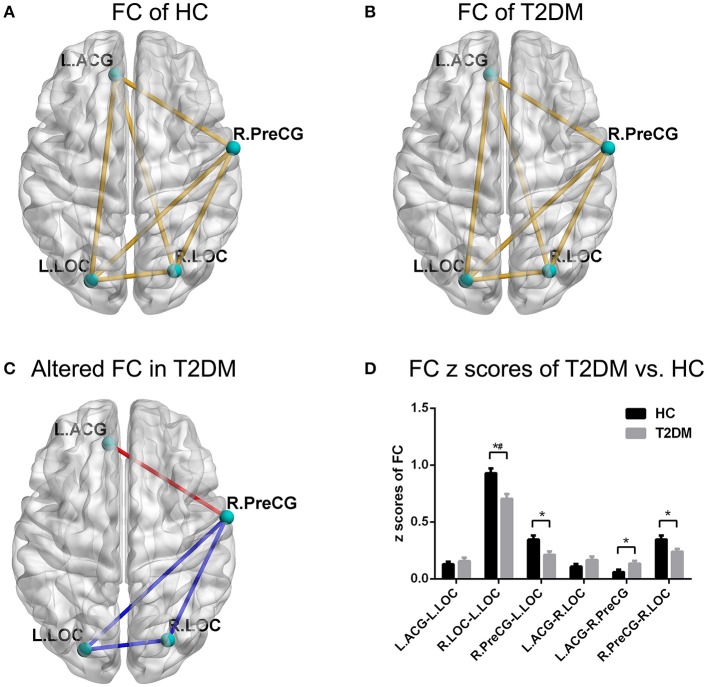
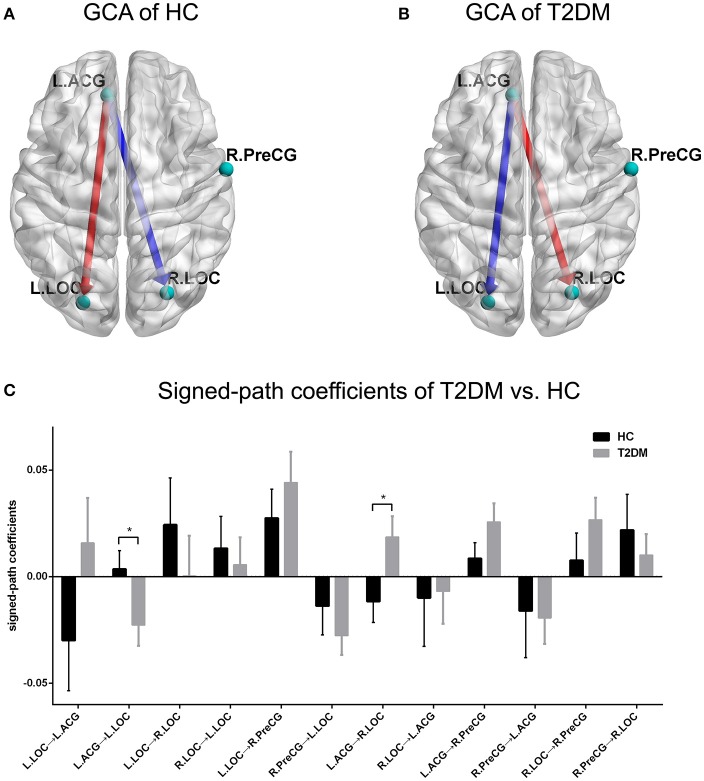
Type 2 diabetes mellitus (T2DM) affects a vast population and is closely associated with cognitive impairment. However, the mechanisms of cognitive impairment in T2DM patients have not been unraveled. Research on the basic units (nodes or hubs and edges) of the brain functional network on the basis of neuroimaging may advance our understanding of the network change pattern in T2DM patients. This study investigated the change patterns of brain functional hubs using degree centrality (DC) analysis and the connectivity among these hubs using functional connectivity and Granger causality analysis. Compared to healthy controls, the DC values were higher in the left anterior cingulate gyrus (ACG) and lower in the bilateral lateral occipital cortices (LOC) and right precentral gyrus (PreCG) in T2DM patients. The functional connectivity between the left ACG and the right PreCG was stronger in T2DM patients, whereas the functional connectivity among the right PreCG and bilateral LOC was weaker. A negative causal effect from the left ACG to left LOC and a positive effect from the left ACG to right LOC were observed in T2DM patients, while in healthy controls, the opposite occurred. Additionally, the reserve of normal brain function in T2DM patients was negatively associated with the elevated glycemic parameters. This study demonstrates that there are brain functional hubs and connectivity alterations that may reflect the aberrant information communication in the brain of T2DM patients. The findings may advance our understanding of the mechanisms of T2DM-related cognitive impairment.
2型糖尿病(T2DM)影响着大量人群,且与认知障碍密切相关。然而,T2DM患者认知障碍的机制尚未阐明。基于神经影像学对脑功能网络的基本单元(节点或枢纽以及边)进行研究,可能会增进我们对T2DM患者网络变化模式的理解。本研究使用度中心性(DC)分析研究脑功能枢纽的变化模式,并使用功能连接和格兰杰因果分析研究这些枢纽之间的连接性。与健康对照相比,T2DM患者左侧前扣带回(ACG)的DC值较高,双侧枕外侧皮质(LOC)和右侧中央前回(PreCG)的DC值较低。T2DM患者左侧ACG与右侧PreCG之间的功能连接较强,而右侧PreCG与双侧LOC之间的功能连接较弱。在T2DM患者中观察到从左侧ACG到左侧LOC的负向因果效应以及从左侧ACG到右侧LOC的正向效应,而在健康对照中则相反。此外,T2DM患者正常脑功能储备与血糖参数升高呈负相关。本研究表明,存在脑功能枢纽和连接性改变,这可能反映了T2DM患者大脑中异常的信息交流。这些发现可能会增进我们对T2DM相关认知障碍机制的理解。