Lee Jeong Hee, Kim Eung Do, Jun Eun Jung, Yoo Hyoung Sun, Lee Joon Woo
1Graduate School of Health Science Business Convergence, College of Medicine, Chungbuk National University, Chungdae-ro 1, Seowon-Gu, Cheongju, Chungbuk 28644 Korea.
Aurios Medical, M-2503, 32 569 Songdogwahak-ro, Yeonsu-gu, Incheon, 21984 Korea.
Biomater Res. 2018 Mar 13;22:8. doi: 10.1186/s40824-018-0114-1. eCollection 2018.
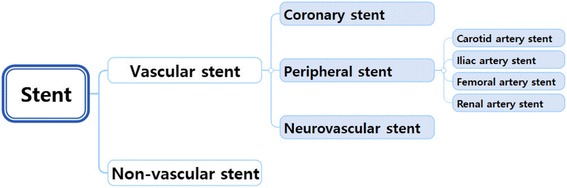
The purpose of this paper is to provide technology trends and information regarding market and prospects in stents used for human blood vessels in Korea and the world.A stent is a medical device in the form of a cylindrical metal net used to normalize flow when blood or other bodily fluids such as biliary fluids are obstructed in blood vessels, gastrointestinal tracts, etc. by inserting the stent into a narrowed or clogged area. Stents are classified into vascular and non-vascular stents. The coronary artery stent is avascular stent that is used for coronary atherosclerosis.The demand is increasing for stents to treat diseases such as those affecting the heart and blood vessels of elderly and middle-aged patients. Due to the current shift in the demographic structure caused by an aging society, the prospect for stents seems to be very bright.The use of a stent designed to prevent acute vascular occlusion and restenosis, which is a side effect of conventional balloon angioplasty, has rapidly become popular because it can prevent acute complications and improve clinical outcomes. Since the initial release of this stent, there have been significant developments in its design, the most notable of which has been the introduction of drug-eluting stents (DES). Bioresorbable scaffolds (BRS) have the potential to introduce a paradigm shift in interventional cardiology, a true anatomical and functional "vascular restoration" instead of an artificial stiff tube encased by a persistent metallic foreign body.
Data for this research were gathered from primary and secondary sources as well as the databases of the Korea Institute of Science Technology Information (KISTI) located in Seoul, Korea like KISTI Market Report. The sources used for primary research included the databases available from the Korea Institute of Science Technology Information, past industry research services/studies, economic and demographic data, and trade and industry journals. Secondary research was used to supplement and complement the primary research. Interviews were conducted with physicians and surgeons from the key hospitals and senior sale/marketing managers from stent product suppliers in South Korea.
The global stent market is estimated at US $ 7.98 billion in 2016 and is expected to grow at a Compound Annual Growth Rate (CAGR) of 3.8% over the next 5 years. As of 2016, the global market for vascular stents is estimated at $ 7.22 billion, with coronary artery stents accounting for 67.3% of the vascular stent market. Among the coronary artery stents, BRS is notably expected to grow at an annual average rate of 8.8% by 2020, but the global adoption rate of BRS remains low at present. In the Korean market, stents for blood vessels account for most of the market, and the market size of stents for blood vessels in Korea was estimated to be 145 billion won as of 2016.
In comparison to the sales growth rate of other medical devices, the future stent technology market is judged to be higher in growth potential.
本文旨在提供有关韩国及全球人体血管支架的技术趋势、市场信息和前景。支架是一种圆柱形金属网形式的医疗器械,通过将其插入血管、胃肠道等变窄或堵塞区域,当血液或其他体液(如胆汁)受阻时使血流恢复正常。支架分为血管支架和非血管支架。冠状动脉支架是用于冠状动脉粥样硬化的血管支架。治疗老年和中年患者心脏及血管疾病等病症的支架需求不断增加。由于老龄化社会导致的当前人口结构变化,支架的前景似乎非常光明。一种旨在预防急性血管闭塞和再狭窄(传统球囊血管成形术的副作用)的支架的使用迅速流行起来,因为它可以预防急性并发症并改善临床结果。自这种支架首次推出以来,其设计有了重大进展,其中最显著的是药物洗脱支架(DES)的引入。生物可吸收支架(BRS)有可能在介入心脏病学领域引发范式转变,实现真正的解剖学和功能性“血管修复”,而不是由持续存在的金属异物包裹的人工硬管。
本研究的数据来自一手和二手资料以及位于韩国首尔的韩国科学技术信息研究所(KISTI)的数据库,如KISTI市场报告。用于一手研究的资料来源包括韩国科学技术信息研究所提供的数据库、过往行业研究服务/研究、经济和人口数据以及贸易和行业期刊。二手研究用于补充和完善一手研究。对韩国主要医院的内科医生和外科医生以及支架产品供应商的高级销售/市场经理进行了访谈。
2016年全球支架市场估计为79.8亿美元,预计在未来5年将以3.8%的复合年增长率增长。截至2016年,全球血管支架市场估计为72.2亿美元,冠状动脉支架占血管支架市场的67.3%。在冠状动脉支架中,预计到2020年生物可吸收支架将以年均8.8%的速度增长,但目前其全球采用率仍然较低。在韩国市场,血管支架占市场的大部分,截至2016年韩国血管支架的市场规模估计为1450亿韩元。
与其他医疗器械的销售增长率相比,未来支架技术市场的增长潜力被认为更高。
