Koh Wee Ming, Badaruddin Hishamuddin, La Hanh, Chen Mark I-Cheng, Cook Alex R
Saw Swee Hock School of Public Health, National University of Singapore and National University Health System, Singapore.
Ministry of Health, Singapore.
BMJ Glob Health. 2018 Jan 26;3(1):e000442. doi: 10.1136/bmjgh-2017-000442. eCollection 2018.
Hand, foot and mouth disease (HFMD) affects millions of children across Asia annually, leading to an increase in implemented control policies such as surveillance, isolation and social distancing in affected jurisdictions. However, limited knowledge of disease burden and severity causes difficulty in policy optimisation as the associated economic cost cannot be easily estimated. We use a data synthesis approach to provide a comprehensive picture of HFMD disease burden, estimating infection risk, symptomatic rates, the risk of complications and death, and overall disability-adjusted life-year (DALY) losses, along with associated uncertainties.
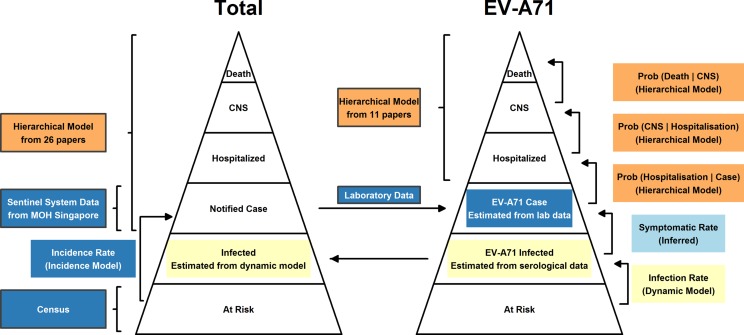
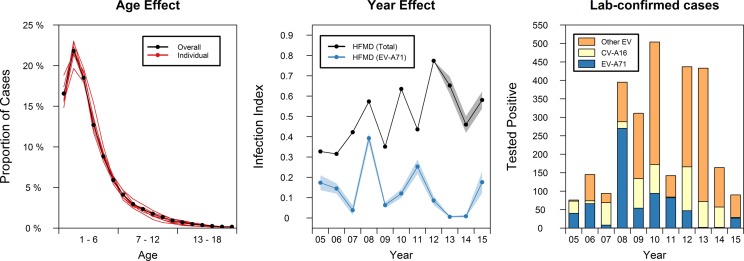
Complementary data from a variety of sources were synthesised with mathematical models to obtain estimates of severity of HFMD. This includes serological and other data extracted through a systematic review of HFMD epidemiology previously published by the authors, and laboratory investigations and sentinel reports from Singapore's surveillance system.
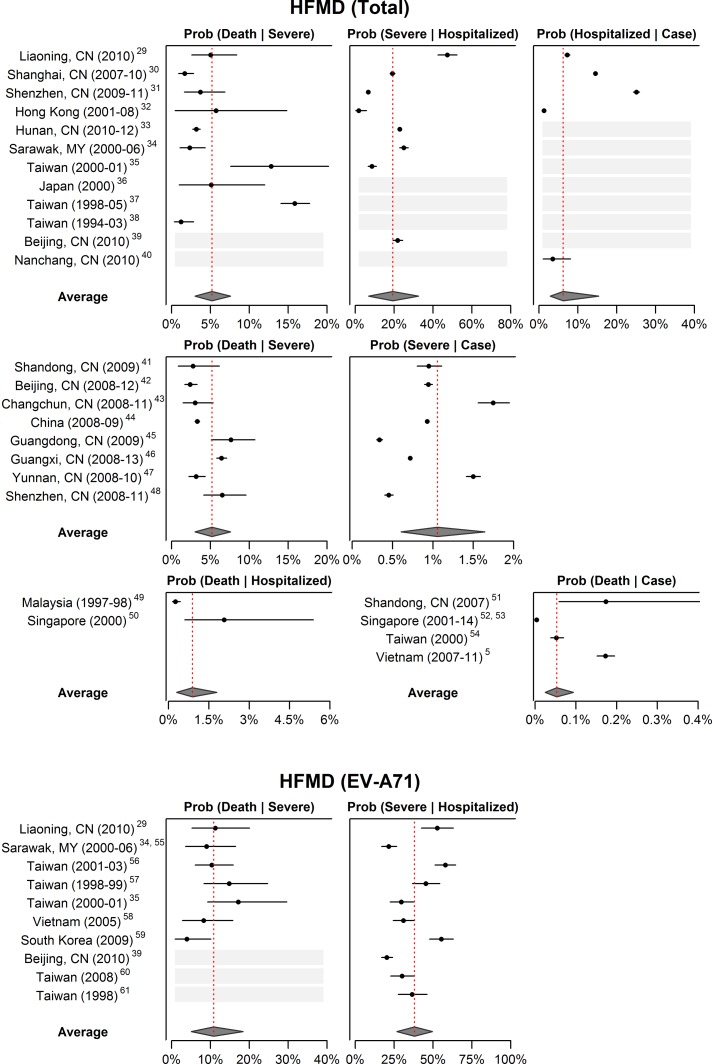
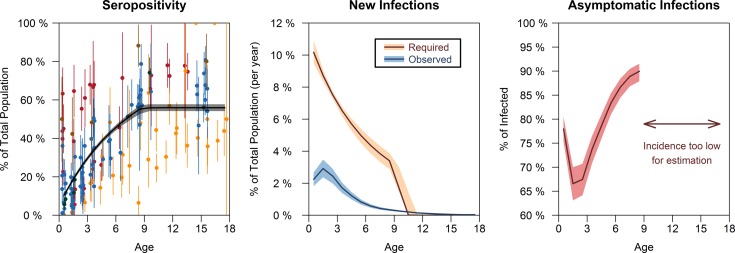
HFMD is estimated to cause 96 900 (95% CI 40 600 to 259 000) age-weighted DALYs per annum in eight high-burden countries in East and Southeast Asia, with the majority of DALYs attributed to years of life lost. The symptomatic case hospitalisation rate of HFMD is 6% (2.8%-14.9%), of which 18.7% (6.7%-31.5%) are expected to develop complications. 5% (2.9%-7.4%) of such cases are fatal, bringing the overall case fatality ratio to be 52.3 (24.4-92.7) per 100 000 symptomatic infections. In contrast, the EV-A71 case fatality ratio is estimated to be at least 229.7 (75.4-672.1) per 100 000 symptomatic cases. Asymptomatic rate for EV-A71 is 71.4% (68.3%-74.3%) for ages 1-4, the years of greatest incidence.
Despite the high incidence rate of HFMD, total DALY due to HFMD is limited in comparison to other endemic diseases in the region, such as dengue and upper respiratory tract infection. With the majority of DALY caused by years of life lost, it is possible to mitigate most with increased EV-A71 vaccine coverage.
手足口病(HFMD)每年影响亚洲数百万儿童,导致受影响地区实施更多控制政策,如监测、隔离和社交距离措施。然而,由于对疾病负担和严重程度的了解有限,难以优化政策,因为相关经济成本不易估算。我们采用数据综合方法全面呈现手足口病的疾病负担,估计感染风险、症状发生率、并发症和死亡风险以及总体伤残调整生命年(DALY)损失,并评估相关不确定性。
综合来自多种来源的补充数据与数学模型,以获得手足口病严重程度的估计值。这包括通过对作者先前发表的手足口病流行病学系统评价提取的血清学和其他数据,以及新加坡监测系统的实验室调查和哨点报告。
据估计,东亚和东南亚八个高负担国家每年因手足口病导致96900(95%可信区间40600至259000)个年龄加权DALY,其中大部分DALY归因于寿命损失年数。手足口病有症状病例的住院率为6%(2.8%-14.9%),其中18.7%(6.7%-31.5%)预计会出现并发症。此类病例的5%(2.9%-7.4%)是致命的,使每10万例有症状感染的总体病死率达到52.3(24.4-92.7)。相比之下,肠道病毒A71型(EV-A71)每10万例有症状病例的病死率估计至少为229.7(75.4-672.1)。1-4岁是发病率最高的年龄段,该年龄段EV-A71的无症状感染率为71.4%(68.3%-74.3%)。
尽管手足口病发病率很高,但与该地区其他地方病(如登革热和上呼吸道感染)相比,手足口病导致的总DALY有限。由于大部分DALY是由寿命损失年数造成的,提高EV-A71疫苗接种覆盖率有可能最大程度地减轻影响。