Duong Veasna, Mey Channa, Eloit Marc, Zhu Huachen, Danet Lucie, Huang Zhong, Zou Gang, Tarantola Arnaud, Cheval Justine, Perot Philippe, Laurent Denis, Richner Beat, Ky Santy, Heng Sothy, Touch Sok, Sovann Ly, van Doorn Rogier, Tan Tran Thanh, Farrar Jeremy J, Wentworth David E, Das Suman R, Stockwell Timothy B, Manuguerra Jean-Claude, Delpeyroux Francis, Guan Yi, Altmeyer Ralf, Buchy Philippe
Pasteur Institute in Cambodia, Phnom Penh 12000, Cambodia.
Pasteur Institute, Paris 75724, France.
Emerg Microbes Infect. 2016 Sep 21;5(9):e104. doi: 10.1038/emi.2016.101.
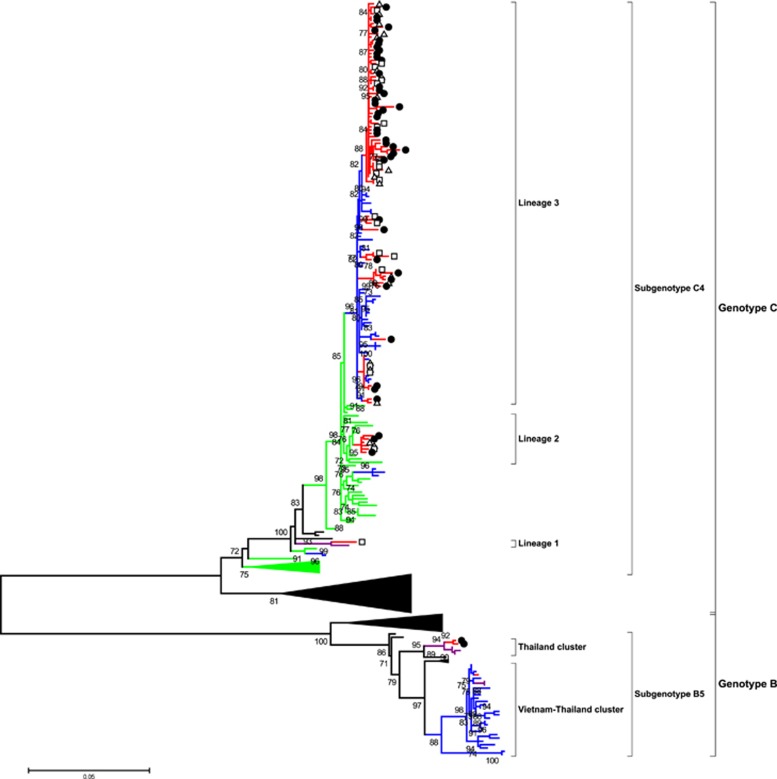
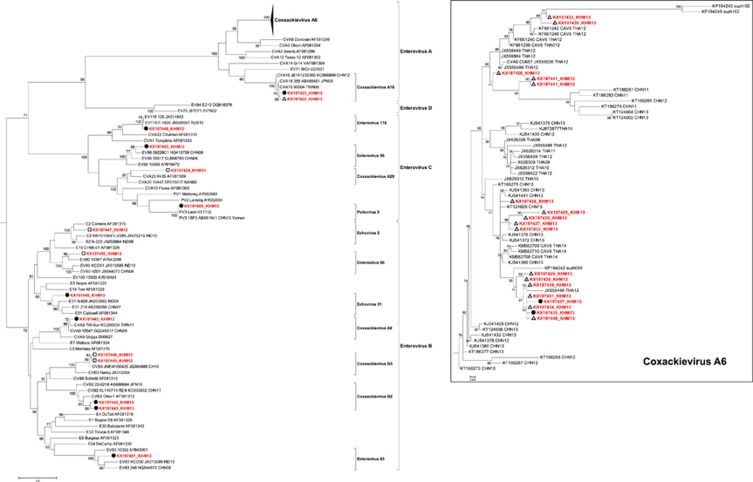
Human enterovirus 71 (EV-A71) causes hand, foot and mouth disease (HFMD). EV-A71 circulates in many countries and has caused large epidemics, especially in the Asia-Pacific region, since 1997. In April 2012, an undiagnosed fatal disease with neurological involvement and respiratory distress occurred in young children admitted to the Kantha Bopha Children's Hospital in Phnom Penh, Cambodia. Most died within a day of hospital admission, causing public panic and international concern. In this study, we describe the enterovirus (EV) genotypes that were isolated during the outbreak in 2012 and the following year. From June 2012 to November 2013, 312 specimens were collected from hospitalized and ambulatory patients and tested by generic EV and specific EV-A71 reverse transcription PCR. EV-A71 was detected in 208 clinical specimens while other EVs were found in 32 patients. The VP1 gene and/or the complete genome were generated. Our phylogenetic sequencing analysis demonstrated that 80 EV-A71 strains belonged to the C4a subgenotype and 3 EV-A71 strains belonged to the B5 genotype. Furthermore, some lineages of EV-A71 were found to have appeared in Cambodia following separate introductions from neighboring countries. Nineteen EV A (CV-A6 and CV-A16), 9 EV B (EV-B83, CV-B3, CV-B2, CV-A9, E-31, E-2 and EV-B80) and 4 EV C (EV-C116, EV-C96, CV-A20 and Vaccine-related PV-3) strains were also detected. We found no molecular markers of disease severity. We report here that EV-A71 genotype C4 was the main etiological agent of a large outbreak of HFMD and particularly of severe forms associated with central nervous system infections. The role played by other EVs in the epidemic could not be clearly established.
人肠道病毒71型(EV - A71)可引起手足口病(HFMD)。自1997年以来,EV - A71在许多国家传播,并引发了大规模疫情,尤其是在亚太地区。2012年4月,柬埔寨金边的甘塔波法儿童医院收治的幼儿中出现了一种未确诊的致命疾病,伴有神经受累和呼吸窘迫。大多数患儿在入院一天内死亡,引起了公众恐慌和国际关注。在本研究中,我们描述了2012年疫情爆发期间及次年分离出的肠道病毒(EV)基因型。2012年6月至2013年11月,从住院和门诊患者中采集了312份标本,并通过通用EV和特异性EV - A71逆转录PCR进行检测。在208份临床标本中检测到EV - A71,在32例患者中发现了其他EV。生成了VP1基因和/或完整基因组。我们的系统发育测序分析表明,80株EV - A71菌株属于C4a亚型,3株EV - A71菌株属于B5基因型。此外,发现EV - A71的一些谱系是在从邻国分别传入后出现在柬埔寨的。还检测到19株EV A(CV - A6和CV - A16)、9株EV B(EV - B83、CV - B3、CV - B2、CV - A9、E - 31、E - 2和EV - B80)和4株EV C(EV - C116、EV - C96、CV - A20和疫苗相关PV - 3)菌株。我们未发现疾病严重程度的分子标志物。我们在此报告,EV - A71基因型C4是手足口病大规模爆发,特别是与中枢神经系统感染相关的严重形式的主要病原体。其他EV在疫情中所起的作用尚无法明确确定。