Sum Grace, Hone Thomas, Atun Rifat, Millett Christopher, Suhrcke Marc, Mahal Ajay, Koh Gerald Choon-Huat, Lee John Tayu
Saw Swee Hock School of Public Health, National University of Singapore, Singapore.
Public Health Policy Evaluation Unit, School of Public Health, Imperial College London, London, UK.
BMJ Glob Health. 2018 Feb 6;3(1):e000505. doi: 10.1136/bmjgh-2017-000505. eCollection 2018.
Multimorbidity, the presence of two or more non-communicable diseases (NCD), is a costly and complex challenge for health systems globally. Patients with NCDs incur high levels of out-of-pocket expenditure (OOPE), often on medicines, but the literature on the association between OOPE on medicines and multimorbidity has not been examined systematically.
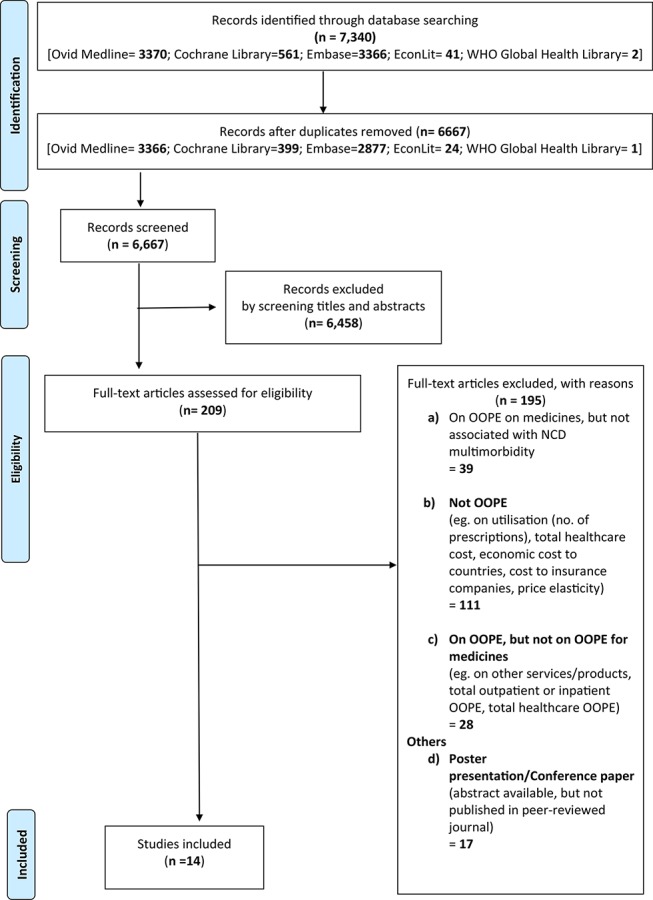
A systematic review was conducted via searching medical and economics databases including Ovid Medline, EMBASE, EconLit, Cochrane Library and the WHO Global Health Library from year 2000 to 2016. Study quality was assessed using Newcastle-Ottawa Scale. PROSPERO: CRD42016053538.
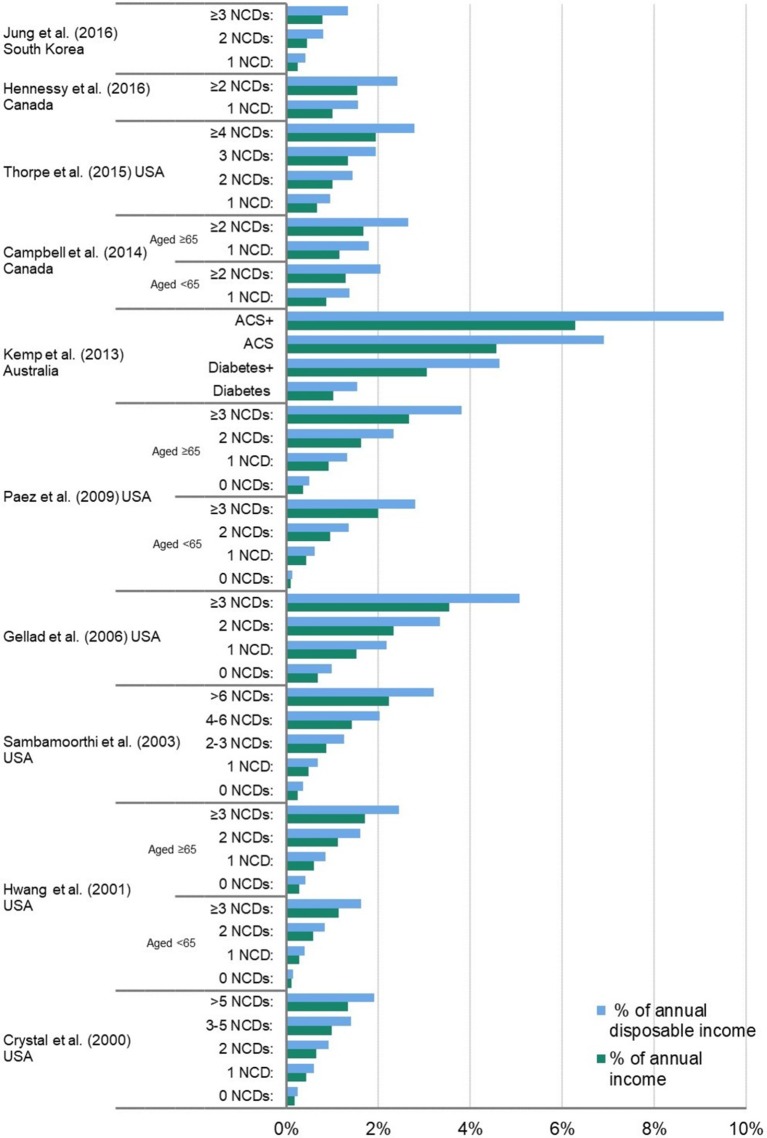
14 articles met inclusion criteria. Findings indicated that multimorbidity was associated with higher OOPE on medicines. When number of NCDs increased from 0 to 1, 2 and ≥3, annual OOPE on medicines increased by an average of 2.7 times, 5.2 times and 10.1 times, respectively. When number of NCDs increased from 0 to 1, 2, ≥2 and ≥3, individuals spent a median of 0.36% (IQR 0.15%-0.51%), 1.15% (IQR 0.62%-1.64%), 1.41% (IQR 0.86%-2.15%), 2.42% (IQR 2.05%-2.64%) and 2.63% (IQR 1.56%-4.13%) of mean annual household net adjusted disposable income per capita, respectively, on annual OOPE on medicines. More multimorbidities were associated with higher OOPE on medicines as a proportion of total healthcare expenditures by patients. Some evidence suggested that the elderly and low-income groups were most vulnerable to higher OOPE on medicines. With the same number of NCDs, certain combinations of NCDs yielded higher medicine OOPE. Non-adherence to medicines was a coping strategy for OOPE on medicines.
Multimorbidity of NCDs is increasingly costly to healthcare systems and OOPE on medicines can severely compromise financial protection and universal health coverage. It is crucial to recognise the need for better equity and financial protection, and policymakers should consider health system financial options, cost sharing policies and service patterns for those with NCD multimorbidities.
多种慢性病共存,即患有两种或更多种非传染性疾病(NCD),对全球卫生系统而言是一项代价高昂且复杂的挑战。患有非传染性疾病的患者自付费用(OOPE)水平很高,通常用于药品,但关于药品自付费用与多种慢性病共存之间关联的文献尚未得到系统研究。
通过检索医学和经济学数据库进行系统综述,这些数据库包括Ovid Medline、EMBASE、EconLit、Cochrane图书馆和世界卫生组织全球卫生图书馆,检索时间跨度为2000年至2016年。使用纽卡斯尔 - 渥太华量表评估研究质量。国际前瞻性系统评价注册平台(PROSPERO)注册号:CRD42016053538。
14篇文章符合纳入标准。研究结果表明,多种慢性病共存与药品方面更高的自付费用相关。当非传染性疾病数量从0增加到1、2和≥3时,药品年度自付费用分别平均增加2.7倍、5.2倍和10.1倍。当非传染性疾病数量从0增加到1、2、≥2和≥3时,个人在药品年度自付费用上分别花费人均家庭年净调整后可支配收入中位数的0.36%(四分位间距0.15% - 0.51%)、1.15%(四分位间距0.62% - 1.64%)、1.41%(四分位间距0.86% - 2.15%)、2.42%(四分位间距2.05% - 2.64%)和2.63%(四分位间距1.56% - 4.13%)。更多的慢性病共存与患者药品自付费用占总医疗支出的比例更高相关。一些证据表明,老年人和低收入群体在药品自付费用方面最易受到影响。在非传染性疾病数量相同的情况下,某些非传染性疾病组合会导致更高的药品自付费用。不坚持服药是应对药品自付费用的一种策略。
非传染性疾病的多种慢性病共存对卫生系统的成本越来越高,药品自付费用会严重损害财务保护和全民健康覆盖。认识到实现更好的公平性和财务保护的必要性至关重要,政策制定者应考虑针对患有多种慢性病的非传染性疾病患者的卫生系统财务选择、费用分担政策和服务模式。