Chan Ho Sze, de Blois Erik, Konijnenberg Mark W, Morgenstern Alfred, Bruchertseifer Frank, Norenberg Jeffrey P, Verzijlbergen Fred J, de Jong Marion, Breeman Wouter A P
Erasmus MC, Department of Radiology and Nuclear Medicine, 's-Gravendijkwal 230, 3015 CE Rotterdam, The Netherlands.
European Commission, Joint Research Centre, Institute for Transuranium Elements (ITU), Hermann-von-Helmholtz-Platz 1, Eggenstein-Leopoldshafen, 76344 Karlsruhe, Germany.
EJNMMI Radiopharm Chem. 2017;1(1):9. doi: 10.1186/s41181-016-0014-4. Epub 2016 May 14.
Bismuth (Bi, T = 45.6 min) is one of the most frequently used α-emitters in cancer research. High specific activity radioligands are required for peptide receptor radionuclide therapy. The use of generators containing less than 222 MBq Ac (actinium), due to limited availability and the high cost to produce large-scale Ac/Bi generators, might complicate in vitro and in vivo applications though.Here we present optimized labelling conditions of a DOTA-peptide with an Ac/Bi generator (< 222 MBq) for preclinical applications using DOTA-Tyr-octreotate (DOTATATE), a somatostatin analogue. The following labelling conditions of DOTATATE with Bi were investigated; peptide mass was varied from 1.7 to 7.0 nmol, concentration of TRIS buffer from 0.15 mol.L to 0.34 mol.L, and ascorbic acid from 0 to 71 mmol.L in 800 μL. All reactions were performed at 95 °C for 5 min. After incubation, DTPA (50 nmol) was added to stop the labelling reaction. Besides optimizing the labelling conditions, incorporation yield was determined by ITLC-SG and radiochemical purity (RCP) was monitored by RP-HPLC up to 120 min after labelling. Dosimetry studies in the reaction vial were performed using Monte Carlo and in vitro clonogenic assay was performed with a rat pancreatic tumour cell line, CA20948.
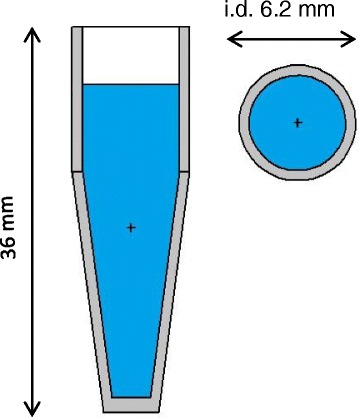
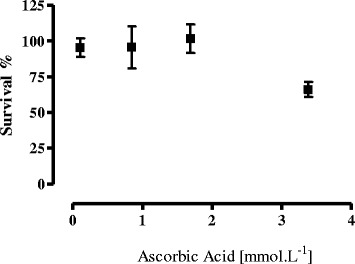
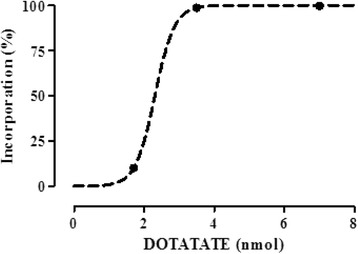
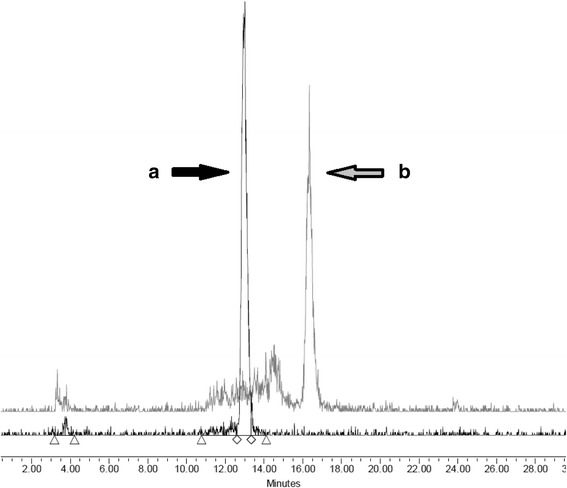
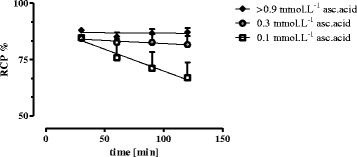
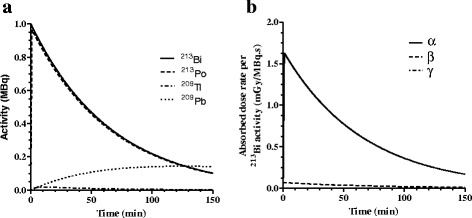
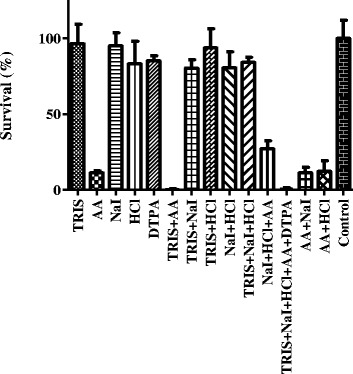
At least 3.5 nmol DOTATATE was required to obtain incorporation ≥ 99 % with 100 MBq Bi (at optimized pH conditions, pH 8.3 with 0.15 mol.L TRIS) in a reaction volume of 800 μL. The cumulative absorbed dose in the reaction vial was 230 Gy/100 MBq in 30 min. A minimal final concentration of 0.9 mmol.L ascorbic acid was required for ~100 MBq (t = 0) to minimize radiation damage of DOTATATE. The osmolarity was decreased to 0.45 Osmol/L.Under optimized labelling conditions, Bi-DOTATATE remained stable up to 2 h after labelling, RCP was ≥ 85 %. In vitro showed a negative correlation between ascorbic acid concentration and cell survival.
Bismuth-DOTA-peptide labelling conditions including peptide amount, quencher and pH were optimized to meet the requirements needed for preclinical applications in peptide receptor radionuclide therapy.
铋(Bi,半衰期T = 45.6分钟)是癌症研究中最常用的α发射体之一。肽受体放射性核素治疗需要高比活度的放射性配体。由于镅(Ac)的可用性有限且生产大规模Ac/Bi发生器成本高昂,使用含镅量低于222 MBq的发生器可能会使体外和体内应用变得复杂。在此,我们展示了使用生长抑素类似物DOTA-酪氨酸-奥曲肽(DOTATATE),对含Ac/Bi发生器(<222 MBq)的DOTA肽进行优化标记条件,用于临床前应用。研究了DOTATATE与铋的以下标记条件:在800 μL溶液中,肽质量从1.7至7.0 nmol变化,TRIS缓冲液浓度从0.15 mol/L至0.34 mol/L,抗坏血酸浓度从0至71 mmol/L。所有反应均在95°C下进行5分钟。孵育后,加入二乙三胺五乙酸(DTPA,50 nmol)以终止标记反应。除了优化标记条件外,通过离子交换薄层层析-硅胶板(ITLC-SG)测定掺入率,并通过反相高效液相色谱(RP-HPLC)监测标记后长达120分钟的放射化学纯度(RCP)。使用蒙特卡罗方法在反应瓶中进行剂量学研究,并使用大鼠胰腺肿瘤细胞系CA20948进行体外克隆形成试验。
在800 μL反应体积中,要在100 MBq铋(在优化的pH条件下,pH 8.3,0.15 mol/L TRIS)下获得掺入率≥99%,至少需要3.5 nmol DOTATATE。反应瓶中的累积吸收剂量在30分钟内为230 Gy/100 MBq。为使DOTATATE的辐射损伤最小化,对于约100 MBq(t = 0),抗坏血酸的最低终浓度需要0.9 mmol/L。渗透压降至0.45 Osmol/L。在优化的标记条件下,Bi-DOTATATE在标记后长达2小时保持稳定,RCP≥85%。体外实验表明抗坏血酸浓度与细胞存活率呈负相关。
优化了铋-DOTA肽的标记条件,包括肽量、淬灭剂和pH值,以满足肽受体放射性核素治疗临床前应用的需求。