• 文献检索
  • 文档翻译
  • 深度研究
  • 学术资讯
  • Suppr Zotero 插件Zotero 插件
  • 邀请有礼
  • 套餐&价格
  • 历史记录
应用&插件
Suppr Zotero 插件Zotero 插件浏览器插件Mac 客户端Windows 客户端微信小程序
定价
高级版会员购买积分包购买API积分包
服务
文献检索文档翻译深度研究API 文档MCP 服务
关于我们
关于 Suppr公司介绍联系我们用户协议隐私条款
关注我们

Suppr 超能文献

核心技术专利:CN118964589B侵权必究
粤ICP备2023148730 号-1Suppr @ 2026

文献检索

告别复杂PubMed语法,用中文像聊天一样搜索,搜遍4000万医学文献。AI智能推荐,让科研检索更轻松。

立即免费搜索

文件翻译

保留排版,准确专业,支持PDF/Word/PPT等文件格式,支持 12+语言互译。

免费翻译文档

深度研究

AI帮你快速写综述,25分钟生成高质量综述,智能提取关键信息,辅助科研写作。

立即免费体验

利用脑电信号实现对经肱骨假肢的控制

Towards Control of a Transhumeral Prosthesis with EEG Signals.

作者信息

Bandara D S V, Arata Jumpei, Kiguchi Kazuo

机构信息

System Engineering Laboratory, Department of Mechanical Engineering, Kyushu University, Fukuoka 819-0395, Japan.

出版信息

Bioengineering (Basel). 2018 Mar 22;5(2):26. doi: 10.3390/bioengineering5020026.

DOI:10.3390/bioengineering5020026
PMID:29565293
原文链接:https://pmc.ncbi.nlm.nih.gov/articles/PMC6027267/
Abstract

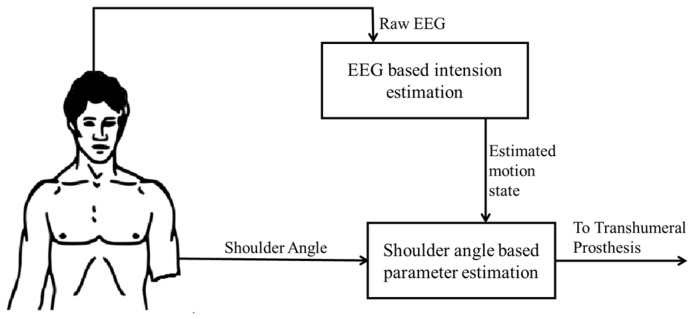
Robotic prostheses are expected to allow amputees greater freedom and mobility. However, available options to control transhumeral prostheses are reduced with increasing amputation level. In addition, for electromyography-based control of prostheses, the residual muscles alone cannot generate sufficiently different signals for accurate distal arm function. Thus, controlling a multi-degree of freedom (DoF) transhumeral prosthesis is challenging with currently available techniques. In this paper, an electroencephalogram (EEG)-based hierarchical two-stage approach is proposed to achieve multi-DoF control of a transhumeral prosthesis. In the proposed method, the motion intention for arm reaching or hand lifting is identified using classifiers trained with motion-related EEG features. For this purpose, neural network and -nearest neighbor classifiers are used. Then, elbow motion and hand endpoint motion is estimated using a different set of neural-network-based classifiers, which are trained with motion information recorded using healthy subjects. The predictions from the classifiers are compared with residual limb motion to generate a final prediction of motion intention. This can then be used to realize multi-DoF control of a prosthesis. The experimental results show the feasibility of the proposed method for multi-DoF control of a transhumeral prosthesis. This proof of concept study was performed with healthy subjects.

摘要

机器人假肢有望让截肢者获得更大的行动自由和灵活性。然而,随着截肢水平的提高,控制经肱骨假肢的现有选择会减少。此外,对于基于肌电图的假肢控制,仅靠残余肌肉无法产生足够不同的信号来实现精确的手臂远端功能。因此,用目前的现有技术控制多自由度(DoF)经肱骨假肢具有挑战性。本文提出了一种基于脑电图(EEG)的分层两阶段方法,以实现对经肱骨假肢的多自由度控制。在所提出的方法中,使用通过与运动相关的脑电图特征训练的分类器来识别手臂伸展或手部抬起的运动意图。为此,使用了神经网络和最近邻分类器。然后,使用另一组基于神经网络的分类器估计肘部运动和手部端点运动,这些分类器是通过使用健康受试者记录的运动信息进行训练的。将分类器的预测结果与残肢运动进行比较,以生成运动意图的最终预测。然后,这可用于实现对假肢的多自由度控制。实验结果表明了所提出的方法用于经肱骨假肢多自由度控制的可行性。这项概念验证研究是在健康受试者身上进行的。
https://cdn.ncbi.nlm.nih.gov/pmc/blobs/db96/6027267/a2d06a15ab0c/bioengineering-05-00026-g010.jpg
https://cdn.ncbi.nlm.nih.gov/pmc/blobs/db96/6027267/c64b0e49028a/bioengineering-05-00026-g001.jpg
https://cdn.ncbi.nlm.nih.gov/pmc/blobs/db96/6027267/f5aec252cda6/bioengineering-05-00026-g002.jpg
https://cdn.ncbi.nlm.nih.gov/pmc/blobs/db96/6027267/10c8b66150c6/bioengineering-05-00026-g003.jpg
https://cdn.ncbi.nlm.nih.gov/pmc/blobs/db96/6027267/8c81df56603b/bioengineering-05-00026-g004.jpg
https://cdn.ncbi.nlm.nih.gov/pmc/blobs/db96/6027267/fb3db5a45f27/bioengineering-05-00026-g005.jpg
https://cdn.ncbi.nlm.nih.gov/pmc/blobs/db96/6027267/35c50bd032cd/bioengineering-05-00026-g006.jpg
https://cdn.ncbi.nlm.nih.gov/pmc/blobs/db96/6027267/651566699c05/bioengineering-05-00026-g007.jpg
https://cdn.ncbi.nlm.nih.gov/pmc/blobs/db96/6027267/10dd5495bd20/bioengineering-05-00026-g008.jpg
https://cdn.ncbi.nlm.nih.gov/pmc/blobs/db96/6027267/a102567de51b/bioengineering-05-00026-g009a.jpg
https://cdn.ncbi.nlm.nih.gov/pmc/blobs/db96/6027267/a2d06a15ab0c/bioengineering-05-00026-g010.jpg
https://cdn.ncbi.nlm.nih.gov/pmc/blobs/db96/6027267/c64b0e49028a/bioengineering-05-00026-g001.jpg
https://cdn.ncbi.nlm.nih.gov/pmc/blobs/db96/6027267/f5aec252cda6/bioengineering-05-00026-g002.jpg
https://cdn.ncbi.nlm.nih.gov/pmc/blobs/db96/6027267/10c8b66150c6/bioengineering-05-00026-g003.jpg
https://cdn.ncbi.nlm.nih.gov/pmc/blobs/db96/6027267/8c81df56603b/bioengineering-05-00026-g004.jpg
https://cdn.ncbi.nlm.nih.gov/pmc/blobs/db96/6027267/fb3db5a45f27/bioengineering-05-00026-g005.jpg
https://cdn.ncbi.nlm.nih.gov/pmc/blobs/db96/6027267/35c50bd032cd/bioengineering-05-00026-g006.jpg
https://cdn.ncbi.nlm.nih.gov/pmc/blobs/db96/6027267/651566699c05/bioengineering-05-00026-g007.jpg
https://cdn.ncbi.nlm.nih.gov/pmc/blobs/db96/6027267/10dd5495bd20/bioengineering-05-00026-g008.jpg
https://cdn.ncbi.nlm.nih.gov/pmc/blobs/db96/6027267/a102567de51b/bioengineering-05-00026-g009a.jpg
https://cdn.ncbi.nlm.nih.gov/pmc/blobs/db96/6027267/a2d06a15ab0c/bioengineering-05-00026-g010.jpg

相似文献

1
Towards Control of a Transhumeral Prosthesis with EEG Signals.利用脑电信号实现对经肱骨假肢的控制
Bioengineering (Basel). 2018 Mar 22;5(2):26. doi: 10.3390/bioengineering5020026.
2
fNIRS-Based Upper Limb Motion Intention Recognition Using an Artificial Neural Network for Transhumeral Amputees.基于近红外光谱的人工神经网络用于肱骨截肢者上肢运动意图识别。
Sensors (Basel). 2022 Jan 18;22(3):726. doi: 10.3390/s22030726.
3
Upper Limb Prosthesis Control: A Hybrid EEG-EMG Scheme for Motion Estimation in Transhumeral Subjects.上肢假肢控制:一种用于经肱骨截肢者运动估计的脑电图-肌电图混合方案。
Annu Int Conf IEEE Eng Med Biol Soc. 2018 Jul;2018:2024-2027. doi: 10.1109/EMBC.2018.8512678.
4
Phantom-Mobility-Based Prosthesis Control in Transhumeral Amputees Without Surgical Reinnervation: A Preliminary Study.无手术神经再支配的经肱骨截肢患者基于幻肢运动的假肢控制:一项初步研究。
Front Bioeng Biotechnol. 2018 Nov 29;6:164. doi: 10.3389/fbioe.2018.00164. eCollection 2018.
5
Synergy-Space Recurrent Neural Network for Transferable Forearm Motion Prediction from Residual Limb Motion.协同空间递归神经网络用于从残肢运动中预测可转移的前臂运动。
Sensors (Basel). 2023 Apr 22;23(9):4188. doi: 10.3390/s23094188.
6
Development of a multi-DoF transhumeral robotic arm prosthesis.多自由度经肱骨机器人手臂假肢的研发。
Med Eng Phys. 2017 Oct;48:131-141. doi: 10.1016/j.medengphy.2017.06.034. Epub 2017 Jul 18.
7
Can We Achieve Intuitive Prosthetic Elbow Control Based on Healthy Upper Limb Motor Strategies?基于健康上肢运动策略,我们能否实现直观的假肢肘部控制?
Front Neurorobot. 2018 Feb 2;12:1. doi: 10.3389/fnbot.2018.00001. eCollection 2018.
8
Motor imagery classification of upper limb movements based on spectral domain features of EEG patterns.基于脑电图模式频谱域特征的上肢运动运动想象分类
Annu Int Conf IEEE Eng Med Biol Soc. 2017 Jul;2017:2976-2979. doi: 10.1109/EMBC.2017.8037482.
9
Classification of Phantom Finger, Hand, Wrist, and Elbow Voluntary Gestures in Transhumeral Amputees With sEMG.经肱骨截肢者中使用表面肌电图对幻指、手、腕和肘自主手势的分类
IEEE Trans Neural Syst Rehabil Eng. 2017 Jan;25(1):68-77. doi: 10.1109/TNSRE.2016.2563222. Epub 2016 May 4.
10
Model predictive controller-based spatiotemporal path tracking method for transhumeral prostheses.基于模型预测控制器的经肱骨假肢时空路径跟踪方法
Int J Med Robot. 2019 Jun;15(3):e1980. doi: 10.1002/rcs.1980. Epub 2019 Jan 9.

引用本文的文献

1
Application of EMG feedback for hand prosthesis control in high-level amputation: a case study.肌电图反馈在高位截肢患者手部假肢控制中的应用:一项病例研究。
Sci Rep. 2024 Dec 30;14(1):31676. doi: 10.1038/s41598-024-80828-x.
2
A comprehensive review on motion trajectory reconstruction for EEG-based brain-computer interface.基于脑电图的脑机接口运动轨迹重建综述
Front Neurosci. 2023 Jun 2;17:1086472. doi: 10.3389/fnins.2023.1086472. eCollection 2023.
3
A low-cost robotic hand prosthesis with apparent haptic sense controlled by electroencephalographic signals.

本文引用的文献

1
An ICA-EBM-Based sEMG Classifier for Recognizing Lower Limb Movements in Individuals With and Without Knee Pathology.基于 ICA-EBM 的 sEMG 分类器,用于识别膝部病变患者和非膝部病变患者的下肢运动。
IEEE Trans Neural Syst Rehabil Eng. 2018 Mar;26(3):675-686. doi: 10.1109/TNSRE.2018.2796070.
2
Development of a multi-DoF transhumeral robotic arm prosthesis.多自由度经肱骨机器人手臂假肢的研发。
Med Eng Phys. 2017 Oct;48:131-141. doi: 10.1016/j.medengphy.2017.06.034. Epub 2017 Jul 18.
3
Estimation of distal arm joint angles from EMG and shoulder orientation for transhumeral prostheses.
一种由脑电图信号控制的具有明显触觉感知的低成本机器人假手。
HardwareX. 2023 Jun 2;14:e00439. doi: 10.1016/j.ohx.2023.e00439. eCollection 2023 Jun.
4
EEG Channel Selection Techniques in Motor Imagery Applications: A Review and New Perspectives.运动想象应用中的脑电图通道选择技术:综述与新视角
Bioengineering (Basel). 2022 Nov 24;9(12):726. doi: 10.3390/bioengineering9120726.
5
Mind the gap: State-of-the-art technologies and applications for EEG-based brain-computer interfaces.注意差距:基于脑电图的脑机接口的先进技术与应用
APL Bioeng. 2021 Jul 20;5(3):031507. doi: 10.1063/5.0047237. eCollection 2021 Sep.
6
Real-Time EMG Based Pattern Recognition Control for Hand Prostheses: A Review on Existing Methods, Challenges and Future Implementation.基于实时肌电图的假肢手模式识别控制:现有方法、挑战和未来实现的综述。
Sensors (Basel). 2019 Oct 22;19(20):4596. doi: 10.3390/s19204596.
基于肌电图和肩部方位估计经肱骨假肢的上臂远端关节角度
J Electromyogr Kinesiol. 2017 Aug;35:86-94. doi: 10.1016/j.jelekin.2017.06.001. Epub 2017 Jun 11.
4
Study on Interaction Between Temporal and Spatial Information in Classification of EMG Signals for Myoelectric Prostheses.肌电假肢中基于时空信息交互的肌电信号分类研究。
IEEE Trans Neural Syst Rehabil Eng. 2017 Oct;25(10):1832-1842. doi: 10.1109/TNSRE.2017.2687761. Epub 2017 Apr 19.
5
Design and Optimization of an EEG-Based Brain Machine Interface (BMI) to an Upper-Limb Exoskeleton for Stroke Survivors.基于脑电图的脑机接口(BMI)用于中风幸存者上肢外骨骼的设计与优化
Front Neurosci. 2016 Mar 31;10:122. doi: 10.3389/fnins.2016.00122. eCollection 2016.
6
Transradial Amputee Gesture Classification Using an Optimal Number of sEMG Sensors: An Approach Using ICA Clustering.使用最佳数量的表面肌电传感器进行经桡骨截肢者手势分类:一种基于独立成分分析聚类的方法
IEEE Trans Neural Syst Rehabil Eng. 2016 Aug;24(8):837-46. doi: 10.1109/TNSRE.2015.2478138. Epub 2015 Sep 17.
7
Nonnegative matrix factorization for the identification of EMG finger movements: evaluation using matrix analysis.基于矩阵分析的肌电手指运动识别的非负矩阵分解。
IEEE J Biomed Health Inform. 2015 Mar;19(2):478-485. doi: 10.1109/JBHI.2014.2326660. Epub 2014 Jun 3.
8
The DEKA Arm: its features, functionality, and evolution during the Veterans Affairs Study to optimize the DEKA Arm.DEKA 义肢:其特点、功能以及在退伍军人事务部优化 DEKA 义肢研究中的演变
Prosthet Orthot Int. 2014 Dec;38(6):492-504. doi: 10.1177/0309364613506913. Epub 2013 Oct 22.
9
Detection of movement intention from single-trial movement-related cortical potentials.基于单次运动相关皮层电位的运动意图检测。
J Neural Eng. 2011 Dec;8(6):066009. doi: 10.1088/1741-2560/8/6/066009. Epub 2011 Oct 26.
10
The moving phantom: motor execution or motor imagery?运动幻像:运动执行还是运动想象?
Cortex. 2012 Jun;48(6):746-57. doi: 10.1016/j.cortex.2011.02.003. Epub 2011 Feb 12.