Osher Center for Integrative Medicine, University of California, San Francisco, San Francisco, California, USA.
Department of Psychiatry, University of California, San Francisco, San Francisco, California, USA.
Obesity (Silver Spring). 2018 May;26(5):869-876. doi: 10.1002/oby.22150. Epub 2018 Mar 22.
The aim of this study was to examine whether baseline chronic stress and impulsive risk-taking synergistically predict changes in visceral fat among healthy mothers in an observational, longitudinal, 18-month study.
A prospective cohort of 113 adult women (age, mean ± SD: 42.83 ± 4.70; BMI, mean ± SD: 24.86 ± 4.32; 74%, n = 84 white) completed assessments at baseline and 18-month follow-up. Chronically stressed mothers caring for a child with an autism spectrum disorder ("caregivers"; n = 72 participants) were compared with lower stress mothers caring for a neurotypical child ("controls"; n = 41). This study objectively assessed impulsive risk-taking by using the Behavioral Analog Risk Task at baseline and assessed visceral fat at baseline and 18-month follow-up by using bioelectrical impedance (ViScan; Tanita Corporation, Tokyo, Japan).
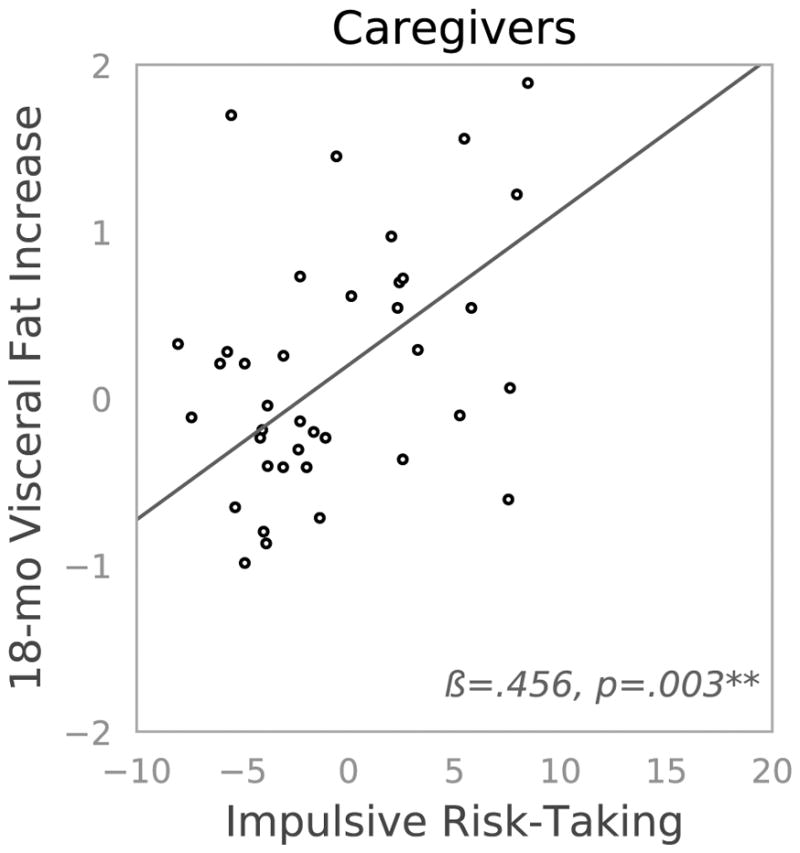
The interaction of baseline chronic caregiving stress and impulsive risk-taking predicted an 18-month change in visceral fat, such that greater impulsive risk-taking was associated with greater 18-month increases in visceral fat among caregivers (ß = 0.423; P = 0.005) but not among controls (ß = -0.030; P = 0.802), both in unadjusted models and after accounting for covariates. Neither chronic stress nor impulsive risk-taking independently predicted 18-month changes in visceral fat.
The combination of high chronic stress and high impulsive risk-taking may increase risk for visceral fat gain over time and therefore may be an important intervention target in obesity prevention.
本研究旨在通过观察性、纵向、为期 18 个月的研究,检验基线慢性应激和冲动风险-taking 是否协同预测健康母亲内脏脂肪的变化。
前瞻性队列研究纳入了 113 名成年女性(年龄,平均值±标准差:42.83±4.70;BMI,平均值±标准差:24.86±4.32;74%,n=84 名白种人),她们在基线和 18 个月随访时完成了评估。照顾患有自闭症谱系障碍儿童的慢性应激母亲(“照顾者”;n=72 名参与者)与照顾神经典型儿童的低应激母亲(“对照组”;n=41 名)进行了比较。本研究通过行为模拟风险任务在基线时客观评估冲动风险-taking,通过生物电阻抗(ViScan;Tanita Corporation,东京,日本)在基线和 18 个月随访时评估内脏脂肪。
基线慢性照顾应激和冲动风险-taking 的相互作用预测了内脏脂肪的 18 个月变化,即更大的冲动风险-taking 与照顾者内脏脂肪的 18 个月增加有关(β=0.423;P=0.005),而与对照组无关(β=0.030;P=0.802),无论是在未调整模型中还是在考虑了协变量后。慢性应激和冲动风险-taking 都不能独立预测 18 个月内脏脂肪的变化。
高慢性应激和高冲动风险-taking 的组合可能会随着时间的推移增加内脏脂肪增加的风险,因此可能是肥胖预防的一个重要干预目标。