Mukumbang Ferdinand C
School of Public Health, University of the Western Cape, South Africa.
Department of Public Health, Institute of Tropical Medicine, Belgium.
South Afr J HIV Med. 2017 Apr 4;18(1):698. doi: 10.4102/sajhivmed.v18i1.698. eCollection 2017.
Condom failure has always been found to coexist with condom usage, especially among sex workers.
To describe the actions of female sex workers when they are faced with situations of condom failure.
Using the survey design, the participants were selected through the snowball sampling method. Their responses were obtained using a structured questionnaire. A total of 100 questionnaires were analysed.
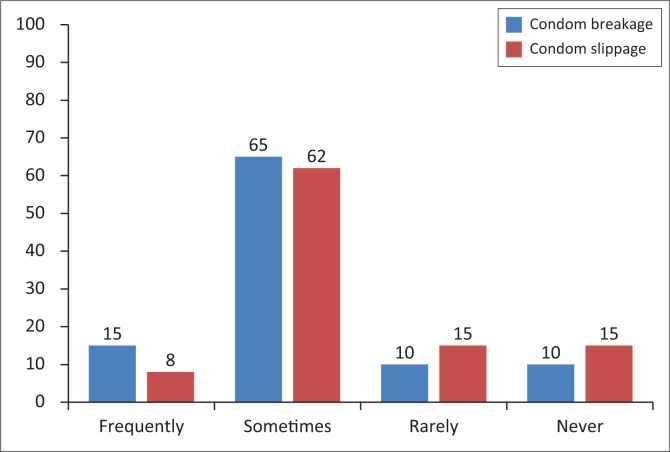
With respect to the immediate actions of sex workers after condom failure, 36% of the respondents continued with the sexual encounter after noticing that the condom was broken. Another 36% stopped immediately when they noticed that the condom had failed, but replaced the condom; 13% of the participants stopped the sexual encounter completely; 3% applied vaginal spermicidal foam; and 5% of the respondents stopped immediately and took a douche when they had the chance. For the actions within the next 24 hours of experiencing condom failure with a client, 53% of the participants did nothing; 4% sought counsel from a professional; 3% of the respondents took alcohol or drugs to forget the incident, 25% went to the clinic for assistance and 8% offered other responses.
While continuing the sexual encounter without replacing the condom, taking alcohol and drugs or doing nothing could increase the risk of contracting HIV; however, actions like stopping the sexual encounter completely and visiting a clinic or a professional could make a difference between staying HIV negative or seroconverting. There is a need for targeted intervention to address issues of inappropriate behaviours after experiencing condom failure.
避孕套失败一直与避孕套的使用并存,尤其是在性工作者中。
描述女性性工作者在面临避孕套失败情况时的行为。
采用调查设计,通过滚雪球抽样法选取参与者。使用结构化问卷获取他们的回答。共分析了100份问卷。
关于避孕套失败后性工作者的即时行为,36%的受访者在注意到避孕套破裂后继续性行为。另外36%的人在注意到避孕套失败后立即停止,但更换了避孕套;13%的参与者完全停止了性行为;3%的人使用了阴道杀精泡沫;5%的受访者在有机会时立即停止并进行了冲洗。对于与客户避孕套失败后的接下来24小时内的行为,53%的参与者什么也没做;4%的人向专业人士寻求建议;3%的受访者饮酒或吸毒以忘记此事,25%的人前往诊所寻求帮助,8%的人给出了其他回答。
在不更换避孕套的情况下继续性行为、饮酒和吸毒或什么都不做可能会增加感染艾滋病毒的风险;然而,像完全停止性行为以及前往诊所或咨询专业人士等行为可能会决定是保持艾滋病毒阴性还是血清转化。需要有针对性的干预措施来解决避孕套失败后不适当行为的问题。