
靶向外显子组测序揭示晚期实体瘤的新型潜在驱动基因。
Novel putative drivers revealed by targeted exome sequencing of advanced solid tumors.
机构信息
Stanley S. Scott Cancer Center, Louisiana State University Health Sciences Center, New Orleans, Louisiana, United States of America.
Department of Oncology, Imperial College of Medicine, London, United Kingdom.
出版信息
PLoS One. 2018 Mar 23;13(3):e0194790. doi: 10.1371/journal.pone.0194790. eCollection 2018.
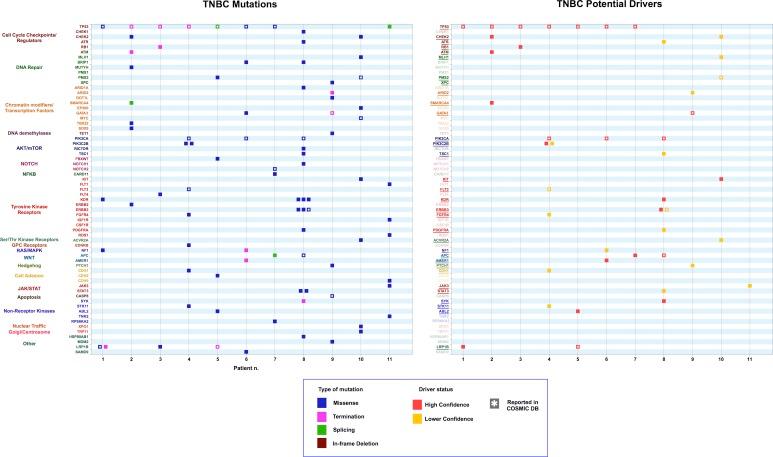
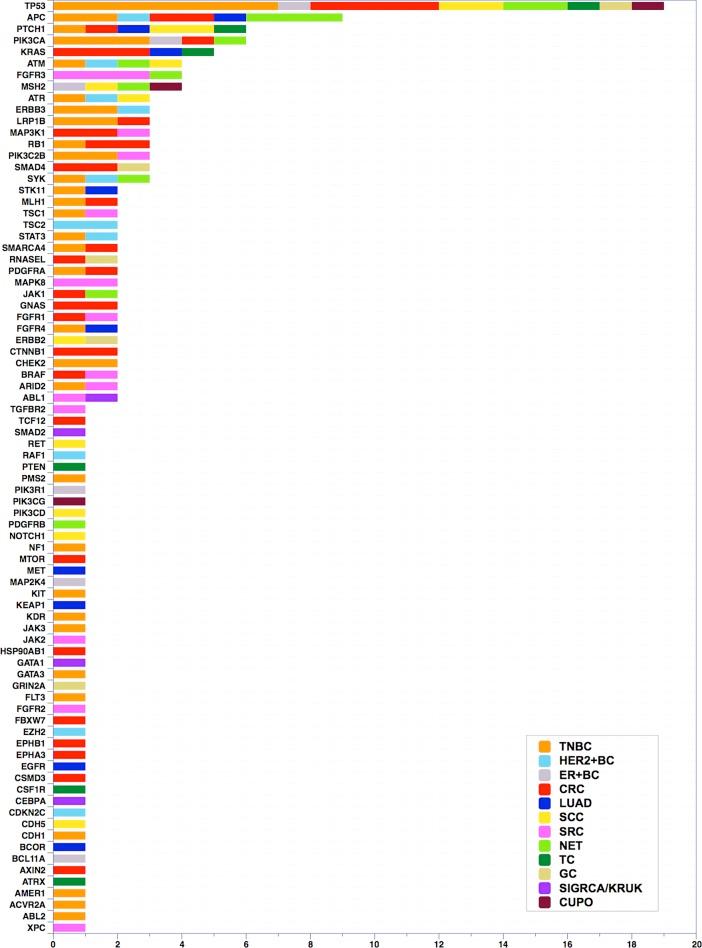
Next generation sequencing (NGS) is becoming increasingly integrated into oncological practice and clinical research. NGS methods have also provided evidence for clonal evolution of cancers during disease progression and treatment. The number of variants associated with response to specific therapeutic agents keeps increasing. However, the identification of novel driver mutations as opposed to passenger (phenotypically silent or clinically irrelevant) mutations remains a major challenge. We conducted targeted exome sequencing of advanced solid tumors from 44 pre-treated patients with solid tumors including breast, colorectal and lung carcinomas, neuroendocrine tumors, sarcomas and others. We catalogued established driver mutations and putative new drivers as predicted by two distinct algorithms. The established drivers we detected were consistent with published observations. However, we also detected a significant number of mutations with driver potential never described before in each tumor type we studied. These putative drivers belong to key cell fate regulatory networks, including potentially druggable pathways. Should our observations be confirmed, they would support the hypothesis that new driver mutations are selected by treatment in clinically aggressive tumors, and indicate a need for longitudinal genomic testing of solid tumors to inform second line cancer treatment.
下一代测序(NGS)技术在肿瘤学临床实践和研究中得到了越来越多的应用。NGS 方法也为癌症在疾病进展和治疗过程中的克隆进化提供了证据。与特定治疗药物反应相关的变异数量不断增加。然而,与乘客(表型沉默或临床无关)突变相反,鉴定新的驱动突变仍然是一个主要挑战。我们对包括乳腺癌、结直肠癌和肺癌、神经内分泌肿瘤、肉瘤等在内的 44 名经预处理的晚期实体瘤患者的肿瘤进行了靶向外显子组测序。我们根据两种不同的算法对已建立的驱动突变和假定的新驱动基因进行了分类。我们检测到的已建立的驱动基因与已发表的观察结果一致。然而,我们还在每个研究的肿瘤类型中检测到了大量以前从未描述过的具有驱动潜力的突变。这些假定的驱动基因属于关键的细胞命运调控网络,包括潜在可用药的途径。如果我们的观察结果得到证实,它们将支持这样一种假说,即在临床上侵袭性肿瘤中,新的驱动突变是由治疗选择的,这表明需要对实体瘤进行纵向基因组检测,以告知二线癌症治疗。



 Zotero 插件