Department of Medicine, Baylor College of Medicine, Houston, Texas.
Center for Innovations in Quality, Effectiveness and Safety (IQuESt), Michael E. DeBakey VA Medical Center, Houston, Texas.
Cancer Med. 2018 May;7(5):2180-2191. doi: 10.1002/cam4.1426. Epub 2018 Mar 23.
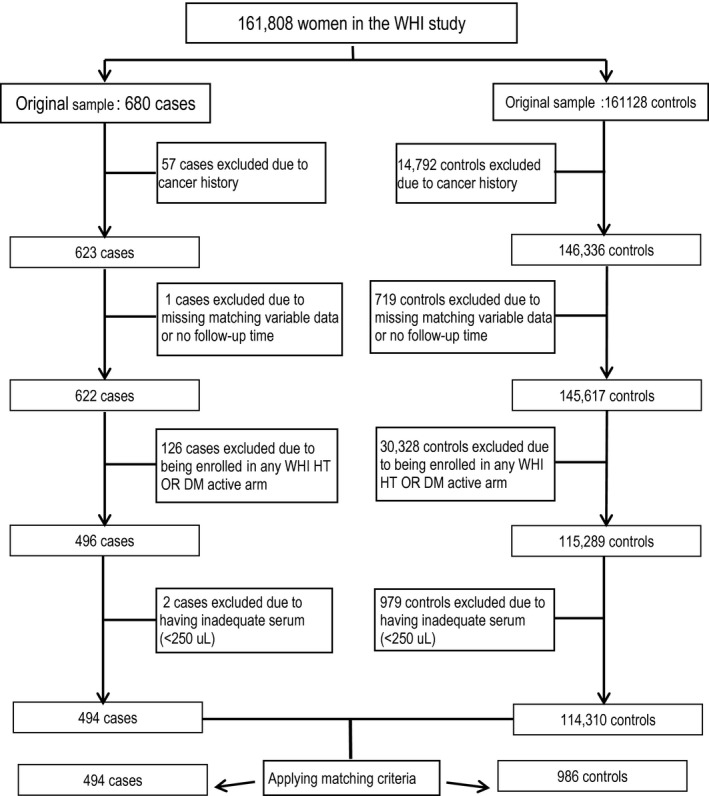
Advanced glycation end products (AGEs) dysregulate adipokines and induce inflammation by binding to their adipocyte receptor (RAGE). Soluble RAGE (sRAGE) prevents AGEs/RAGE signaling. We performed a nested case-control study of the association between sRAGE, adipokines, and incident pancreatic cancer risk in the prospective Women's Health Initiative Study. We individually matched controls (n = 802) to cases (n = 472) on age, race, and blood draw date. We evaluated serum concentrations of sRAGE, adiponectin, leptin, monocyte chemotactic protein 1 (MCP1), and plasminogen activator inhibitor-1 (PAI1) using immunoassay. We used conditional logistic regression model to estimate adjusted odds ratios (aORs) and 95% confidence intervals (CIs) for pancreatic cancer over biomarker quartiles (Q1-Q4). We used principal component analysis to create two composite biomarkers and performed a confirmatory factor analysis to examine the association between composite biomarker scores (CBS) and pancreatic cancer risk. Baseline serum sRAGE concentrations were inversely associated with pancreatic cancer risk (aOR = 0.70, 95% CI: 0.50-0.99). High MCP1 (aOR = 2.55, 95% CI: 1.41-4.61) and the higher CBS including MCP1, PAI1, and leptin (aOR = 1.82, 95% CI = 1.04-3.18) were also associated with increased pancreatic cancer risk among women with BMI <25 kg/m (P values for interaction <0.05). We found an inverse association between prediagnostic sRAGE concentrations and risk of incident pancreatic cancer in postmenopausal women. A proinflammatory CBS was associated with increased risk only in women with normal BMI. MCP1 was not modulated by sRAGE.
晚期糖基化终产物 (AGEs) 通过与脂肪细胞受体 (RAGE) 结合来调节脂肪细胞因子并引发炎症。可溶性 RAGE (sRAGE) 可防止 AGEs/RAGE 信号传导。我们在前瞻性妇女健康倡议研究中进行了一项嵌套病例对照研究,以研究 sRAGE、脂肪细胞因子与胰腺癌发病风险之间的关系。我们按年龄、种族和采血日期将对照(n=802)与病例(n=472)进行个体匹配。我们使用免疫测定法评估了血清 sRAGE、脂联素、瘦素、单核细胞趋化蛋白 1 (MCP1) 和纤溶酶原激活物抑制剂 1 (PAI1) 的浓度。我们使用条件逻辑回归模型估计了按生物标志物四分位数 (Q1-Q4) 计算的胰腺癌的调整比值比 (aOR) 和 95%置信区间 (CI)。我们使用主成分分析创建了两个复合生物标志物,并进行了验证性因子分析以检验复合生物标志物评分 (CBS) 与胰腺癌风险之间的关联。基线血清 sRAGE 浓度与胰腺癌风险呈负相关 (aOR=0.70, 95%CI: 0.50-0.99)。高 MCP1(aOR=2.55, 95%CI: 1.41-4.61) 和包括 MCP1、PAI1 和瘦素在内的较高 CBS(aOR=1.82, 95%CI=1.04-3.18) 与 BMI<25kg/m2 的女性胰腺癌风险增加相关(交互作用 P 值<0.05)。我们发现绝经后妇女中,sRAGE 浓度与诊断前的胰腺癌发病风险呈负相关。促炎 CBS 仅在 BMI 正常的女性中与风险增加相关。MCP1 不受 sRAGE 调节。