Department of Global Health and Center for Global Health and Development, Boston University School of Public Health, Boston, Massachusetts, USA.
Department of Epidemiology and Prevention, Wake Forest School of Medicine, Winston-Salem, North Carolina, USA.
Tob Control. 2019 Jan;28(1):42-49. doi: 10.1136/tobaccocontrol-2017-054108. Epub 2018 Mar 24.
The role of electronic cigarettes (e-cigarettes) in product transitions has been debated.
We used nationally representative data from the Population Assessment of Tobacco and Health Study waves 1 (2013-2014) and 2 (2014-2015) to investigate the associations between e-cigarette initiation and cigarette cessation/reduction in the USA. We limited the sample to current cigarette smokers aged 25+ years who were not current e-cigarette users at wave 1. We modelled 30-day cigarette cessation and substantial reduction in cigarette consumption as a function of e-cigarette initiation between surveys using multivariable logistic regression.
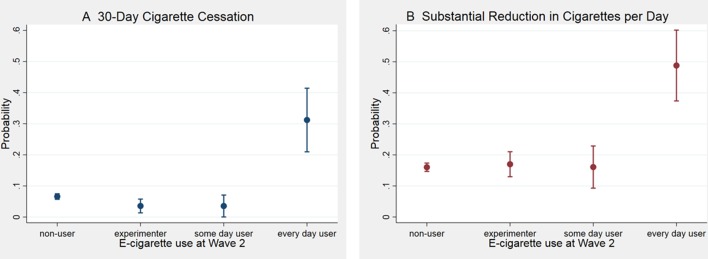
Between waves 1 and 2, 6.9% of cigarette smokers who were not current e-cigarette users transitioned to former smokers. After adjusting for covariates, cigarette smokers who initiated e-cigarette use between waves and reported they used e-cigarettes daily at wave 2 had 7.88 (95% CI 4.45 to 13.95) times the odds of 30-day cigarette cessation compared with non-users of e-cigarettes at wave 2. Cigarette smokers who began using e-cigarettes every day and did not achieve cessation had 5.70 (95% CI 3.47 to 9.35) times the odds of reducing their average daily cigarette use by at least 50% between waves 1 and 2 compared with e-cigarette non-users.
Daily e-cigarette initiators were more likely to have quit smoking cigarettes or reduced use compared with non-users. However, less frequent e-cigarette use was not associated with cigarette cessation/reduction. These results suggest incorporating frequency of e-cigarette use is important for developing a more thorough understanding of the association between e-cigarette use and cigarette cessation.
电子烟在产品转换中的作用一直存在争议。
我们使用全国代表性的人群评估烟草和健康研究(Population Assessment of Tobacco and Health Study,PATH)调查的第 1 波(2013-2014 年)和第 2 波(2014-2015 年)的数据,调查了电子烟使用与美国人群中戒烟或减少吸烟的关联。我们将样本限定为当前年龄在 25 岁及以上的成年卷烟吸烟者,且在第 1 波调查时未使用电子烟。我们使用多变量逻辑回归模型,将第 1 波和第 2 波之间的电子烟使用与 30 天内戒烟或大幅减少吸烟量关联进行建模。
在第 1 波和第 2 波调查之间,有 6.9%的未使用电子烟的成年卷烟吸烟者成为了前吸烟者。调整了协变量后,在第 2 波调查时报告使用电子烟且每天使用电子烟的卷烟吸烟者,与第 2 波调查时未使用电子烟的吸烟者相比,在 30 天内戒烟的可能性高出 7.88 倍(95%置信区间 4.45 到 13.95)。开始每天使用电子烟但未戒烟的吸烟者与第 2 波调查时未使用电子烟的吸烟者相比,将平均每日吸烟量减少至少 50%的可能性高出 5.70 倍(95%置信区间 3.47 到 9.35)。
与非使用者相比,每天使用电子烟的电子烟使用者更有可能戒烟或减少吸烟量。然而,电子烟使用频率较低与戒烟或减少吸烟量无关。这些结果表明,纳入电子烟使用频率对于深入了解电子烟使用与戒烟之间的关联非常重要。