GReD, Université Clermont Auvergne, CNRS, INSERM, Clermont-Ferrand, France.
Hématologie Biologique, CHU Clermont-Ferrand, Hôpital Estaing, Clermont-Ferrand Cedex 1, France.
Mol Oncol. 2018 Jun;12(6):814-829. doi: 10.1002/1878-0261.12191. Epub 2018 Apr 27.
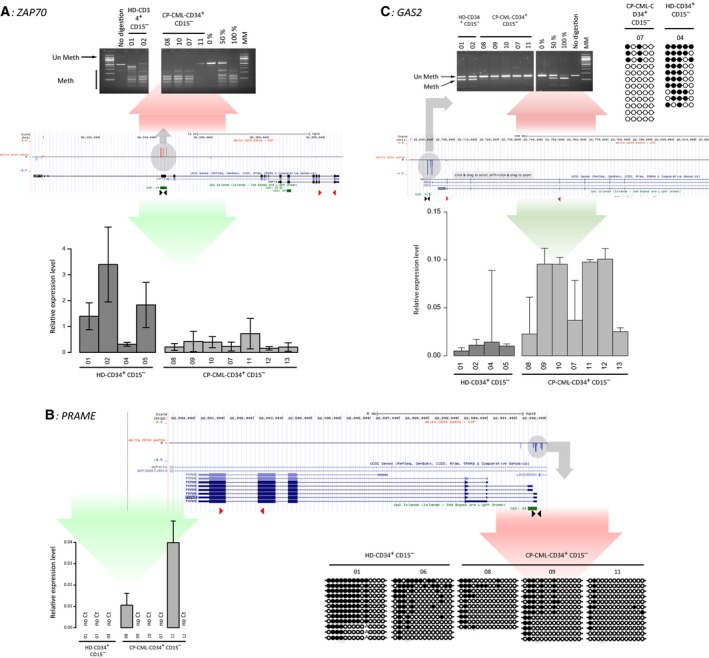
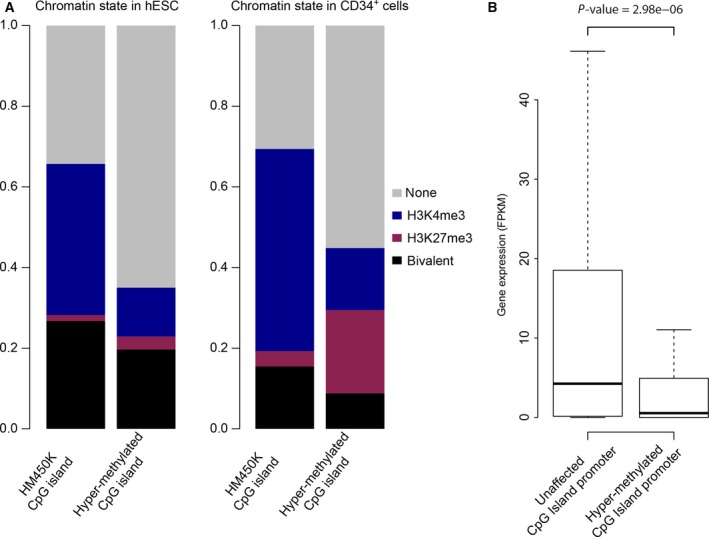
Despite the high efficiency of tyrosine kinase inhibitors (TKI), some patients with chronic myeloid leukemia (CML) will display residual disease that can become resistant to treatment, indicating intraclonal heterogeneity in chronic-phase CML (CP-CML). To determine the basis of this heterogeneity, we conducted the first exhaustive characterization of the DNA methylation pattern of sorted CP-CML CD34 CD15 (immature) and CD34 CD15 (mature) cells at diagnosis (prior to any treatment) and compared it to that of CD34 CD15 and CD34 CD15 cells isolated from healthy donors (HD). In both cell types, we identified several hundreds of differentially methylated regions (DMRs) showing DNA methylation changes between CP-CML and HD samples, with only a subset of them in common between CD34 CD15 and CD34 CD15 cells. This suggested DNA methylation variability within the same CML clone. We also identified 70 genes that could be aberrantly repressed upon hypermethylation and 171 genes that could be aberrantly expressed upon hypomethylation of some of these DMRs in CP-CML cells, among which 18 and 81, respectively, were in CP-CML CD34 CD15 cells only. We then validated the DNA methylation and expression defects of selected candidate genes. Specifically, we identified GAS2, a candidate oncogene, as a new example of gene the hypomethylation of which is associated with robust overexpression in CP-CML cells. Altogether, we demonstrated that DNA methylation abnormalities exist at early stages of CML and can affect the transcriptional landscape of malignant cells. These observations could lead to the development of combination treatments with epigenetic drugs and TKI for CP-CML.
尽管酪氨酸激酶抑制剂 (TKI) 的效率很高,但一些慢性髓性白血病 (CML) 患者仍会出现残留疾病,从而对治疗产生耐药性,这表明慢性期 CML (CP-CML) 中存在克隆内异质性。为了确定这种异质性的基础,我们首次对诊断时(在任何治疗之前)分选的 CP-CML CD34 CD15(幼稚)和 CD34 CD15(成熟)细胞的 DNA 甲基化模式进行了详尽的特征描述,并将其与来自健康供体 (HD) 的 CD34 CD15 和 CD34 CD15 细胞进行了比较。在这两种细胞类型中,我们确定了数百个差异甲基化区域 (DMR),这些区域显示 CP-CML 和 HD 样本之间的 DNA 甲基化变化,其中只有一小部分在 CD34 CD15 和 CD34 CD15 细胞之间共同存在。这表明同一 CML 克隆内的 DNA 甲基化具有可变性。我们还鉴定了 70 个可能因超甲基化而异常抑制的基因和 171 个可能因这些 CP-CML 细胞中一些 DMR 的低甲基化而异常表达的基因,其中分别有 18 个和 81 个仅在 CP-CML CD34 CD15 细胞中。然后,我们验证了选定候选基因的 DNA 甲基化和表达缺陷。具体来说,我们确定了 GAS2,一种候选癌基因,作为基因的新例子,其低甲基化与 CP-CML 细胞中强大的过表达相关。总之,我们证明了 DNA 甲基化异常存在于 CML 的早期阶段,并且可以影响恶性细胞的转录谱。这些观察结果可能导致开发用于 CP-CML 的联合治疗方案,包括表观遗传药物和 TKI。