Department of Physiology, Faculty of Medicine and Nursing, University of the Basque Country (UPV/EHU), Barrio Sarriena s/n, E-48940, Leioa, Bizkaia, Spain.
Matia Instituto Gerontológico Foundation, Camino de los Pinos 35, E-20018, Donostia-San Sebastian, Gipuzkoa, Spain.
BMC Geriatr. 2018 Mar 27;18(1):80. doi: 10.1186/s12877-018-0770-y.
Few studies have simultaneously examined changes in physical, cognitive and emotional performance throughout the aging process.
Baseline data from an ongoing experimental randomized study were analyzed. Physical activity, handgrip, the Senior Fitness Test, Trail Making Test A, Rey Auditory-Verbal Learning Test, Quality of Life-Alzheimer's Disease Scale (QoL-AD) and the Goldberg Depression Scale were used to assess study participants. Logistic regression models were applied.
ACTRN12616001044415 (04/08/2016).
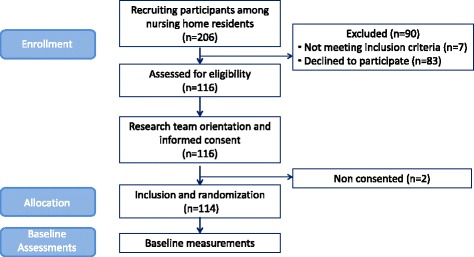
The study enrolled 114 participants with a mean age of 84.9 (standard deviation 6.9) years from ten different nursing homes. After adjusting for age, gender and education level, upper limb muscle strength was found to be associated with Rey Auditory-Verbal Learning Test [EXP(B): 1.16, 95% confidence interval (CI): 1.04-1.30] and QoL-AD [EXP(B): 1.18, 95% CI: 1.06-1.31]. Similarly, the number of steps taken per day was negatively associated with the risk of depression according to the Goldberg Depression Scale [EXP(B): 1.14, 95% CI: 1.000-1.003]. Additional analyses suggest that the factors associated with these variables are different according to the need for using an assistive device for walking. In those participants who used it, upper limb muscle strength remained associated with Rey Auditory-Verbal Learning Test [EXP(B): 1.21, 95% CI: 1.01-1.44] and QoL-AD tests [EXP(B): 1.19, 95% CI: 1.02-1.40]. In those individuals who did not need an assistive device for walking, lower limb muscle strength was associated with Rey Auditory-Verbal Learning Test [EXP(B): 1.35, 95% CI: 1.07-1.69], time spent in light physical activity was associated with QoL-AD test [EXP(B): 1.13, 95% CI: 1.00-1.02], and the number of steps walked per day was negatively associated with the risk of depression according to the Goldberg Depression Scale [EXP(B): 1.27, 95% CI: 1.000-1.004].
Muscle strength and physical activity are factors positively associated with a better performance on the Rey Auditory-Verbal Learning Test, QoL-AD and Goldberg Depression Scale in older adults with mild to moderate cognitive impairment living in nursing homes. These associations appeared to differ according to the use of an assistive device for walking. Our findings support the need for the implementation of interventions directed to increase the strength and physical activity of individuals living in nursing homes to promote physical, cognitive and emotional benefits.
ACTRN12616001044415 (04/08/2016).
很少有研究同时考察了整个衰老过程中身体、认知和情感表现的变化。
对一项正在进行的实验性随机研究的基线数据进行了分析。使用身体活动、握力、高级体能测试、连线测试 A、 Rey 听觉词语学习测试、生活质量-阿尔茨海默病量表(QoL-AD)和 Goldberg 抑郁量表来评估研究参与者。应用逻辑回归模型。
ACTRN12616001044415(2016 年 04 月 08 日)。
该研究纳入了来自 10 家不同养老院的 114 名平均年龄为 84.9(标准差 6.9)岁的参与者。在校正年龄、性别和教育水平后,上肢肌肉力量与 Rey 听觉词语学习测试呈正相关[EXP(B):1.16,95%置信区间(CI):1.04-1.30]和 QoL-AD [EXP(B):1.18,95%CI:1.06-1.31]。同样,每天走的步数与根据 Goldberg 抑郁量表评估的抑郁风险呈负相关[EXP(B):1.14,95%CI:1.000-1.003]。进一步的分析表明,与这些变量相关的因素根据步行时是否需要辅助设备而有所不同。在那些使用辅助设备的参与者中,上肢肌肉力量仍然与 Rey 听觉词语学习测试[EXP(B):1.21,95%CI:1.01-1.44]和 QoL-AD 测试[EXP(B):1.19,95%CI:1.02-1.40]呈正相关。在那些不需要步行辅助设备的参与者中,下肢肌肉力量与 Rey 听觉词语学习测试呈正相关[EXP(B):1.35,95%CI:1.07-1.69],轻体力活动时间与 QoL-AD 测试呈正相关[EXP(B):1.13,95%CI:1.00-1.02],每天走的步数与 Goldberg 抑郁量表评估的抑郁风险呈负相关[EXP(B):1.27,95%CI:1.000-1.004]。
肌肉力量和身体活动是与养老院中轻度至中度认知障碍的老年人 Rey 听觉词语学习测试、QoL-AD 和 Goldberg 抑郁量表表现较好相关的因素。这些关联似乎因步行辅助设备的使用而异。我们的研究结果支持需要实施干预措施,以增加居住在养老院中的个人的力量和身体活动,从而促进身体、认知和情感方面的益处。
ACTRN12616001044415(2016 年 04 月 08 日)。