Chen Jian-Guo, Chen Hai-Zhen, Zhu Jian, Yang Yan-Lei, Zhang Yong-Hui, Huang Pei-Xin, Chen Yong-Sheng, Zhu Chao-Yong, Yang Li-Ping, Shen Kang, Qiang Fu-Lin, Wang Gao-Ren
Nantong University Tumor Hospital / Institute, 226361 Nantong, China.
Qidong Liver Cancer Institute, 226200 Qidong, China.
J Cancer. 2018 Feb 12;9(5):851-860. doi: 10.7150/jca.23039. eCollection 2018.
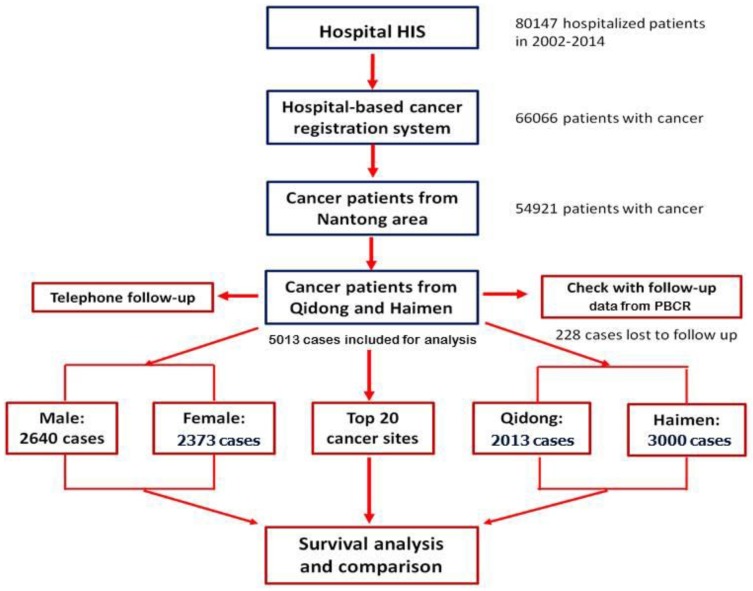
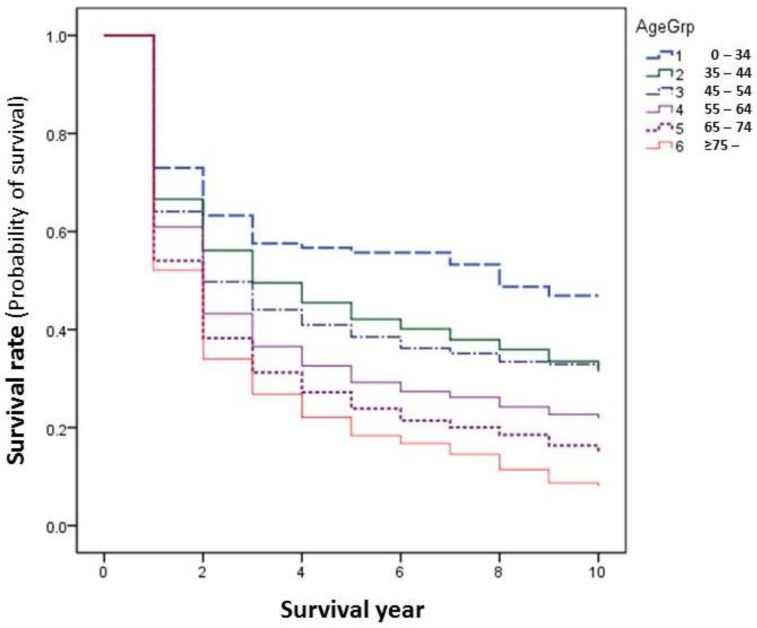
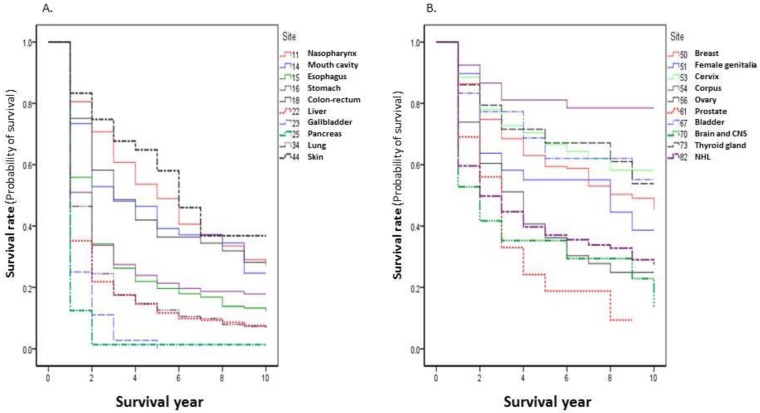
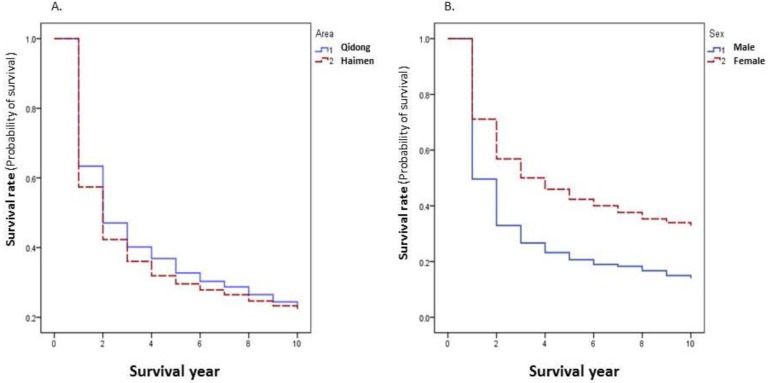
There are few reports on survival rate analysis from hospital-based cancer registries (HBCR) in China, although the National Center of Cancer Registry of China has launched such an effort with the mission to expand the scope of registration and follow-up. Our study aimed to evaluate survival and outcomes of cancer patients from a HBCR in eastern China. Active and passive follow-up methods were used to obtain information on survival status for all patients from Qidong City and Haimen City in the databases of our hospital-based registrations from 2002 to 2014. Censor time for survival was 31 March, 2016. Survival probability was estimated using the life-table method with SPSS Statistics software, and comparison of significant differences in survival rates was tested by Wilcoxon (Gehan) statistic. The outcomes of 5010 patients were identified in the follow-up for 5244 cases from Qidong and Haimen, with a follow-up rate of 95.65%, and a rate of lost to follow-up of 4.35%. The 1-, 3-, 5-, and 10-year observed survival (OS) rate in all-combined cancer sites were 59.80%, 37.70%, 30.82%, and 22.60%, respectively. The top 10 cancer sites in rank were cancers of lung, esophagus, liver, cervix, stomach, breast, colon-rectum, non-Hodgkin's lymphoma, nasopharynx, and ovary, with 5-year OS rates of 12.63%, 19.62%, 11.69%, 66.61%, 21.35%, 59.43%, 36.36%, 37.03%, 48.95% and 36.17%, respectively. Females experienced better survival than males for lung, esophageal, liver, nasopharyngeal and pancreatic cancers (<0.05), but not for other sites (>0.05). A significant difference was also found between males and females when all-sites were combined (<0.01). There are significant differences (<0.05) between the 2015 patients (from Qidong) and the 3001 patients (from Haimen) with 5-year OS rates of 32.72% vs 29.57%; no significant differences were found for 5-year OS rates for individual cancer sites (>0.05) except for liver (=0.0005) and ovary (=0.0460) between the two cities. Younger patients had better prognosis, but significance was only seen in cervical (=0.0102) and nasopharyngeal (=0.0305) cancers. The survival rates of each site or of all sites-combined in this setting are consistent with those elsewhere in China and abroad. Discrepancies in overall survival could be affected by the proportion of sites with or without better prognosis. Hospital-based cancer survival is a better index to evaluate outcomes that reflect the levels of comprehensive treatment and improvement of medical and health services.
尽管中国国家癌症登记中心已开展相关工作,旨在扩大登记和随访范围,但关于中国医院癌症登记处(HBCR)生存率分析的报道较少。我们的研究旨在评估中国东部一家医院癌症登记处癌症患者的生存情况和预后。采用主动和被动随访方法,从我院2002年至2014年基于医院登记的数据库中获取启东市和海门市所有患者的生存状态信息。生存审查时间为2016年3月31日。使用SPSS统计软件通过寿命表法估计生存概率,并通过Wilcoxon(Gehan)统计量检验生存率显著差异的比较。在对启东和海门5244例病例的随访中,确定了5010例患者的预后情况,随访率为95.65%,失访率为4.35%。所有癌症部位综合的1年、3年、5年和10年观察生存率(OS)分别为59.80%、37.70%、30.82%和22.60%。排名前十的癌症部位为肺癌、食管癌、肝癌、宫颈癌、胃癌、乳腺癌、结直肠癌、非霍奇金淋巴瘤、鼻咽癌和卵巢癌,5年OS率分别为12.63%、19.62%、11.69%、66.61%、21.35%、59.43%、36.36%、37.03%、48.95%和36.17%。在肺癌、食管癌、肝癌、鼻咽癌和胰腺癌中,女性的生存率高于男性(<0.05),但在其他部位则不然(>0.05)。当所有部位综合考虑时,男性和女性之间也存在显著差异(<0.01)。2015例(来自启东)和3001例(来自海门)患者的5年OS率分别为32.72%和29.57%,两者之间存在显著差异(<0.05);除肝脏(=0.0005)和卵巢(=0.0460)外,两个城市各癌症部位的5年OS率无显著差异(>0.05)。年轻患者的预后较好,但仅在宫颈癌(=0.0102)和鼻咽癌(=0.0305)中具有统计学意义。本研究中各部位或所有部位综合的生存率与中国其他地区及国外一致。总生存率的差异可能受预后较好或较差部位比例的影响。基于医院的癌症生存率是评估反映综合治疗水平和医疗卫生服务改善情况的预后的更好指标。