Goag Eun Kyong, Lee Jung Mo, Chung Kyung Soo, Kim Song Yee, Leem Ah Young, Song Joo Han, Jung Ji Ye, Park Moo Suk, Chang Yoon Soo, Kim Young Sam, Chang Joon, Kim Eun Young
Division of Pulmonology, Department of Internal Medicine, Severance Hospital, Yonsei University College of Medicine, Seoul, Republic of Korea.
Division of Pulmonology, Department of Internal Medicine, Gangnam Severance Hospital, Yonsei University College of Medicine, Seoul, Republic of Korea.
J Cancer. 2018 Mar 2;9(6):1113-1120. doi: 10.7150/jca.21650. eCollection 2018.
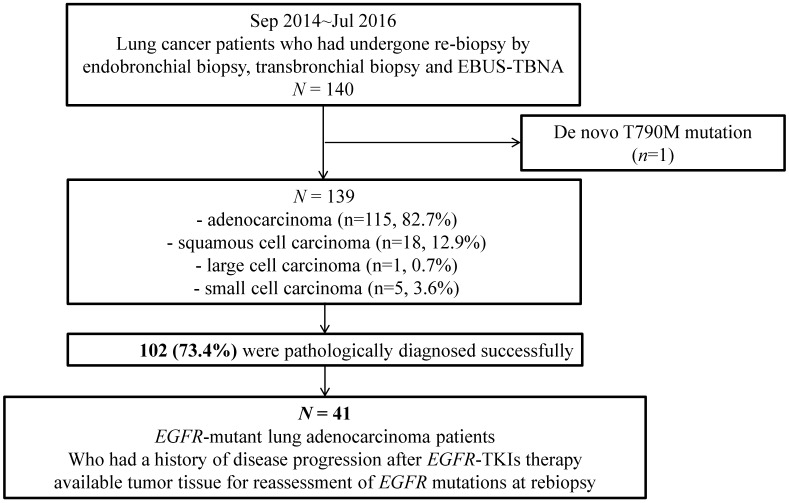
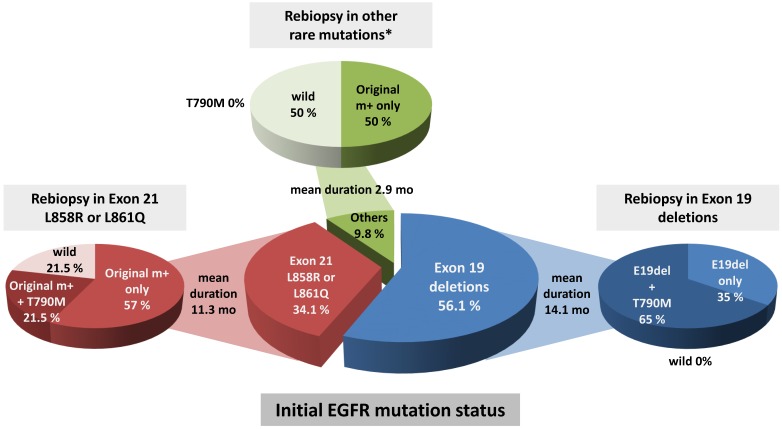
: Approximately 50% of non-small cell lung cancer (NSCLC) patients with acquired resistance to EGFR-TKI harbor the mutation T790M. The recent development and wide use of third-generation EGFR-TKIs targeting T790M-mutant NSCLCs have increased the importance of rebiopsy after EGFR-TKI failure. We aimed to investigate the advantages of flexible bronchoscopy as a rebiopsy method and the prevalence of and factors affecting the T790M mutation after EGFR-TKI failure. : We investigated 139 patients who had undergone bronchoscopic rebiopsy and endobronchial ultrasound-guided transbronchial needle aspiration (EBUS-TBNA) between Sep 2014 and Jul 2016. : Among the 139 patients, bronchoscopic rebiopsy yielded successful pathological diagnoses in 102 (73.4%). Among them, 41 patients with -mutant lung adenocarcinoma and EGFR-TKI progression were selected for an investigation of T790M mutation prevalence at rebiopsy. The initial mutations were exon 19 del (56.1%), L858R or L861Q (34.1%), and others (9.8%). The most common rebiopsy method was transbronchial lung biopsy (41.5%), followed by EBUS-TBNA (26.8%) and endobronchial biopsy (19.5%). The median interval to T790M emergence was the longest among cases with exon 19 deletion (14.1 months), followed by exon 21 L858R or L861Q (11.3 months) and other rare mutations (2.9 months). The T790M mutation was identified in 18 (43.9%) patients, and exon 19 del was the most significant factor affecting T790M mutation development (hazard ratio: 6.875, = 0.014). : Bronchoscopy was more useful than other rebiopsy approaches. The T790M emergence rate was highest in cases with exon 19 deletion, likely as a consequence of long-term EGFR-TKI exposure.
大约50%对表皮生长因子受体酪氨酸激酶抑制剂(EGFR-TKI)产生获得性耐药的非小细胞肺癌(NSCLC)患者存在T790M突变。针对T790M突变的非小细胞肺癌的第三代EGFR-TKIs的最新研发和广泛应用增加了EGFR-TKI治疗失败后再次活检的重要性。我们旨在研究柔性支气管镜作为再次活检方法的优势以及EGFR-TKI治疗失败后T790M突变的发生率和影响因素。:我们调查了2014年9月至2016年7月间接受支气管镜再次活检和支气管内超声引导下经支气管针吸活检(EBUS-TBNA)的139例患者。:在这139例患者中,支气管镜再次活检成功获得病理诊断的有102例(73.4%)。其中,41例发生EGFR-TKI进展的肺腺癌突变患者被选来调查再次活检时T790M突变的发生率。最初的突变类型为19外显子缺失(56.1%)、L858R或L861Q(34.1%)以及其他类型(9.8%)。最常用的再次活检方法是经支气管肺活检(41.5%),其次是EBUS-TBNA(26.8%)和支气管内活检(19.5%)。19外显子缺失病例中T790M出现的中位间隔时间最长(14.1个月),其次是21外显子L858R或L861Q(11.3个月)以及其他罕见突变(2.9个月)。18例(43.9%)患者检测到T790M突变,19外显子缺失是影响T790M突变发生的最显著因素(风险比:6.875,P = 0.014)。:支气管镜检查比其他再次活检方法更有用。19外显子缺失病例中T790M出现率最高,可能是长期EGFR-TKI暴露的结果。