Luera Micheal J, Dowling Brittany, Magrini Mitchel A, Muddle Tyler W D, Colquhoun Ryan J, Jenkins Nathaniel D M
Applied Neuromuscular Physiology Laboratory, Oklahoma State University, Stillwater, Oklahoma, USA.
Motus Global, IMG Academy Campus, Rockville Centre, New York, USA.
Orthop J Sports Med. 2018 Mar 20;6(3):2325967118760780. doi: 10.1177/2325967118760780. eCollection 2018 Mar.
Elbow injury rates among baseball pitchers are rapidly rising. However, this increase has been most dramatic among high school (HS) pitchers.
To examine pitch velocity and the kinetic and kinematic characteristics of HS versus professional (PRO) pitchers to identify potential differences that may play a role in the increased risk of ulnar collateral ligament injury in youth pitchers.
Controlled laboratory study.
A total of 37 HS (mean ± SD: age, 16 ± 1 years) and 40 PRO (age, 21 ± 2 years) baseball pitchers completed maximal-effort baseball pitches during a single testing session, from which pitch velocity (PV), absolute and normalized elbow varus torque (EVT and EVT, respectively) during arm cocking and at maximum shoulder external rotation (MER), and 8 other elbow and shoulder torques or forces and rotational kinematics of the pelvis and trunk were analyzed, recorded, and compared.
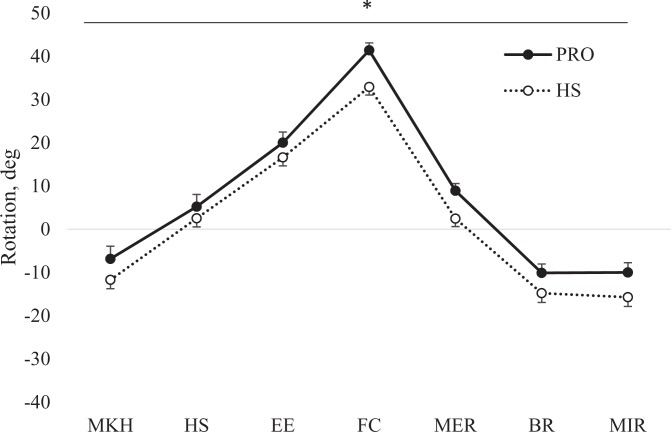
PV was greater in PRO than HS athletes; EVT was greater in PRO than HS athletes during arm cocking and at MER; but EVT was similar during arm cocking and greater in HS than PRO athletes at MER. In PRO athletes, PV was not related to EVT during arm cocking or MER ( = 0.01-0.05). Furthermore, in PRO athletes, EVT during arm cocking and at MER were inversely related to upper trunk rotation at hand separation and foot contact and to pelvis rotation at elbow extension ( = -0.30 to -0.33). In contrast, in HS athletes, PV was strongly related to EVT during arm cocking and MER ( = 0.76-0.77). Furthermore, in HS athletes, PV and EVT during arm cocking and at MER were moderately or strongly related to the other elbow and shoulder torques and forces ( = 0.424-0.991), and EVT was not related to upper trunk rotation or pelvis rotation throughout the throwing motion ( = -0.16 to 0.15).
The kinetic and rotational kinematic differences observed between PRO and HS pitchers in this study may help explain the greater performance of PRO pitchers while allowing them to minimize EVT during pitching. HS pitchers, however, do not appear to be as capable of utilizing the forces generated by rotation of their trunk and pelvis to aid in pitching, and those who throw the hardest generate the greatest forces at the shoulder and elbow. As a result, they experience higher EVTs relative to their body size, which may place them at an increased risk of injury.
HS pitchers throw harder primarily by generating larger forces in the arm and shoulder. Thus, owing to the relative physical immaturity of HS versus PRO pitchers, these factors may place them at an increased risk of injury. Coaches may first wish to focus on improving the rotational kinematics of HS pitchers rather than first focusing on achieving greater pitch velocities.
棒球投手中肘部损伤率正在迅速上升。然而,这种增长在高中(HS)投手中最为显著。
研究高中(HS)投手与职业(PRO)投手的投球速度以及动力学和运动学特征,以确定可能导致青少年投手尺侧副韧带损伤风险增加的潜在差异。
对照实验室研究。
共有37名高中(平均±标准差:年龄,16±1岁)和40名职业(年龄,21±2岁)棒球投手在一次测试中完成了全力投球,从中分析、记录并比较了投球速度(PV)、手臂后摆和最大肩部外旋(MER)时的绝对和标准化肘部内翻扭矩(分别为EVT和EVT),以及其他8个肘部和肩部扭矩或力以及骨盆和躯干的旋转运动学。
职业运动员的PV高于高中运动员;手臂后摆和MER时,职业运动员的EVT高于高中运动员;但手臂后摆时EVT相似,且MER时高中运动员的EVT大于职业运动员。在职业运动员中,手臂后摆或MER时PV与EVT无关(=0.01 - 0.05)。此外,在职业运动员中,手臂后摆和MER时的EVT与手部分离和足部接触时的上躯干旋转以及肘部伸展时骨盆旋转呈负相关(=-0.30至-0.33)。相比之下,在高中运动员中,手臂后摆和MER时PV与EVT密切相关(=0.76 - 0.77)。此外,在高中运动员中,手臂后摆和MER时的PV和EVT与其他肘部和肩部扭矩或力呈中度或高度相关(=0.424 - 0.991),并且在整个投球动作中EVT与上躯干旋转或骨盆旋转无关(=-0.16至0.15)。
本研究中观察到的职业和高中投手之间的动力学和旋转运动学差异可能有助于解释职业投手的更好表现,同时使他们在投球时将EVT降至最低。然而,高中投手似乎不太能够利用躯干和骨盆旋转产生的力量来辅助投球,而那些投球最用力的人在肩部和肘部产生的力量最大。因此,相对于他们的体型,他们经历更高的EVT,这可能使他们面临更高的受伤风险。
高中投手主要通过在手臂和肩部产生更大的力量来更用力地投球。因此,由于高中投手相对于职业投手在身体上相对不成熟,这些因素可能使他们面临更高的受伤风险。教练可能首先希望专注于改善高中投手的旋转运动学,而不是首先专注于实现更高的投球速度。