Research School of Population Health, College of Health and Medicine, The Australian National University, ACT, Canberra, Australia.
Department of Population Medicine, College of Medicine, Qatar University, Doha, Qatar.
Parasit Vectors. 2018 Mar 27;11(1):210. doi: 10.1186/s13071-018-2783-y.
Malaria causes significant morbidity and mortality worldwide. There are several preventive measures that are currently employed, including insecticide-treated nets (ITNs, including long-lasting insecticidal nets and insecticidal-treated bed nets), indoor residual spraying (IRS), prophylactic drugs (PD), and untreated nets (UN). However, it is unclear which measure is the most effective for malaria prevention. We therefore undertook a network meta-analysis to compare the efficacy of different preventive measures on incidence of malaria infection.
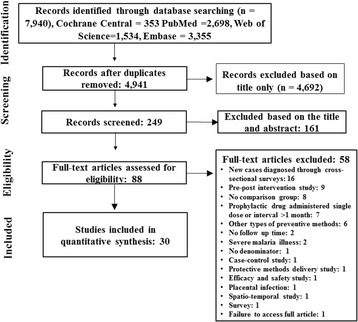
A systematic literature review was undertaken across four medical and life sciences databases (PubMed, Cochrane Central, Embase, and Web of Science) from their inception to July 2016 to compare the effectiveness of different preventive measures on malaria incidence. Data from the included studies were analysed for the effectiveness of several measures against no intervention (NI). This was carried out using an automated generalized pairwise modeling (GPM) framework for network meta-analysis to generate mixed treatment effects against a common comparator of no intervention (NI).
There were 30 studies that met the inclusion criteria from 1998-2016. The GPM framework led to a final ranking of effectiveness of measures in the following order from best to worst: PD, ITN, IRS and UN, in comparison with NI. However, only ITN (RR: 0.49, 95% CI: 0.32-0.74) showed precision while other methods [PD (RR: 0.24, 95% CI: 0.004-15.43), IRS (RR: 0.55, 95% CI: 0.20-1.56) and UN (RR: 0.73, 95% CI: 0.28-1.90)] demonstrating considerable uncertainty associated with their point estimates.
Current evidence is strong for the protective effect of ITN interventions in malaria prevention. Even though ITNs were found to be the only preventive measure with statistical support for their effectiveness, the role of other malaria control measures may be important adjuncts in the global drive to eliminate malaria.
疟疾在全球范围内导致了大量的发病率和死亡率。目前有几种预防措施,包括经杀虫剂处理的蚊帐(ITN,包括长效杀虫剂蚊帐和驱虫蚊帐)、室内滞留喷洒(IRS)、预防性药物(PD)和未处理的蚊帐(UN)。然而,目前尚不清楚哪种措施对预防疟疾最有效。因此,我们进行了一项网络荟萃分析,比较不同预防措施对疟疾感染发生率的效果。
从 1998 年至 2016 年,我们在四个医学和生命科学数据库(PubMed、Cochrane Central、Embase 和 Web of Science)中进行了系统的文献综述,以比较不同预防措施对疟疾发病率的有效性。对纳入研究的数据进行了分析,以确定几种措施对无干预(NI)的效果。这是通过使用自动广义成对建模(GPM)框架进行网络荟萃分析来实现的,该框架针对无干预(NI)的常见比较器生成混合治疗效果。
有 30 项研究符合 1998-2016 年的纳入标准。GPM 框架导致了措施有效性的最终排名,从最好到最差依次为:PD、ITN、IRS 和 UN,与 NI 相比。然而,只有 ITN(RR:0.49,95%CI:0.32-0.74)显示出精确性,而其他方法[PD(RR:0.24,95%CI:0.004-15.43)、IRS(RR:0.55,95%CI:0.20-1.56)和 UN(RR:0.73,95%CI:0.28-1.90)]显示出其点估计值存在相当大的不确定性。
目前有强有力的证据表明 ITN 干预措施对预防疟疾具有保护作用。尽管 ITN 被发现是唯一具有统计学支持其有效性的预防措施,但其他疟疾控制措施的作用可能是全球消除疟疾努力中的重要辅助手段。