Discovery, R&D Microbial Platform, Chr. Hansen A/S, 2970 Hørsholm, Denmark.
Discovery, R&D Microbial Platform, Chr. Hansen A/S, 2970 Hørsholm, Denmark
Biochem Soc Trans. 2018 Apr 17;46(2):249-260. doi: 10.1042/BST20170268. Epub 2018 Mar 27.
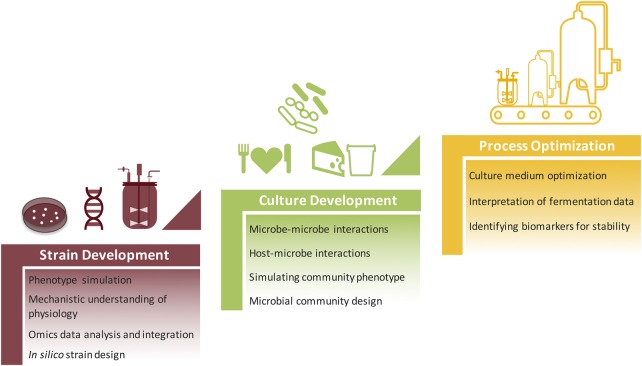
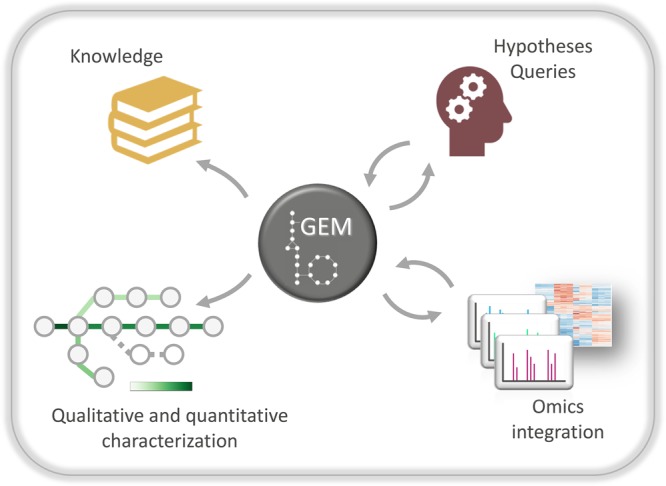
Genome-scale metabolic network reconstruction offers a means to leverage the value of the exponentially growing genomics data and integrate it with other biological knowledge in a structured format. Constraint-based modeling (CBM) enables both the qualitative and quantitative analyses of the reconstructed networks. The rapid advancements in these areas can benefit both the industrial production of microbial food cultures and their application in food processing. CBM provides several avenues for improving our mechanistic understanding of physiology and genotype-phenotype relationships. This is essential for the rational improvement of industrial strains, which can further be facilitated through various model-guided strain design approaches. CBM of microbial communities offers a valuable tool for the rational design of defined food cultures, where it can catalyze hypothesis generation and provide unintuitive rationales for the development of enhanced community phenotypes and, consequently, novel or improved food products. In the industrial-scale production of microorganisms for food cultures, CBM may enable a knowledge-driven bioprocess optimization by rationally identifying strategies for growth and stability improvement. Through these applications, we believe that CBM can become a powerful tool for guiding the areas of strain development, culture development and process optimization in the production of food cultures. Nevertheless, in order to make the correct choice of the modeling framework for a particular application and to interpret model predictions in a biologically meaningful manner, one should be aware of the current limitations of CBM.
基因组规模代谢网络重建为利用不断增长的基因组学数据的价值提供了一种手段,并将其与其他生物学知识以结构化的形式整合在一起。基于约束的建模(CBM)能够对重建网络进行定性和定量分析。这些领域的快速发展可以使微生物食品培养物的工业生产及其在食品加工中的应用都受益。CBM 为我们对生理学和基因型-表型关系的机械理解提供了多种途径。这对于理性地改进工业菌株是必不可少的,而通过各种基于模型的菌株设计方法可以进一步促进这一点。微生物群落的 CBM 为理性设计特定的食品培养物提供了有价值的工具,它可以促进假设的产生,并为增强群落表型的发展提供非直观的合理化依据,从而开发出新颖或改进的食品产品。在微生物用于食品培养物的工业规模生产中,CBM 可以通过合理确定生长和稳定性改进的策略,实现基于知识的生物过程优化。通过这些应用,我们相信 CBM 可以成为指导食品培养物生产中菌株开发、培养物开发和过程优化领域的有力工具。然而,为了为特定应用选择正确的建模框架,并以有意义的生物学方式解释模型预测,应该了解 CBM 的当前局限性。