Department of Ecology and Evolutionary Biology, University of Michigan, Ann Arbor, MI, United States of America.
Annis Water Resources Institute, Grand Valley State University, Muskegon, MI, United States of America.
PLoS One. 2018 Mar 28;13(3):e0195112. doi: 10.1371/journal.pone.0195112. eCollection 2018.
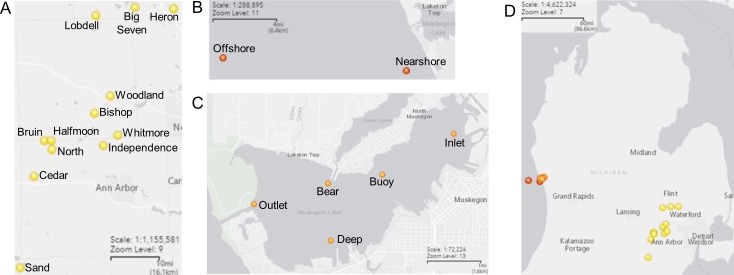
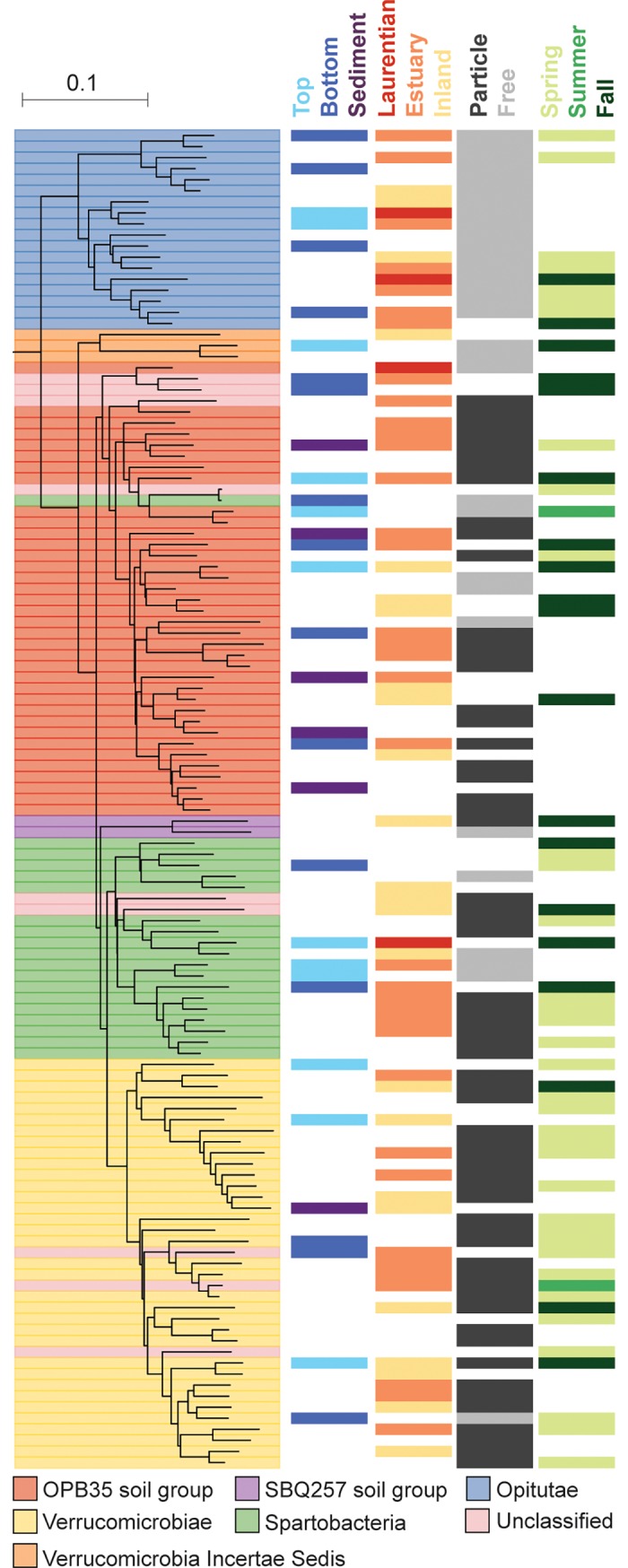
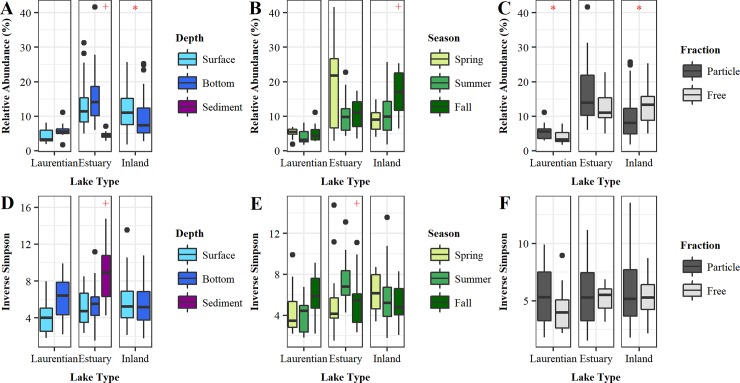
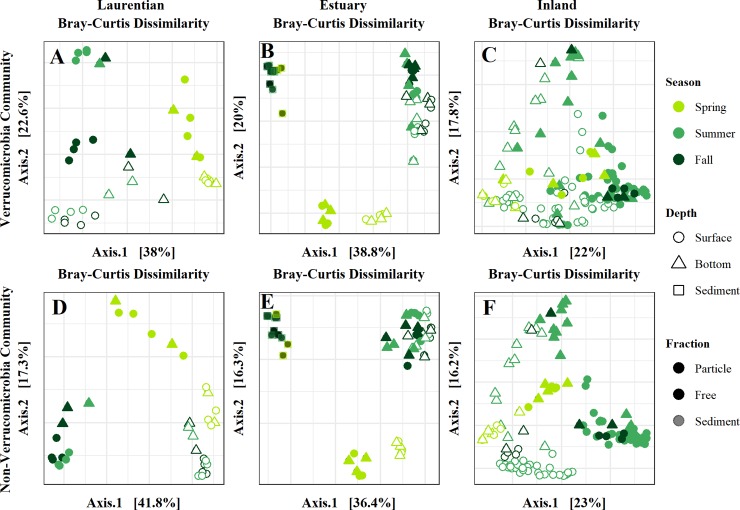
The bacterial phylum Verrucomicrobia was formally described two decades ago and originally believed to be a minor member of many ecosystems; however, it is now recognized as ubiquitous and abundant in both soil and aquatic systems. Nevertheless, knowledge of the drivers of its relative abundance and within-phylum habitat preferences remains sparse, especially in lake systems. Here, we documented the distribution of Verrucomicrobia in 12 inland lakes in Southeastern Michigan, a Laurentian Great Lake (Lake Michigan), and a freshwater estuary, which span a gradient in lake sizes, depths, residence times, and trophic states. A wide range of physical and geochemical parameters was covered by sampling seasonally from the surface and bottom of each lake, and by separating samples into particle-associated and free-living fractions. On average, Verrucomicrobia was the 4th most abundant phylum (range 1.7-41.7%). Fraction, season, station, and depth explained up to 70% of the variance in Verrucomicrobia community composition and preference for these habitats was phylogenetically conserved at the class-level. When relative abundance was linearly modeled against environmental data, Verrucomicrobia and non-Verrucomicrobia bacterial community composition correlated to similar quantitative environmental parameters, although there were lake system-dependent differences and > 55% of the variance remained unexplained. A majority of the phylum exhibited preference for the particle-associated fraction and two classes (Opitutae and Verrucomicrobiae) were identified to be more abundant during the spring season. This study highlights the high relative abundance of Verrucomicrobia in north temperate lake systems and expands insights into drivers of within-phylum habitat preferences of the Verrucomicrobia.
二十年前,人们正式描述了细菌门疣微菌门,最初认为它是许多生态系统中的一个次要成员;然而,现在人们认识到它在土壤和水生系统中无处不在且丰富。尽管如此,对于其相对丰度和属内栖息地偏好的驱动因素的了解仍然很少,特别是在湖泊系统中。在这里,我们记录了疣微菌门在密歇根州东南部的 12 个内陆湖泊、一个大湖(密歇根湖)和一个淡水河口的分布情况,这些湖泊的大小、深度、停留时间和营养状态都存在梯度。通过对每个湖泊的表面和底部进行季节性采样,并将样本分为颗粒相关和自由生活两部分,涵盖了广泛的物理和地球化学参数。疣微菌门平均是第四丰富的门(范围为 1.7-41.7%)。部分、季节、站位和深度解释了疣微菌门群落组成变化的 70%,并且在科级水平上,对这些栖息地的偏好具有系统发育保守性。当相对丰度与环境数据进行线性建模时,疣微菌门和非疣微菌门的细菌群落组成与类似的定量环境参数相关,尽管存在湖泊系统依赖的差异,并且 55%以上的方差仍未得到解释。该门的大多数都表现出对颗粒相关部分的偏好,并且有两个类(Opitutae 和 Verrucomicrobiae)在春季更丰富。这项研究强调了疣微菌门在北温带湖泊系统中的相对高丰度,并扩展了对疣微菌门属内栖息地偏好驱动因素的认识。