Research and Development Department, Sanofi Pasteur, Marcy L'Etoile, France
Research and Development Department, Sanofi Pasteur, Marcy L'Etoile, France.
J Virol. 2018 May 29;92(12). doi: 10.1128/JVI.00440-18. Print 2018 Jun 15.
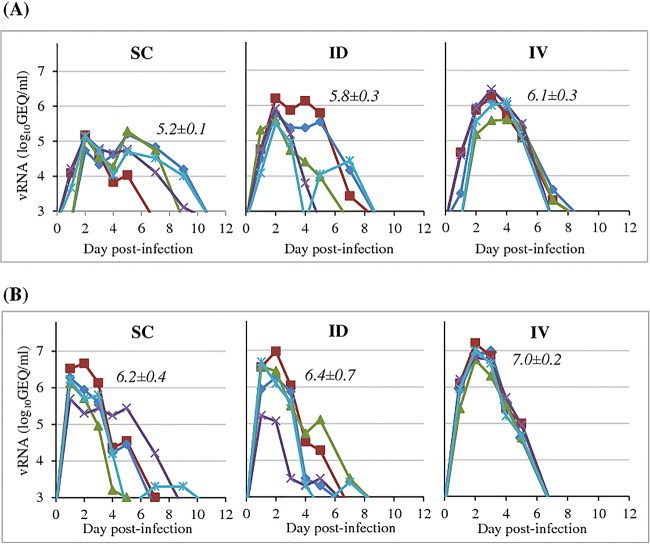
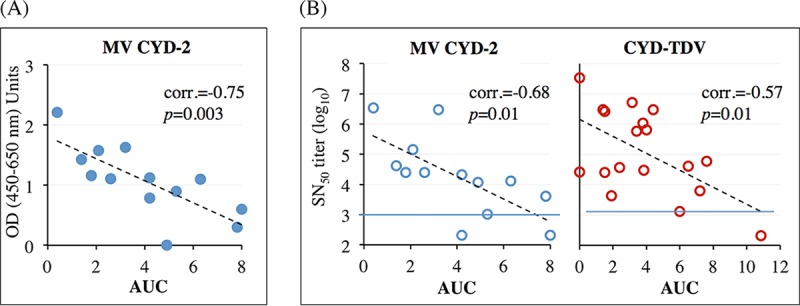
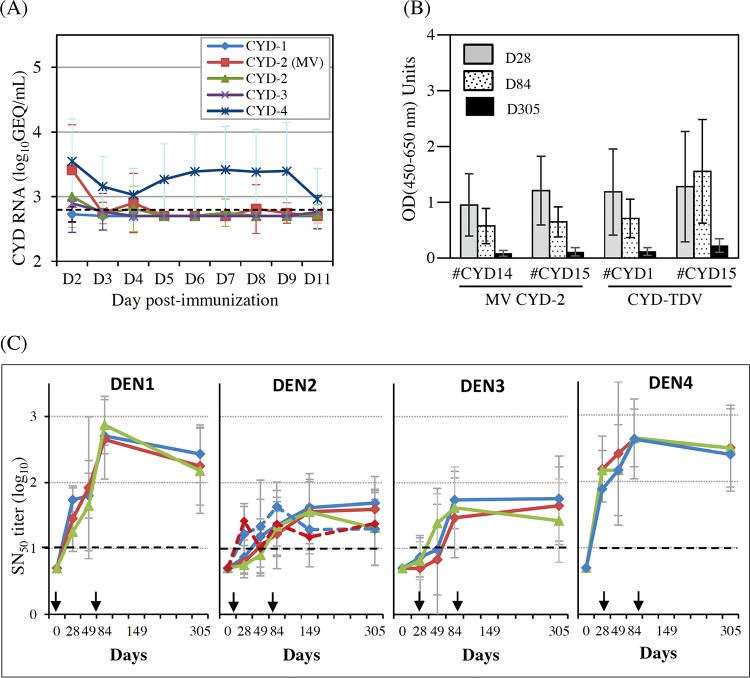
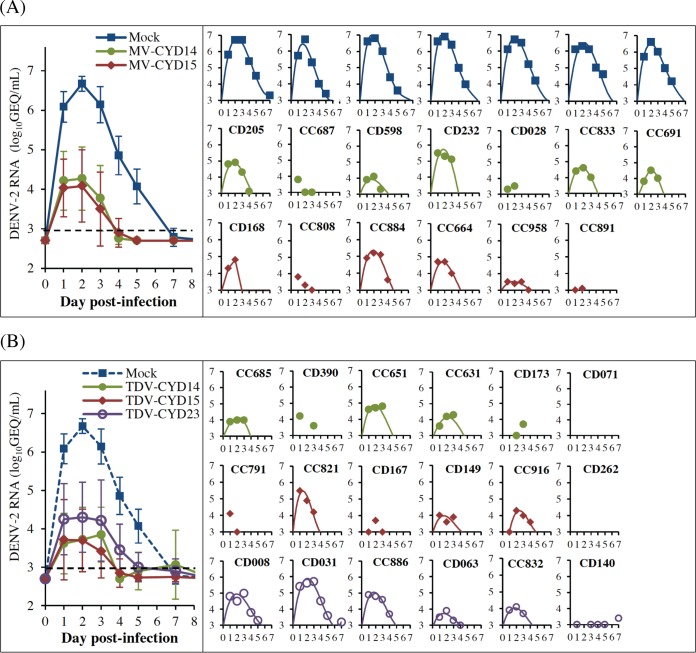
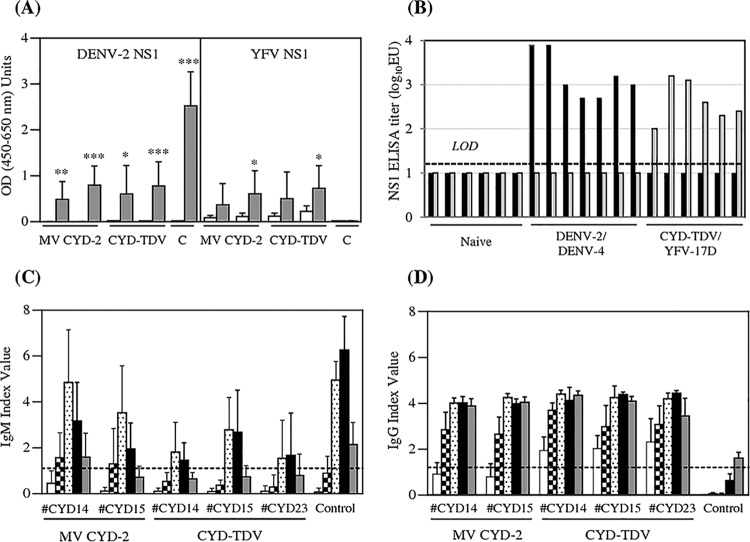
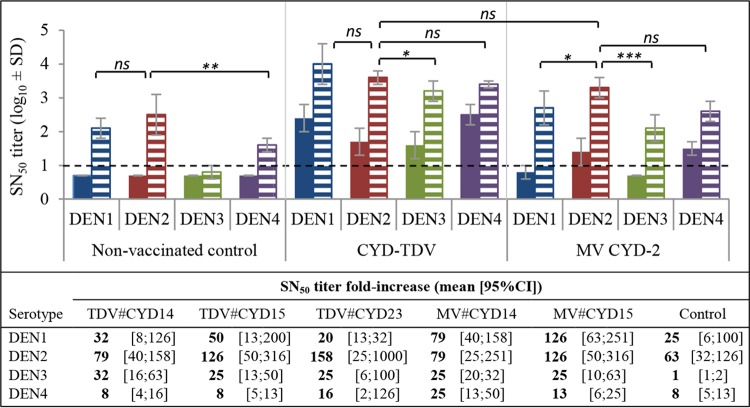
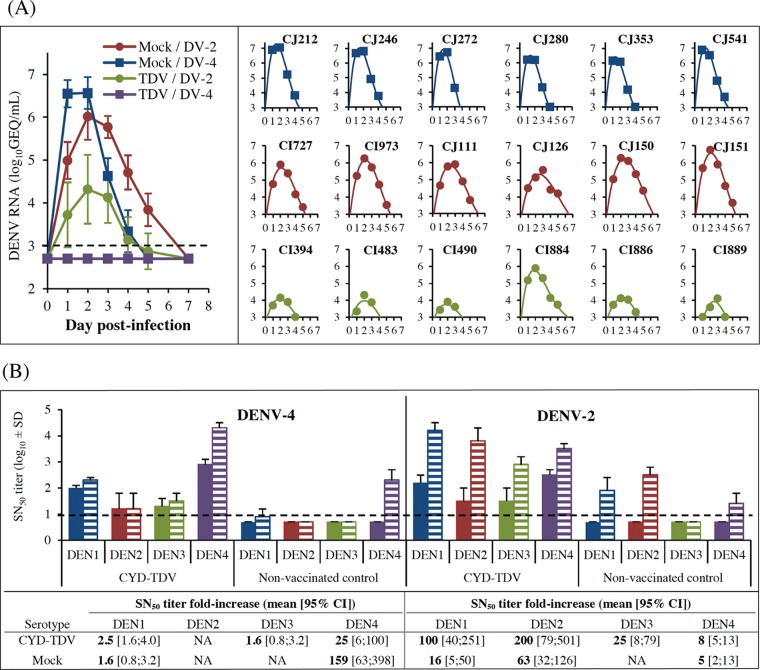
Recent data obtained with the live-attenuated tetravalent dengue CYD-TDV vaccine showed higher protective efficacy against dengue virus type 4 (DENV-4) than against DENV-2. In contrast, results from previous studies in nonhuman primates predicted comparable high levels of protection against each serotype. Maximum viral loads achieved in macaques by subcutaneous inoculation of DENV are generally much lower than those observed in naturally dengue virus-infected humans. This may contribute to an overestimation of vaccine efficacy. Using more-stringent DENV infection conditions consisting of the intravenous inoculation of 10 50% cell culture infectious doses (CCID) in CYD-TDV-vaccinated macaques, complete protection (i.e., undetectable viral RNA) was achieved in all 6 monkeys challenged with DENV-4 and in 6/18 of those challenged with DENV-2, including transiently positive animals. All other infected macaques (12/18) developed sustained DENV-2 RNAemia (defined as detection of viral RNA in serum samples) although 1 to 3 log units below the levels achieved in control animals. Similar results were obtained with macaques immunized with either CYD-TDV or monovalent (MV) CYD-2. This suggests that partial protection against DENV-2 was mediated mainly by CYD-2 and not by the other CYDs. Postchallenge induction of strong anamnestic responses, suggesting efficient vaccine priming, likely contributed to the reduction of DENV-2 RNAemia. Finally, an inverse correlation between DENV RNA titers postchallenge and vaccine-induced homotypic neutralizing antibody titers prechallenge was found, emphasizing the key role of these antibodies in controlling DENV infection. Collectively, these data show better agreement with reported data on CYD-TDV clinical vaccine efficacy against DENV-2 and DENV-4. Despite inherent limitations of the nonhuman primate model, these results reinforce its value in assessing the efficacy of dengue vaccines. The nonhuman primate (NHP) model is the most widely recognized tool for assessing the protective activity of dengue vaccine candidates, based on the prevention of postinfection DENV viremia. However, its use has been questioned after the recent CYD vaccine phase III trials, in which moderate protective efficacy against DENV-2 was reported, despite full protection against DENV-2 viremia previously being demonstrated in CYD-vaccinated monkeys. Using a reverse translational approach, we show here that the NHP model can be improved to achieve DENV-2 protection levels that show better agreement with clinical efficacy. With this new model, we demonstrate that the injection of the CYD-2 component of the vaccine, in either a monovalent or a tetravalent formulation, is able to reduce DENV-2 viremia in all immunized animals, and we provide clear statistical evidence that DENV-2-neutralizing antibodies are able to reduce viremia in a dose-dependent manner.
最近使用减毒活四价登革热 CYD-TDV 疫苗获得的数据显示,该疫苗预防登革病毒 4 型(DENV-4)的保护效力高于预防登革病毒 2 型(DENV-2)。相比之下,之前在非人类灵长类动物中的研究结果预测,该疫苗对每种血清型的保护水平相当高。通过皮下接种 DENV,猕猴体内达到的最大病毒载量通常远低于自然感染登革病毒的人类中观察到的水平。这可能导致对疫苗效力的高估。使用更严格的 DENV 感染条件,即静脉内接种 1050%细胞培养感染剂量(CCID)的 CYD-TDV 疫苗,在接受 DENV-4 挑战的所有 6 只猕猴中均实现了完全保护(即无法检测到病毒 RNA),在接受 DENV-2 挑战的 6/18 只猕猴中也实现了完全保护,其中包括一过性阳性动物。所有其他感染的猕猴(12/18)均出现持续的 DENV-2 RNAemia(定义为在血清样本中检测到病毒 RNA),尽管其水平比对照动物低 1 到 3 个对数单位。用 CYD-TDV 或单价(MV)CYD-2 免疫的猕猴也获得了类似的结果。这表明,对 DENV-2 的部分保护主要由 CYD-2 介导,而不是由其他 CYD 介导。接种后诱导强烈的回忆应答,表明疫苗接种诱导了有效的疫苗 priming,可能有助于降低 DENV-2 RNAemia。最后,发现接种后 DENV RNA 滴度与接种前诱导的同源中和抗体滴度之间存在反比关系,强调了这些抗体在控制 DENV 感染中的关键作用。总的来说,这些数据与 CYD-TDV 临床疫苗对 DENV-2 和 DENV-4 的保护效力的报告数据更一致。尽管非人类灵长类动物模型存在固有局限性,但这些结果强调了该模型在评估登革热疫苗效力方面的价值。非人类灵长类动物(NHP)模型是评估登革热候选疫苗保护活性的最广泛认可的工具,其依据是预防感染后 DENV 病毒血症。然而,在最近的 CYD 疫苗 III 期临床试验报告了对 DENV-2 的中等保护效力后,该模型的使用受到了质疑,尽管之前在接种 CYD 的猕猴中已证明对 DENV-2 病毒血症有完全保护。通过采用反向转化方法,我们在此显示,该 NHP 模型可以得到改进,以实现与临床疗效更一致的 DENV-2 保护水平。使用这种新模型,我们证明了疫苗的 CYD-2 成分(无论是单价还是四价形式)的注射均能够降低所有免疫动物中的 DENV-2 病毒血症,并且我们提供了明确的统计证据,表明 DENV-2 中和抗体能够以剂量依赖的方式降低病毒血症。