The Cancer Institute, Japanese Foundation for Cancer Research, Koto-ku, Tokyo, 135-8550, Japan.
PRESTO, JST, Kawaguchi, Saitama, 332-0012, Japan.
Nat Commun. 2018 Mar 28;9(1):1249. doi: 10.1038/s41467-018-03555-8.
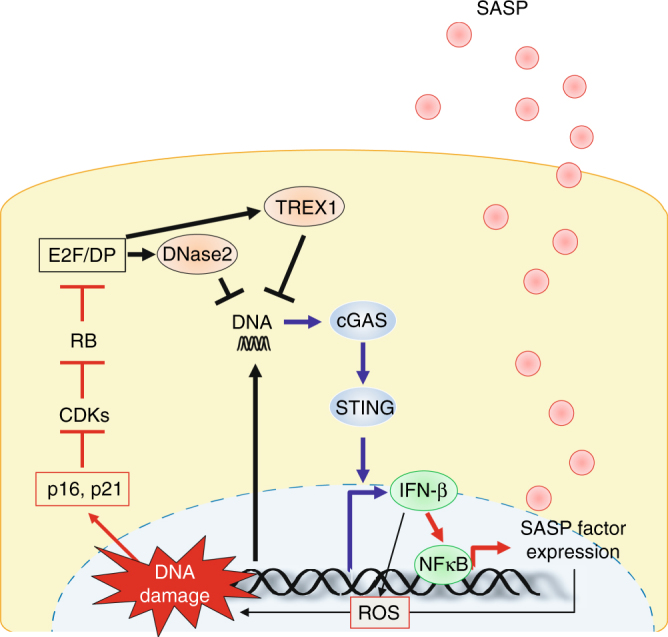
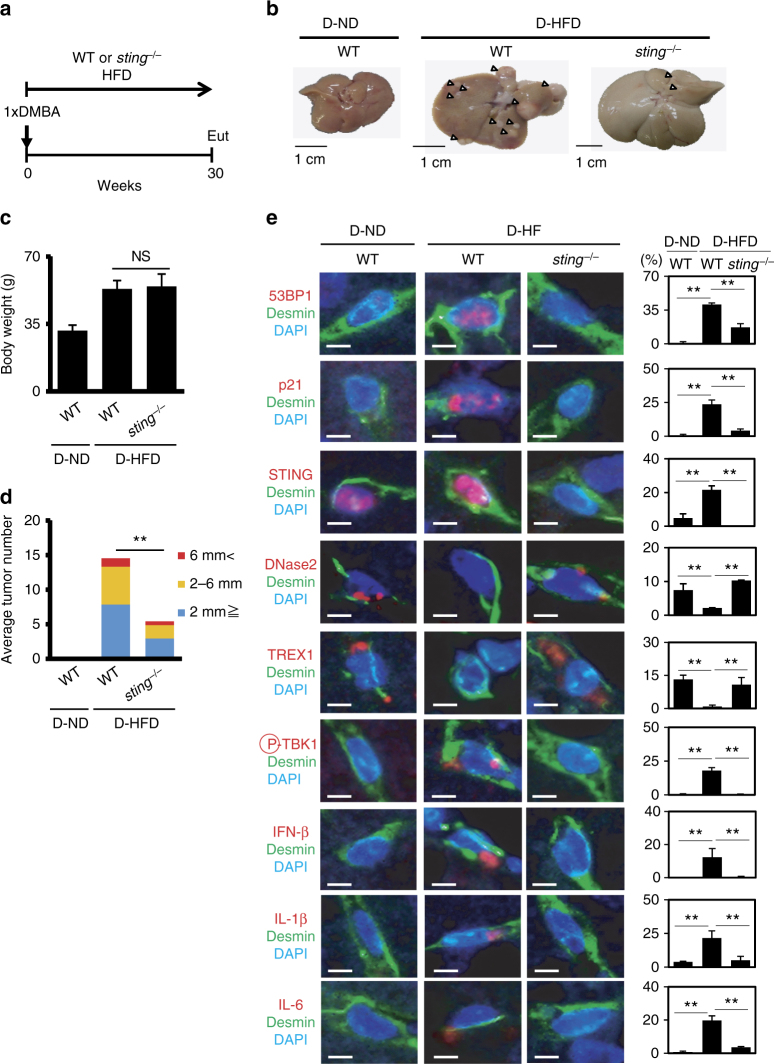
Accumulating evidence indicates that the senescence-associated secretory phenotype (SASP) contributes to many aspects of physiology and disease. Thus, controlling the SASP will have tremendous impacts on our health. However, our understanding of SASP regulation is far from complete. Here, we show that cytoplasmic accumulation of nuclear DNA plays key roles in the onset of SASP. Although both DNase2 and TREX1 rapidly remove the cytoplasmic DNA fragments emanating from the nucleus in pre-senescent cells, the expression of these DNases is downregulated in senescent cells, resulting in the cytoplasmic accumulation of nuclear DNA. This causes the aberrant activation of cGAS-STING cytoplasmic DNA sensors, provoking SASP through induction of interferon-β. Notably, the blockage of this pathway prevents SASP in senescent hepatic stellate cells, accompanied by a decline of obesity-associated hepatocellular carcinoma development in mice. These findings provide valuable new insights into the roles and mechanisms of SASP and possibilities for their control.
越来越多的证据表明,衰老相关分泌表型(SASP)有助于生理学和疾病的许多方面。因此,控制 SASP 将对我们的健康产生巨大影响。然而,我们对 SASP 调控的理解还远远不够。在这里,我们表明核 DNA 的细胞质积累在 SASP 的发生中起着关键作用。尽管 DNA 酶 2 和 TREX1 可以迅速清除前衰老细胞中从细胞核中释放出的细胞质 DNA 片段,但这些 DNA 酶在衰老细胞中的表达下调,导致核 DNA 的细胞质积累。这导致 cGAS-STING 细胞质 DNA 传感器的异常激活,通过诱导干扰素-β引发 SASP。值得注意的是,阻断这条通路可以防止衰老的肝星状细胞发生 SASP,同时伴随着肥胖相关的肝癌在小鼠中的发展下降。这些发现为 SASP 的作用和机制提供了有价值的新见解,并为其控制提供了可能性。