Wang Renjie, Ma Qingjie, Ji Linlin, Yao Yue, Ma Mengshi, Wen Qiang
Department of Nuclear Medicine, China-Japan Union Hospital of Jilin University, Changchun, People's Republic of China.
Onco Targets Ther. 2018 Mar 16;11:1501-1509. doi: 10.2147/OTT.S156810. eCollection 2018.
MicroRNAs (miRNAs) were reportedly to play crucial roles in papillary thyroid carcinoma (PTC) tumorigenesis and development. Therefore, the discovery of miRNAs may provide a new and powerful tool for diagnosis and treatment of PTC.
The aim of this study was to investigate the biological function and underlying mechanism of miR-622 in PTC.
The expression levels of miR-622 in PTC patient tissues and cell lines were determined by quantitative RT-PCR (qRT-PCR). The biological function including cell proliferation, colony formation, migration and invasion, as well as underling mechanism of miR-622 in PTC, were also evaluated by a series of in vitro and in vivo experiments.
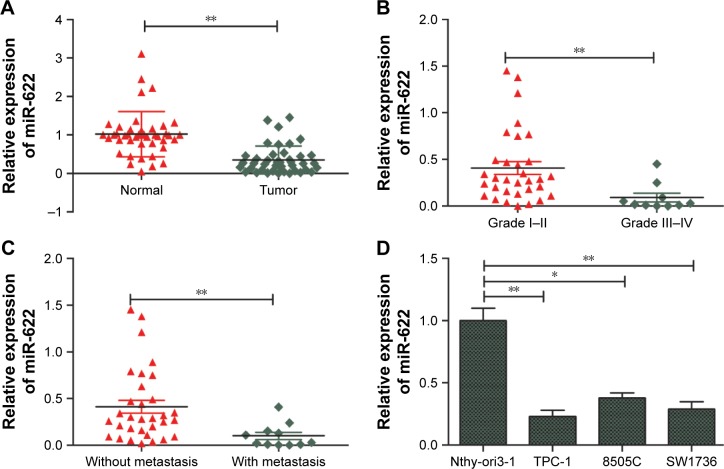
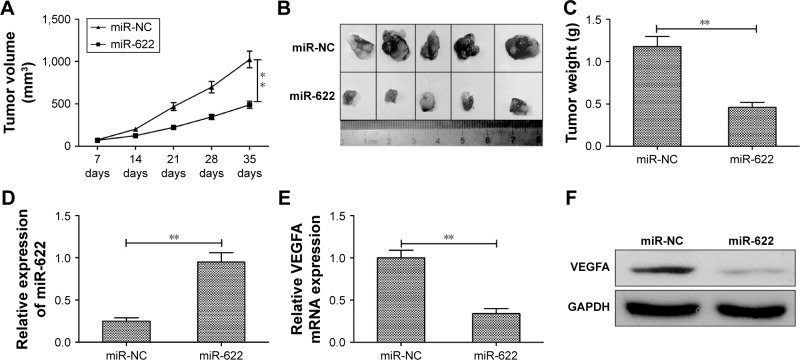
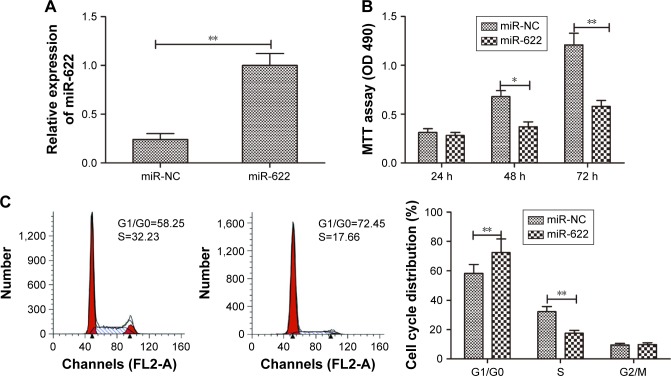
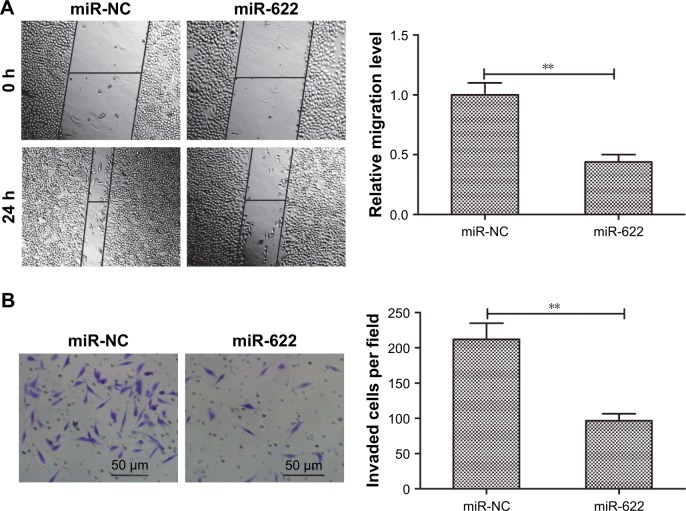
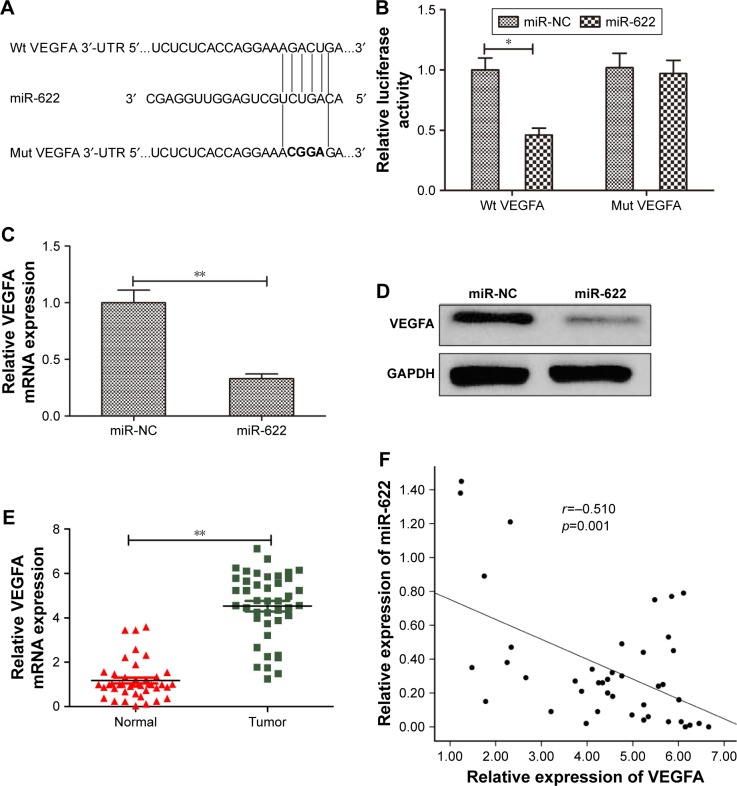
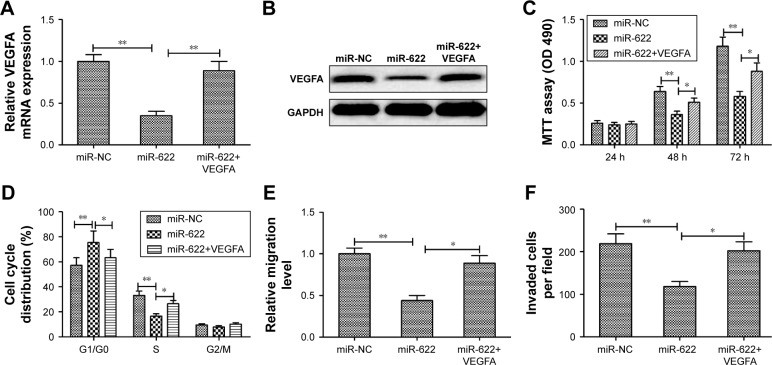
miR-622 expression level was significantly downregulated in PTC tissues and cell lines. Decreased miR-622 expression was associated with advanced clinical stage and lymph node metastasis (<0.01). The overexpression of miR-622 in TPC-1 cells inhibited cell proliferation, migration and invasion in vitro, as well as suppress tumor growth in vivo. Moreover, we also demonstrated that miR-622 specifically targeted the 3'-UTR regions of vascular endothelial growth factor A (VEGFA) and inhibited its expression both mRNA level and protein levels. Overexpression of VEGFA reversed miR-622-mediated inhibition effect on cell proliferation, migration and invasion in thyroid cancer cells. More importantly, VEGFA expression was significantly increased and inversely correlated with the levels of miR-622 in PTC tissues.
These results show that miR-622 acts as a tumor suppressor in thyroid cancer, at least in part, via targeting VEGFA, and suggest that miR-622 may serves as a potential target for treatment of thyroid cancer patients.
据报道,微小RNA(miRNA)在甲状腺乳头状癌(PTC)的肿瘤发生和发展中起关键作用。因此,miRNA的发现可能为PTC的诊断和治疗提供一种新的有力工具。
本研究旨在探讨miR-622在PTC中的生物学功能及其潜在机制。
采用定量逆转录聚合酶链反应(qRT-PCR)检测PTC患者组织和细胞系中miR-622的表达水平。通过一系列体外和体内实验评估miR-622在PTC中的生物学功能,包括细胞增殖、集落形成、迁移和侵袭以及潜在机制。
miR-622在PTC组织和细胞系中的表达水平显著下调。miR-622表达降低与临床晚期和淋巴结转移相关(<0.01)。miR-622在TPC-1细胞中的过表达抑制了体外细胞增殖、迁移和侵袭,并抑制了体内肿瘤生长。此外,我们还证明miR-622特异性靶向血管内皮生长因子A(VEGFA)的3'-UTR区域,并在mRNA水平和蛋白质水平上抑制其表达。VEGFA的过表达逆转了miR-622介导的对甲状腺癌细胞增殖、迁移和侵袭的抑制作用。更重要的是,VEGFA在PTC组织中的表达显著增加,且与miR-622水平呈负相关。
这些结果表明,miR-622至少部分通过靶向VEGFA在甲状腺癌中发挥肿瘤抑制作用,并提示miR-622可能作为甲状腺癌患者治疗的潜在靶点。