Markovic Marica
Institute of Medical Biochemistry, Clinical Centre of Serbia, Višegradska 26, 11 000 Belgrade, Serbia,
EJIFCC. 2007 Dec 21;18(4):121-125. eCollection 2007 Dec.
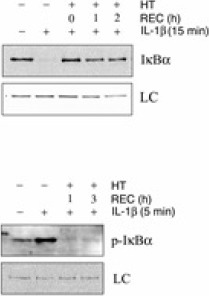
The aim of this study was to investigate the effect and mechanisms of short term hyperthermia on a series of proinflammatory genes in type-B-synoviocytes (fibroblast like synoviocytes - FLS). In vitro experiments demonstrate that exposure of FLS to elevated temperatures for the duration of 30 minutes prevents activation of a series of genes with proinflammatory properties. Exposure to hyperthermia reduces IL-1f3 induced PGE2 release, suppresses activation of the adhesion molecules VCAM-1, ICAM-1, the cytokines TNFa, IL-1a, IL-1p, IL-8 as well as COX-2 protein synthesis. Real time RT-PCR showed that hyperthermia altered gene expression at the transcriptional level. As to the mechanism of inhibition, EMSA experiments demonstrated that exposure of FLS to hyperthermia prevents IL-1f3 induced NF-κB translocation and subsequent DNA binding. Many mechanisms have been shown to be involved in hyperthermia mediated effects on NF-κB-DNA interactions. We demonstrated by Western blot experiments that in FLS, hyperthermia prevents the phosphorylation and subsequent degradation of IκBCC, therefore retaining the NF-κB complex in the cytoplasm. Such data might, at least in part, explain and provide a rationale for treating inflammation e.g. associated with rheumatoid arthritis by balneological means.
本研究旨在探讨短期热疗对B型滑膜细胞(成纤维样滑膜细胞 - FLS)中一系列促炎基因的影响及其机制。体外实验表明,将FLS暴露于高温30分钟可阻止一系列具有促炎特性的基因激活。热疗可降低IL-1β诱导的PGE2释放,抑制黏附分子VCAM-1、ICAM-1、细胞因子TNFα、IL-1α、IL-1β、IL-8的激活以及COX-2蛋白合成。实时RT-PCR显示热疗在转录水平上改变了基因表达。关于抑制机制,EMSA实验表明,将FLS暴露于热疗可阻止IL-1β诱导的NF-κB易位及随后的DNA结合。已证明多种机制参与热疗介导的对NF-κB-DNA相互作用的影响。我们通过蛋白质印迹实验证明,在FLS中,热疗可阻止IκBα的磷酸化及随后的降解,从而使NF-κB复合物保留在细胞质中。这些数据可能至少部分地解释了并为通过温泉疗法治疗例如与类风湿性关节炎相关的炎症提供了理论依据。