Ding Wenya, Sun Jin, Lian He, Xu Changgeng, Liu Xin, Zheng Sidi, Zhang Dong, Han Xiaopeng, Liu Yanyan, Chen Xueying, God Spower Bello O, Li Yanhua
Department of Veterinary Medicine, Northeast Agricultural University, Harbin, China.
Heilongjiang Key Laboratory for Animal Disease Control and Pharmaceutical Development, Harbin, China.
Front Pharmacol. 2018 Mar 13;9:227. doi: 10.3389/fphar.2018.00227. eCollection 2018.
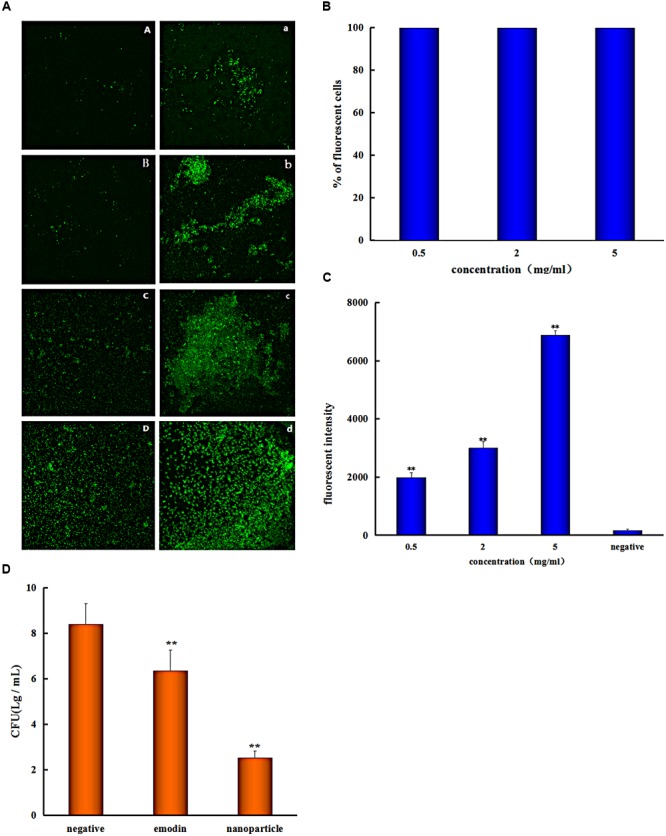
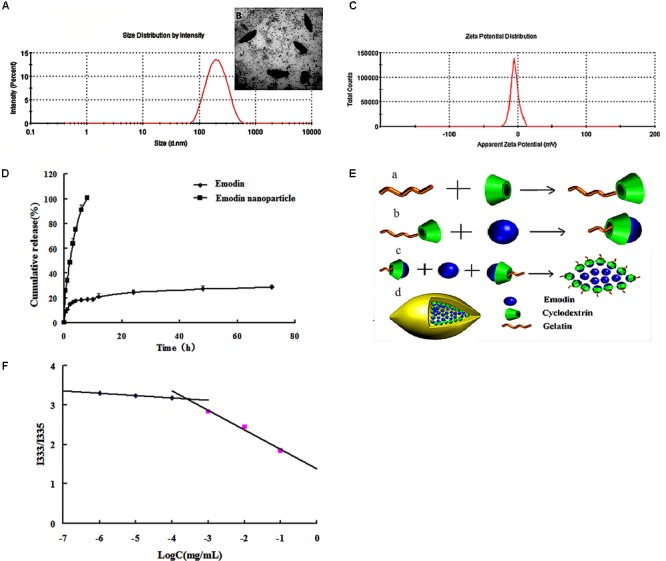
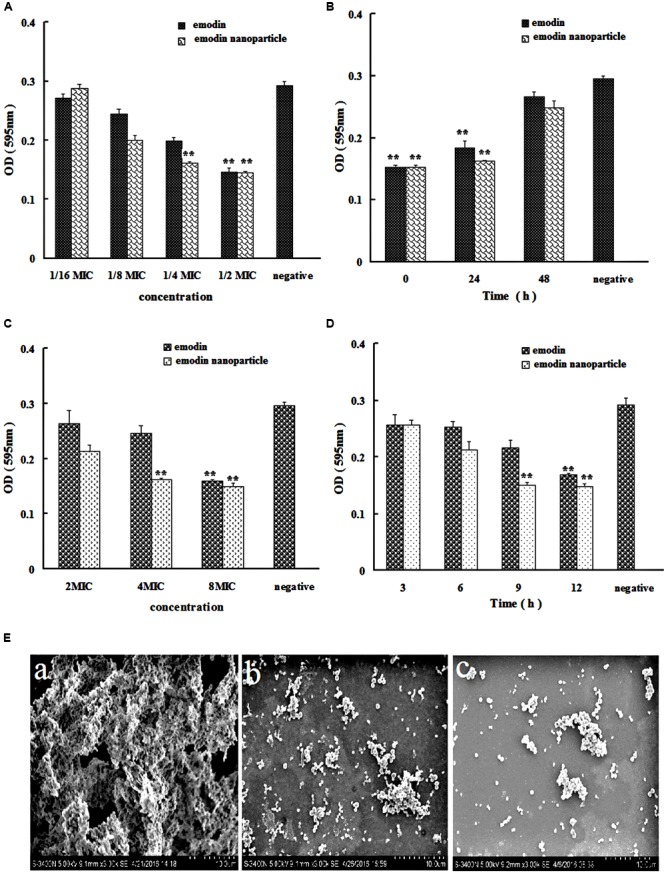
Biofilm is one of the most important physiological protective barriers of the (), and it is also one of the primary causes of hindrance to drug infiltration, reduction of bactericidal effects, and the development of antibiotic resistance. In order to intervene or eliminate biofilm, shuttle-shape emodin-loaded nanoparticles were developed in our study. The emodin nanoparticles were prepared by emodin and gelatin-cyclodextrin which was synthesized as drug carrier, and the nanoparticles were 174 nm in size, -4.64 mv in zeta potential, and exhibited a sustained emodin release. Moreover, the delivery kinetics of nanoparticles were also explored in our study. The confocal laser scanning microscopy and colony forming unit enumeration experiment indicated that nanoparticles could increase drug infiltration and uptake by biofilm. The flow cytometry system analysis showed that nanoparticles could be up taken by 99% of the bacteria cells. TCP assay and scanning electron microscopy showed that the nanoparticles had better effect on biofilm inhibition and elimination when compared with emodin solution. These results revealed that the emodin nanoparticles had a better therapeutic effect on the biofilm .
生物膜是()最重要的生理保护屏障之一,也是阻碍药物渗透、降低杀菌效果以及产生抗生素耐药性的主要原因之一。为了干预或消除生物膜,我们的研究中制备了负载梭形大黄素的纳米颗粒。大黄素纳米颗粒由大黄素和作为药物载体合成的明胶-环糊精制备而成,纳米颗粒尺寸为174 nm,zeta电位为-4.64 mv,并呈现大黄素的持续释放。此外,我们的研究还探索了纳米颗粒的递送动力学。共聚焦激光扫描显微镜和菌落形成单位计数实验表明,纳米颗粒可增加生物膜对药物的渗透和摄取。流式细胞术系统分析显示,纳米颗粒可被99%的细菌细胞摄取。TCP测定和扫描电子显微镜表明,与大黄素溶液相比,纳米颗粒对生物膜的抑制和消除效果更好。这些结果表明,大黄素纳米颗粒对生物膜具有更好的治疗效果。