Hulin Alexia, Hego Alexandre, Lancellotti Patrizio, Oury Cécile
GIGA Cardiovascular Sciences, Laboratory of Thrombosis and Hemostasis and Valvular Heart Disease, University of Liège, CHU Sart Tilman, Liège, Belgium.
GIGA Cardiovascular Sciences, Department of Cardiology, University of Liège Hospital, Heart Valve Clinic, CHU Sart Tilman, Liège, Belgium.
Front Cardiovasc Med. 2018 Mar 14;5:21. doi: 10.3389/fcvm.2018.00021. eCollection 2018.
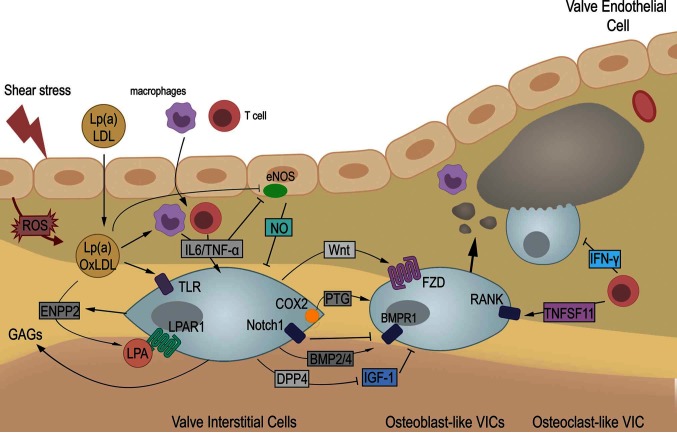
Calcific Aortic Valve Disease (CAVD) is the most common heart valve disease and its incidence is expected to rise with aging population. No medical treatment so far has shown slowing progression of CAVD progression. Surgery remains to this day the only way to treat it. Effective drug therapy can only be achieved through a better insight into the pathogenic mechanisms underlying CAVD. The cellular and molecular events leading to leaflets calcification are complex. Upon endothelium cell damage, oxidized LDLs trigger a proinflammatory response disrupting healthy cross-talk between valve endothelial and interstitial cells. Therefore, valve interstitial cells transform into osteoblasts and mineralize the leaflets. Studies have investigated signaling pathways driving and connecting lipid metabolism, inflammation and osteogenesis. This review draws a summary of the recent advances and discusses their exploitation as promising therapeutic targets to treat CAVD and reduce valve replacement.
钙化性主动脉瓣疾病(CAVD)是最常见的心脏瓣膜疾病,随着人口老龄化,其发病率预计将会上升。迄今为止,尚无药物治疗能够减缓CAVD的进展。直至今日,手术仍是治疗该病的唯一方法。只有通过更深入地了解CAVD潜在的致病机制,才能实现有效的药物治疗。导致瓣叶钙化的细胞和分子事件十分复杂。在内皮细胞受损后,氧化型低密度脂蛋白引发促炎反应,破坏瓣膜内皮细胞与间质细胞之间的健康交互。因此,瓣膜间质细胞转化为成骨细胞并使瓣叶矿化。已有研究对驱动并连接脂质代谢、炎症和成骨作用的信号通路进行了探究。本综述总结了近期的研究进展,并探讨了将其作为治疗CAVD及减少瓣膜置换的潜在治疗靶点加以利用的可能性。