Weber Andreas, Pfaff Melissa, Schöttler Friederike, Schmidt Vera, Lichtenberg Artur, Akhyari Payam
Department of Cardiac Surgery, Medical Faculty, University Hospital Düsseldorf, Heinrich-Heine-University Düsseldorf, 40225 Düsseldorf, Germany.
Biomedicines. 2021 Apr 26;9(5):474. doi: 10.3390/biomedicines9050474.
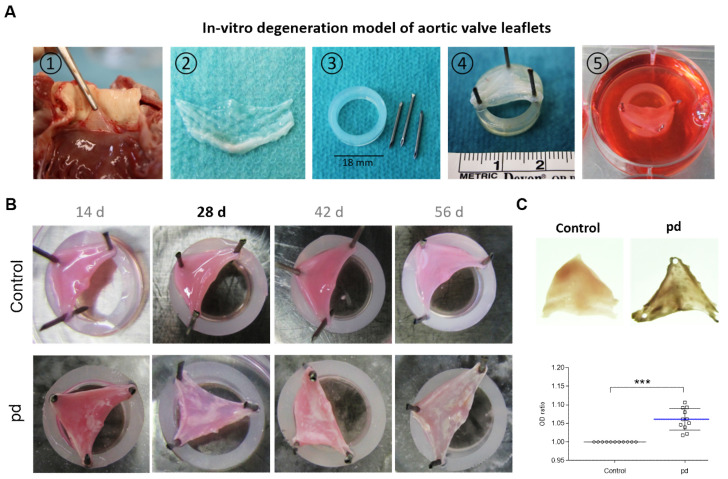
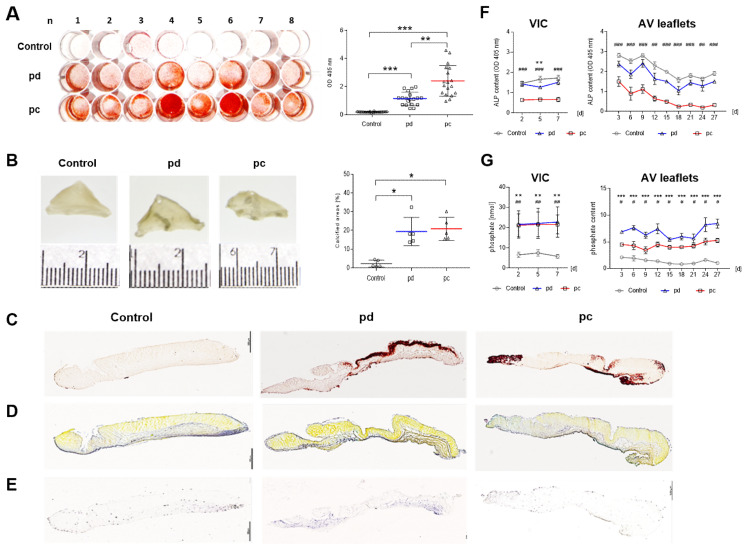
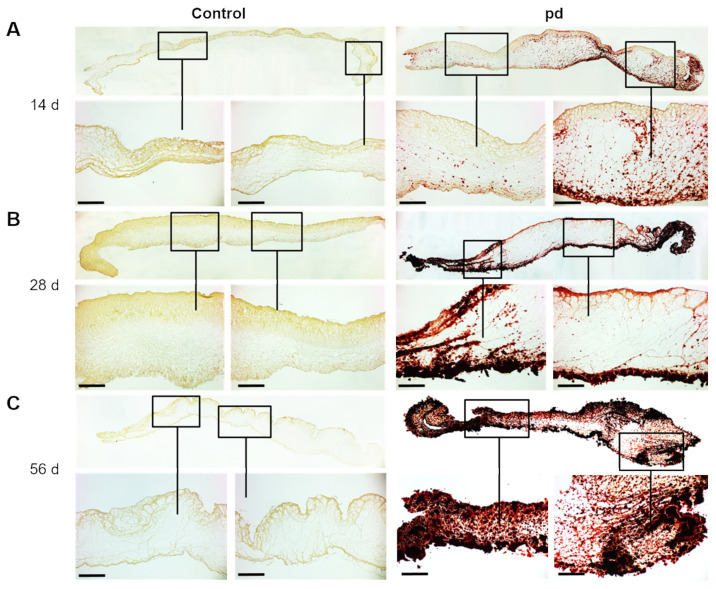
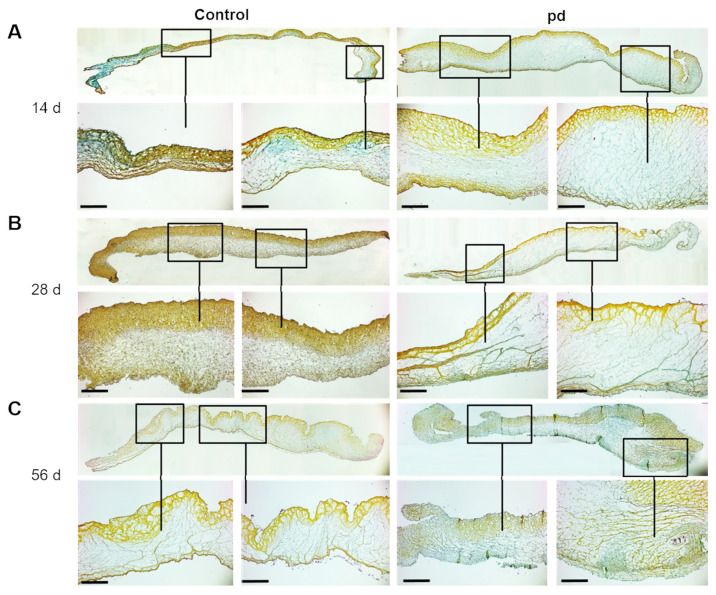
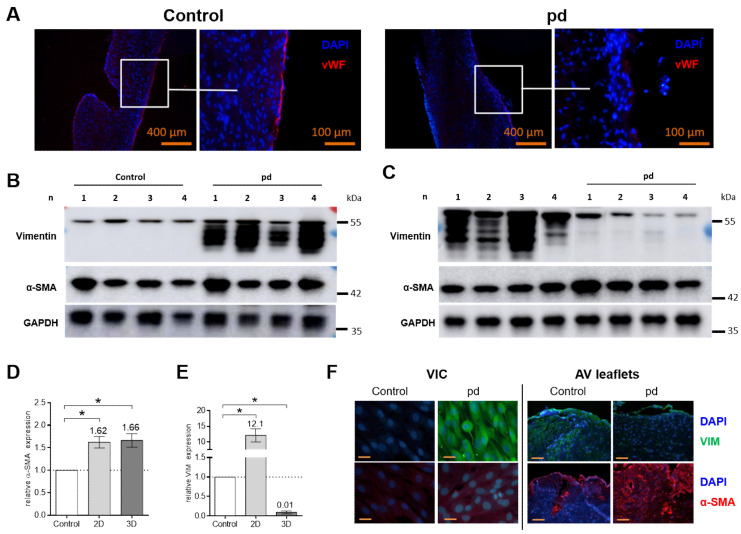
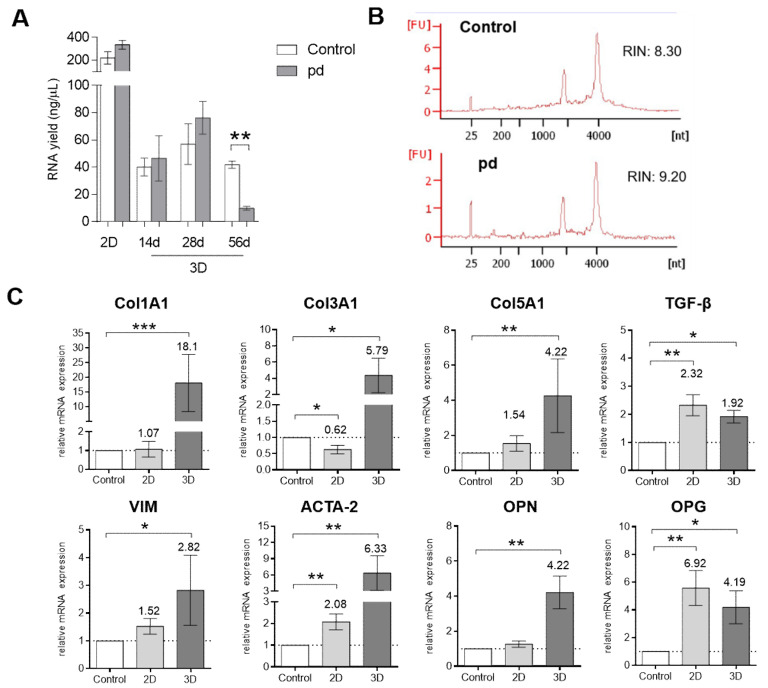
The hallmarks of calcific aortic valve disease (CAVD), an active and regulated process involving the creation of calcium nodules, lipoprotein accumulation, and chronic inflammation, are the significant changes that occur in the composition, organization, and mechanical properties of the extracellular matrix (ECM) of the aortic valve (AV). Most research regarding CAVD is based on experiments using two-dimensional (2D) cell culture or artificially created three-dimensional (3D) environments of valvular interstitial cells (VICs). Because the valvular ECM has a powerful influence in regulating pathological events, we developed an in vitro AV tissue culture model, which is more closely able to mimic natural conditions to study cellular responses underlying CAVD. AV leaflets, isolated from the hearts of 6-8-month-old sheep, were fixed with needles on silicon rubber rings to achieve passive tension and treated in vitro under pro-degenerative and pro-calcifying conditions. The degeneration of AV leaflets progressed over time, commencing with the first visible calcified domains after 14 d and winding up with the distinct formation of calcium nodules, heightened stiffness, and clear disruption of the ECM after 56 d. Both the expression of pro-degenerative genes and the myofibroblastic differentiation of VICs were altered in AV leaflets compared to that in VIC cultures. In this study, we have established an easily applicable, reproducible, and cost-effective in vitro AV tissue culture model to study pathological mechanisms underlying CAVD. The valvular ECM and realistic VIC-VEC interactions mimic natural conditions more closely than VIC cultures or 3D environments. The application of various culture conditions enables the examination of different pathological mechanisms underlying CAVD and could lead to a better understanding of the molecular mechanisms that lead to VIC degeneration and AS. Our model provides a valuable tool to study the complex pathobiology of CAVD and can be used to identify potential therapeutic targets for slowing disease progression.
钙化性主动脉瓣疾病(CAVD)是一个活跃且受调控的过程,涉及钙结节形成、脂蛋白积聚和慢性炎症,其特征是主动脉瓣(AV)细胞外基质(ECM)的组成、组织结构及力学性能发生显著变化。大多数关于CAVD的研究基于二维(2D)细胞培养实验或人工构建的瓣膜间质细胞(VIC)三维(3D)环境。由于瓣膜ECM在调节病理事件方面具有强大影响力,我们开发了一种体外AV组织培养模型,该模型更能紧密模拟自然条件,以研究CAVD潜在的细胞反应。从6 - 8月龄绵羊心脏分离的AV瓣叶,用针固定在硅橡胶环上以实现被动张力,并在促退变和促钙化条件下进行体外处理。AV瓣叶的退变随时间进展,14天后开始出现首个可见的钙化区域,56天后出现明显的钙结节形成、硬度增加以及ECM明显破坏。与VIC培养相比,AV瓣叶中促退变基因的表达和VIC的肌成纤维细胞分化均发生改变。在本研究中,我们建立了一种易于应用、可重复且经济高效的体外AV组织培养模型,以研究CAVD潜在的病理机制。瓣膜ECM以及实际的VIC - VEC相互作用比VIC培养或3D环境更能紧密模拟自然条件。应用各种培养条件能够研究CAVD潜在的不同病理机制,并可能有助于更好地理解导致VIC退变和AS的分子机制。我们的模型为研究CAVD复杂的病理生物学提供了有价值的工具,可用于识别减缓疾病进展的潜在治疗靶点。