Department of Biology, Brandon University, Brandon, MB R7A6A9, Canada.
Department of Anatomy and Cell Biology, Schulich School of Medicine and Dentistry, University of Western Ontario, London, ON N6A5C1, Canada.
Int J Mol Sci. 2018 Mar 29;19(4):1019. doi: 10.3390/ijms19041019.
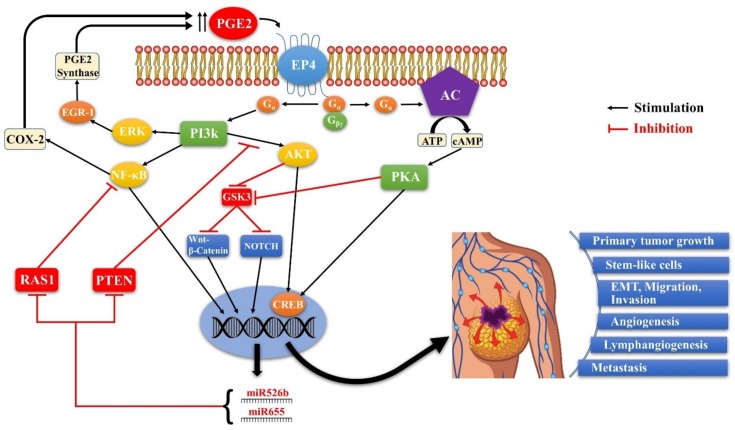
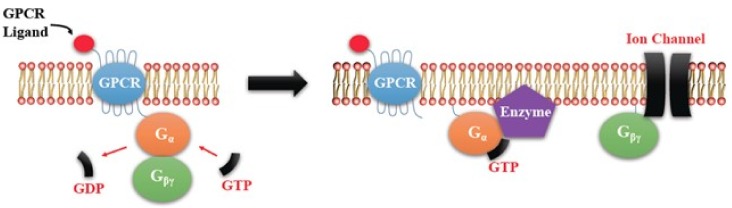
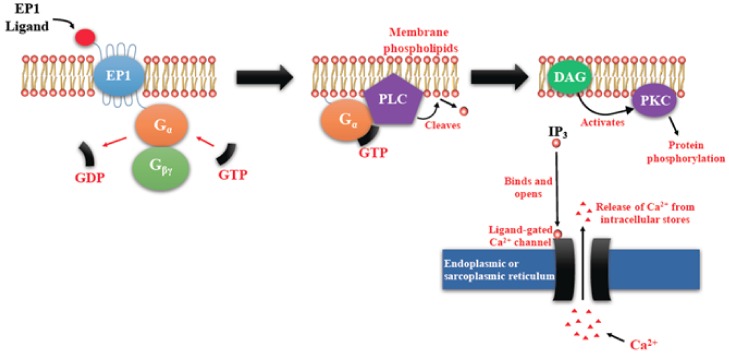
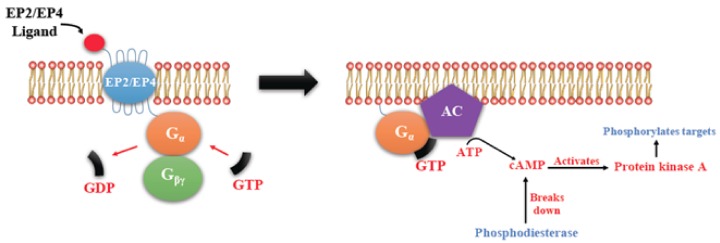
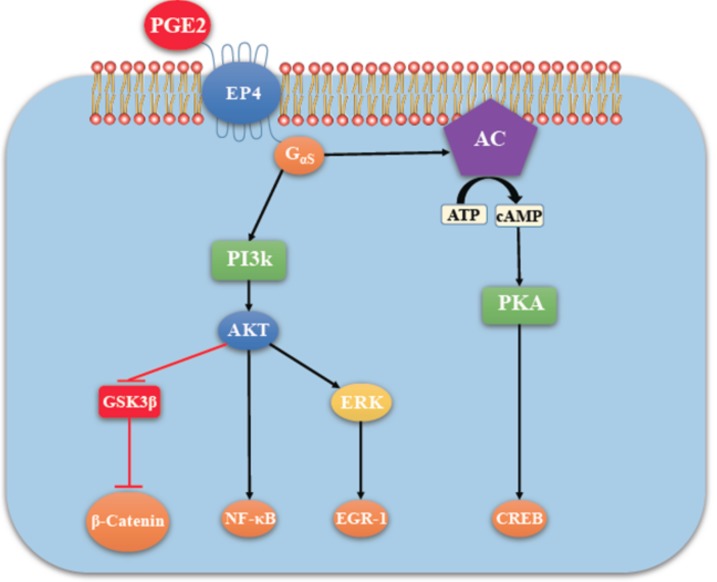
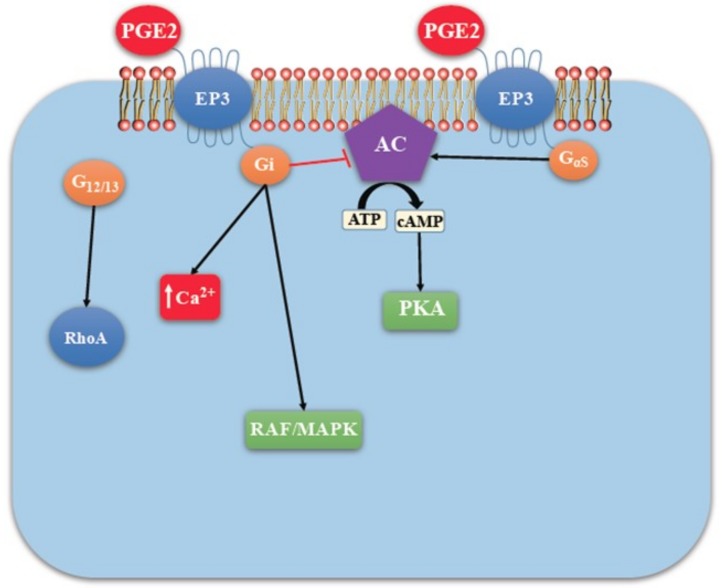
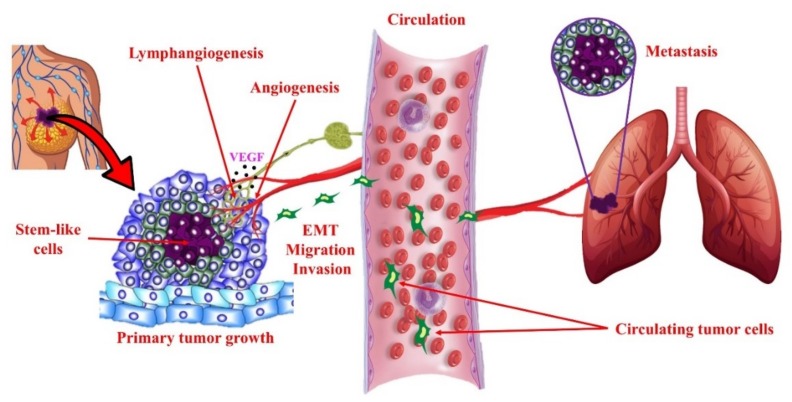
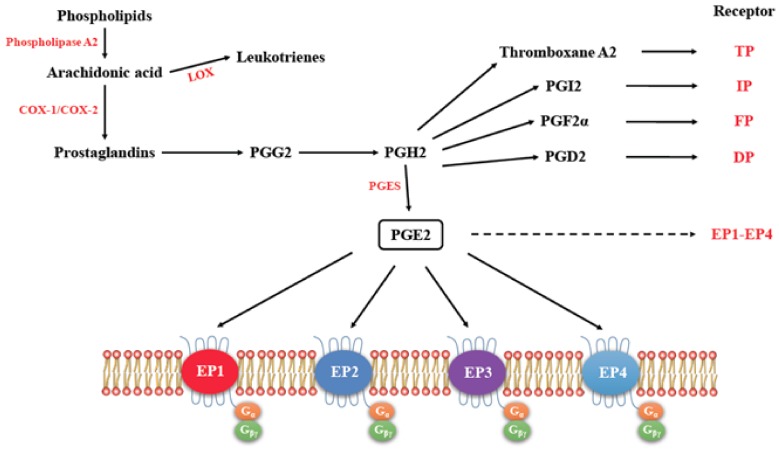
G-protein-coupled receptors (GPCRs, also called seven-transmembrane or heptahelical receptors) are a superfamily of cell surface receptor proteins that bind to many extracellular ligands and transmit signals to an intracellular guanine nucleotide-binding protein (G-protein). When a ligand binds, the receptor activates the attached G-protein by causing the exchange of Guanosine-5'-triphosphate (GTP) for guanosine diphosphate (GDP). They play a major role in many physiological functions, as well as in the pathology of many diseases, including cancer progression and metastasis. Only a few GPCR members have been exploited as targets for developing drugs with therapeutic benefit in cancer. Present review briefly summarizes the signaling pathways utilized by the EP (prostaglandin E receptor) family of GPCR, their physiological and pathological roles in carcinogenesis, with special emphasis on the roles of EP4 in breast cancer progression. We make a case for EP4 as a promising newer therapeutic target for treating breast cancer. We show that an aberrant over-expression of cyclooxygenase (COX)-2, which is an inflammation-associated enzyme, occurring in 40-50% of breast cancer patients leads to tumor progression and metastasis due to multiple cellular events resulting from an increased prostaglandin (PG) E2 production in the tumor milieu. They include inactivation of host anti-tumor immune cells, such as Natural Killer (NK) and T cells, increased immuno-suppressor function of tumor-associated macrophages, promotion of tumor cell migration, invasiveness and tumor-associated angiogenesis, due to upregulation of multiple angiogenic factors including Vascular Endothelial Growth Factor (VEGF)-A, increased lymphangiogenesis (due to upregulation of VEGF-C/D), and a stimulation of stem-like cell (SLC) phenotype in cancer cells. All of these events were primarily mediated by activation of the Prostaglandin (PG) E receptor EP4 on tumor or host cells. We show that selective EP4 antagonists (EP4A) could mitigate all of these events tested with cells in vitro as well as in vivo in syngeneic COX-2 expressing mammary cancer bearing mice or immune-deficient mice bearing COX-2 over-expressing human breast cancer xenografts. We suggest that EP4A can avoid thrombo-embolic side effects of long term use of COX-2 inhibitors by sparing cardio-protective roles of PGI2 via IP receptor activation or PGE2 via EP3 receptor activation. Furthermore, we identified two COX-2/EP4 induced oncogenic and SLC-stimulating microRNAs-miR526b and miR655, one of which (miR655) appears to be a potential blood biomarker in breast cancer patients for monitoring SLC-ablative therapies, such as with EP4A. We suggest that EP4A will likely produce the highest benefit in aggressive breast cancers, such as COX-2 expressing triple-negative breast cancers, when combined with other newer agents, such as inhibitors of programmed cell death (PD)-1 or PD-L1.
G 蛋白偶联受体(GPCRs,也称为七跨膜或七螺旋受体)是细胞表面受体蛋白的超家族,可与许多细胞外配体结合,并将信号传递至细胞内鸟嘌呤核苷酸结合蛋白(G 蛋白)。当配体结合时,受体通过引起鸟苷-5'-三磷酸(GTP)与鸟苷二磷酸(GDP)的交换而激活附着的 G 蛋白。它们在许多生理功能以及许多疾病的病理学中发挥着重要作用,包括癌症的进展和转移。只有少数 GPCR 成员被开发为用于开发具有治疗益处的癌症药物的靶点。本综述简要总结了 EP(前列腺素 E 受体)家族 GPCR 利用的信号通路,及其在致癌作用中的生理和病理作用,特别强调了 EP4 在乳腺癌进展中的作用。我们认为 EP4 是治疗乳腺癌的一个有前途的新的治疗靶点。我们表明,在 40-50%的乳腺癌患者中发生的 COX-2(炎症相关酶)的异常过度表达,由于肿瘤微环境中前列腺素(PG)E2 产生的增加而导致肿瘤进展和转移,导致多种细胞事件。其中包括宿主抗肿瘤免疫细胞的失活,如自然杀伤(NK)和 T 细胞,肿瘤相关巨噬细胞的免疫抑制功能增强,肿瘤细胞迁移、侵袭和肿瘤相关血管生成的促进,这是由于多种血管生成因子的上调,包括血管内皮生长因子(VEGF)-A,淋巴管生成增加(由于 VEGF-C/D 的上调),以及癌细胞中干细胞样(SLC)表型的刺激。所有这些事件主要是通过肿瘤或宿主细胞上的前列腺素(PG)E 受体 EP4 的激活介导的。我们表明,选择性 EP4 拮抗剂(EP4A)可以减轻在体外以及在表达 COX-2 的同源乳腺癌荷瘤小鼠或过表达 COX-2 的人乳腺癌异种移植免疫缺陷小鼠体内进行的所有这些测试中观察到的事件。我们认为,EP4A 通过激活 IP 受体来保留 PGI2 的心脏保护作用,或通过激活 EP3 受体来保留 PGE2 的作用,从而可以避免长期使用 COX-2 抑制剂引起的血栓栓塞副作用。此外,我们鉴定了两种 COX-2/EP4 诱导的致癌和 SLC 刺激 microRNAs-miR526b 和 miR655,其中一种(miR655)似乎是乳腺癌患者监测 SLC 消融治疗(如 EP4A)的潜在血液生物标志物。我们认为,当与其他新型药物(如程序性细胞死亡(PD)-1 或 PD-L1 的抑制剂)联合使用时,EP4A 在侵袭性乳腺癌(如表达 COX-2 的三阴性乳腺癌)中可能产生最高的益处。