Department of Third Neurology, Cangzhou Central Hospital, Cangzhou Clinical Medical School of Hebei Medical University, Cangzhou 061001, Hebei Province, China.
World J Gastroenterol. 2018 Mar 28;24(12):1343-1352. doi: 10.3748/wjg.v24.i12.1343.
To explore the correlation between serum vitamin B12 level and peripheral neuropathy in patients with chronic atrophic gastritis (CAG).
A total of 593 patients diagnosed with chronic gastritis by gastroscopy and pathological examination from September 2013 to September 2016 were selected for this study. The age of these patients ranged within 18- to 75-years-old. Blood pressure, height and weight were measured in each patient, and the body mass index value was calculated. Furthermore, gastric acid, serum gastrin, serum vitamin and serum creatinine tests were performed, and peripheral nerve conduction velocity and () were detected. In addition, the type of gastritis was determined by gastroscopy. The above factors were used as independent variables to analyze chronic gastritis with peripheral neuropathy and vitamin B12 deficiency risk factors, and to analyze the relationship between vitamin B12 levels and peripheral nerve conduction velocity. In addition, in the treatment of CAG on the basis of vitamin B12, patients with peripheral neuropathy were observed.
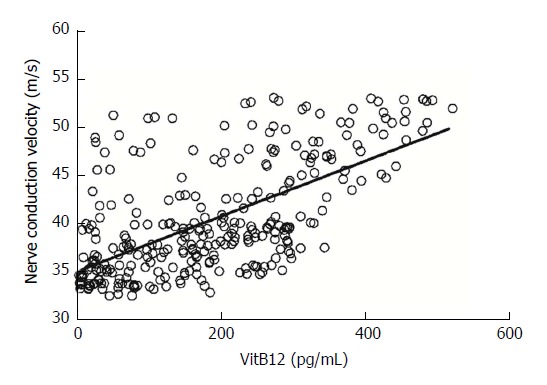
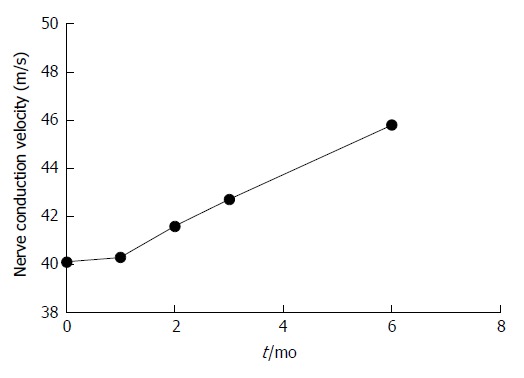
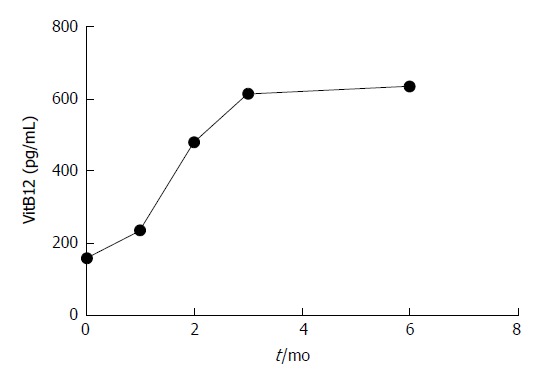
Age, infection, CAG, vitamin B9 and vitamin B12 were risk factors for the occurrence of peripheral nerve degeneration. Furthermore, CAG and infection were risk factors for chronic gastritis associated with vitamin B12 deficiency. Serum vitamin B12 level was positively correlated with sensory nerve conduction velocity in the tibial nerve ( = 0.463). After vitamin B12 supplementation, patients with peripheral neuropathy improved.
Serum vitamin B12 levels in patients with chronic gastritis significantly decreased, and the occurrence of peripheral neuropathy had a certain correlation. CAG and infection are risk factors for vitamin B12 deficiency and peripheral neuropathy. When treating CAG, vitamin B12 supplementation can significantly reduce peripheral nervous system lesions. Therefore, the occurrence of peripheral neuropathy associated with vitamin B12 deficiency may be considered in patients with CAG. Furthermore, the timely supplementation of vitamin B12 during the clinical treatment of CAG can reduce or prevent peripheral nervous system lesions.
探讨慢性萎缩性胃炎(CAG)患者血清维生素 B12 水平与周围神经病变的相关性。
选取 2013 年 9 月至 2016 年 9 月经胃镜和病理检查诊断为慢性胃炎的 593 例患者作为研究对象。患者年龄 18~75 岁,测量每位患者的血压、身高、体质量并计算体质量指数值,同时进行胃酸、血清胃泌素、血清维生素和血清肌酐检测,并检测周围神经传导速度和()。此外,通过胃镜确定胃炎类型。以上因素作为独立变量分析慢性萎缩性胃炎合并周围神经病及维生素 B12 缺乏的危险因素,分析维生素 B12 水平与周围神经传导速度的关系。另外,在 CAG 治疗的基础上补充维生素 B12,观察患者周围神经病的改善情况。
年龄、感染、CAG、维生素 B9 和维生素 B12 是周围神经退行性病变发生的危险因素。CAG 和感染是 CAG 合并维生素 B12 缺乏的危险因素。血清维生素 B12 水平与胫神经感觉神经传导速度呈正相关( = 0.463)。补充维生素 B12 后,患者周围神经病改善。
慢性萎缩性胃炎患者血清维生素 B12 水平明显降低,与周围神经病变的发生存在一定相关性。CAG 和感染是维生素 B12 缺乏和周围神经病的危险因素。在治疗 CAG 时补充维生素 B12 可明显减少周围神经系统病变。因此,考虑 CAG 患者可能存在与维生素 B12 缺乏相关的周围神经病。另外,在 CAG 的临床治疗中及时补充维生素 B12,可减少或预防周围神经系统病变。