Women's Global Health Imperative (WGHI) RTI International, San Francisco, CA, USA.
Department of Medicine, Center for AIDS prevention studies, UCSF, San Francisco, CA, USA.
J Int AIDS Soc. 2018 Mar;21(3):e25094. doi: 10.1002/jia2.25094.
Preventing HIV and unintended pregnancies are key global health priorities. To inform product rollout and to understand attributes of future multipurpose prevention technologies (MPT) associated with preference and use, we evaluated three placebo delivery forms: daily oral tablets, a monthly vaginal ring, and two monthly intramuscular injections in TRIO, a five-month study among young Kenyan and South African women.
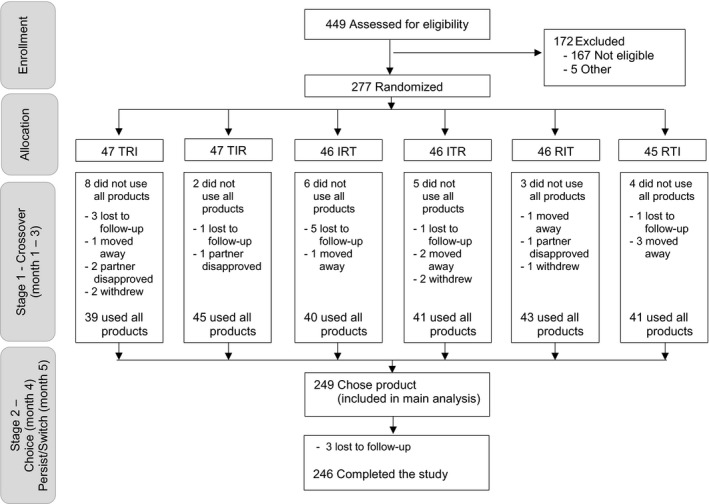
HIV-negative, sexually active, non-pregnant women aged 18 to 30 were enrolled and randomized to use each placebo delivery form for one month (stage 1). Then, participants chose one product to use for two additional months (stage 2). We assessed safety, product ranking, choice, and use. We examined demographic and behavioural correlates of choice and, reciprocally, unwillingness to use in the future with logistic regression models.
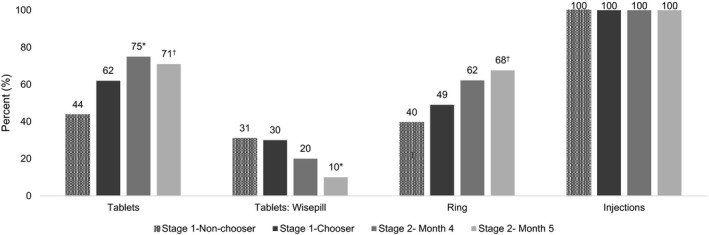
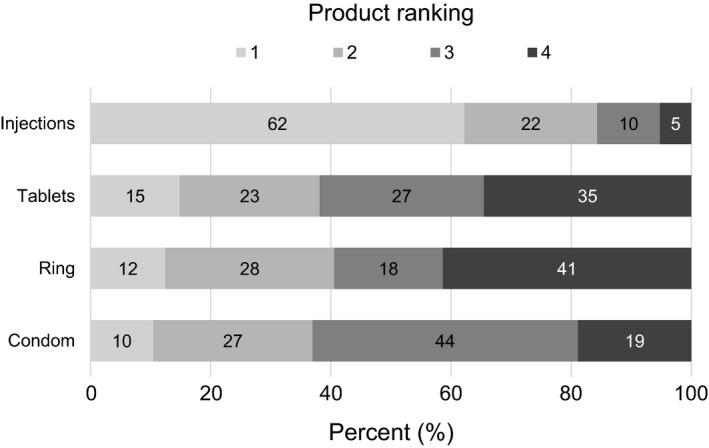
277 women enrolled, 249 completed stage 1 and 246 completed stage 2. Median age was 23 years, 49% were Kenyan and 51% were South African. Three participants became pregnant during the study and one participant HIV-seroconverted. There were 18 product-related adverse events, six tablets-related, 11 ring-related, and one injection-related. After trying each product, 85% preferred a TRIO product over condoms. Injections were chosen most (64%, 95% confidence interval (CI) 58%, 70%; p < 0.001), and by more South Africans than Kenyans (odds ratio (OR) 2.01, 95% CI: 1.17, 3.43; p = 0.01). There was no significant difference in choosing tablets versus ring (21%, 95% CI: 16%, 26% vs. 15%, 95% CI: 11%, 20%; p = 0.11). Tablet and ring adherence, based on direct observations and self-reports, improved over time. However, participants' self-reported use of tablets did not match objective data from the electronic dose monitoring device. Participants were fully compliant with injections.
In this population at risk for HIV and pregnancy, all participants agreed to choose and use a placebo MPT delivery form. A majority of participants preferred TRIO products to male condoms, an existing MPT. Injections were most liked and best used, however, they are years away from reaching the clinics. In the meantime, expanding the availability of tablets and giving access to rings can begin to fulfill the promise of choice for HIV prevention technologies and inform the development of suitable delivery forms as MPT.
预防艾滋病毒和意外怀孕是全球卫生的重点。为了为产品推出提供信息,并了解与偏好和使用相关的未来多用途预防技术(MPT)的属性,我们评估了三种安慰剂递送形式:每日口服片剂、每月阴道环和两种每月肌内注射,这是在肯尼亚和南非年轻女性中进行的为期五个月的 TRIO 研究。
招募了艾滋病毒阴性、有性行为、未怀孕的 18 至 30 岁女性,并将其随机分配使用每种安慰剂递送形式一个月(第 1 阶段)。然后,参与者选择一种产品再使用两个月(第 2 阶段)。我们评估了安全性、产品排名、选择和使用情况。我们检查了选择和未来不愿意使用的人口统计学和行为相关性,使用逻辑回归模型进行了分析。
共有 277 名女性入组,249 名完成第 1 阶段,246 名完成第 2 阶段。中位年龄为 23 岁,49%来自肯尼亚,51%来自南非。3 名参与者在研究期间怀孕,1 名参与者 HIV 血清转换。有 18 种与产品相关的不良事件,6 种与片剂相关,11 种与环相关,1 种与注射相关。在试用每种产品后,85%的人更喜欢 TRIO 产品而不是避孕套。注射的选择最多(64%,95%置信区间(CI)为 58%至 70%;p<0.001),并且南非人的选择比例高于肯尼亚人(优势比(OR)为 2.01,95%CI:1.17,3.43;p=0.01)。与环相比,片剂的选择没有显著差异(21%,95%CI:16%至 26%与 15%,95%CI:11%至 20%;p=0.11)。基于直接观察和自我报告,片剂和环的依从性随着时间的推移而提高。然而,参与者自我报告的片剂使用情况与电子剂量监测设备的客观数据不匹配。参与者对注射完全遵守。
在这个有感染艾滋病毒和怀孕风险的人群中,所有参与者都同意选择和使用一种安慰剂 MPT 递送形式。大多数参与者更喜欢 TRIO 产品而不是现有的 MPT 男性避孕套。注射最受欢迎且使用效果最好,但仍需数年时间才能进入临床。在此期间,扩大片剂的供应并提供环的使用可以开始满足艾滋病毒预防技术的选择承诺,并为合适的递送形式的开发提供信息。