Gislefoss Randi Elin, Stenehjem Jo Steinson, Hektoen Helga Helseth, Andreassen Bettina Kulle, Langseth Hilde, Axcrona Karol, Weiderpass Elisabete, Mondul Alison, Robsahm Trude Eid
Department of Research, Cancer Registry of Norway, Oslo, Norway.
Department of Urology, Akershus University Hospital, Lørenskog, Norway.
BMJ Open. 2018 Mar 30;8(3):e019309. doi: 10.1136/bmjopen-2017-019309.
Bladder cancer (BC) (including renal pelvis, ureter and urethra) is one of the most common urogenital cancers and the fourth most frequent cancer in men in the USA. In Norway, the incidence of BC has increased over the last decades. The age-standardised incidence rates per 100 000 for 2011-2015 were 53.7 in men and 16.5 in women. Compared to the 5-year period 2006-2010, the percentage increase in incidence was 6.1% in men and 12.3% in women. The recurrence rate of BC is over 50%, the highest recurrence rate of any malignancy. Smoking and occupational exposure to aromatic amines are recognised as the major risk factors. Recently, low-serum level of 25-hydroxy vitamin D (25(OH)D) and obesity have been suggested to increase the BC risk, and leptin, which is important in weight regulation, may be involved in bladder carcinogenesis. More knowledge on potential risk factors for BC is necessary for planning and implementing primary prevention measures.
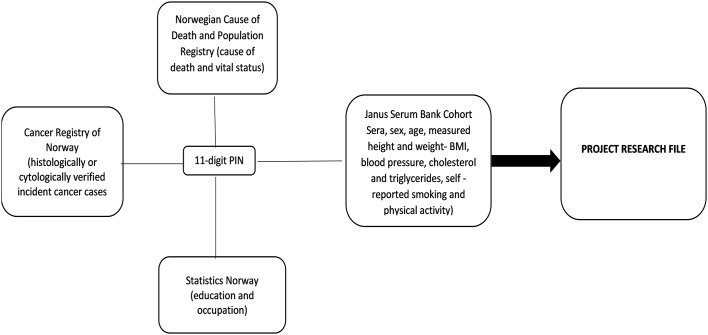
Cohort and nested case-control studies will be carried out using the population-based Janus Serum Bank Cohort consisting of prediagnostic sera, clinical measurement data (body height and weight, body surface area and weight change over time, blood pressure, cholesterol and triglycerides) and self-reported information on lifestyle factors (smoking, physical activity). Participants were followed from cohort inclusion (1972-2003) through 2014. The cohort will be linked to the Cancer Registry of Norway (cancer data), the National Cause of Death Registry (date and cause of death), National Population Registry (vital status) and Statistic Norway (education and occupation). Serum samples will be analysed for 25(OH)D, vitamin D binding protein, leptin, albumin, calcium and parathyroid hormone. Cox regression and conditional logistic regression models and mediation analysis will be used to estimate association between the exposures and BC.
The study has been approved by the Regional Committee for Medical Research Ethics and is funded by the Norwegian Cancer Society. Results will be published in peer-reviewed journals, at scientific conferences and through press releases.
膀胱癌(包括肾盂、输尿管和尿道癌)是最常见的泌尿生殖系统癌症之一,在美国男性中是第四大常见癌症。在挪威,过去几十年间膀胱癌的发病率有所上升。2011 - 2015年每10万人的年龄标准化发病率,男性为53.7,女性为16.5。与2006 - 2010年的5年期间相比,发病率的增长百分比男性为6.1%,女性为12.3%。膀胱癌的复发率超过50%,是所有恶性肿瘤中复发率最高的。吸烟和职业接触芳香胺被认为是主要风险因素。最近,有研究表明血清25 - 羟基维生素D(25(OH)D)水平低和肥胖会增加患膀胱癌的风险,而在体重调节中起重要作用的瘦素可能参与膀胱癌的发生。为了规划和实施一级预防措施,有必要更多地了解膀胱癌的潜在风险因素。
将使用基于人群的贾纳斯血清银行队列进行队列研究和巢式病例对照研究,该队列包含诊断前血清、临床测量数据(身高和体重、体表面积以及随时间的体重变化、血压、胆固醇和甘油三酯)以及关于生活方式因素(吸烟、体育活动)的自我报告信息。参与者从队列纳入(1972 - 2003年)开始随访至2014年。该队列将与挪威癌症登记处(癌症数据)、国家死亡原因登记处(死亡日期和原因)、国家人口登记处(生命状态)以及挪威统计局(教育和职业)相链接。将对血清样本进行25(OH)D、维生素D结合蛋白、瘦素、白蛋白、钙和甲状旁腺激素的分析。将使用Cox回归模型、条件逻辑回归模型和中介分析来估计暴露因素与膀胱癌之间的关联。
本研究已获得地区医学研究伦理委员会的批准,并由挪威癌症协会资助。研究结果将发表在同行评审期刊、科学会议上,并通过新闻稿发布。