Department of Chemistry, University of Jyvaskyla, P.O. Box 35, 40014, Jyväskylä, Finland.
School of Chemistry, University of Bristol, Cantock's Close, Bristol, BS8 1TS, UK.
Chemistry. 2018 Jun 7;24(32):8178-8185. doi: 10.1002/chem.201800537. Epub 2018 May 14.
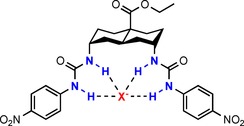
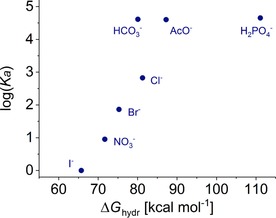
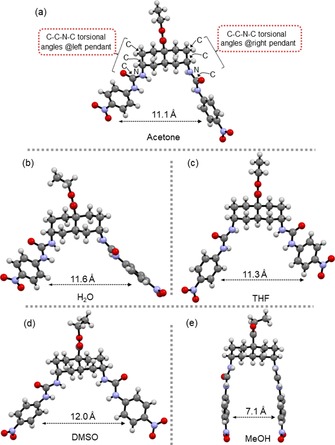
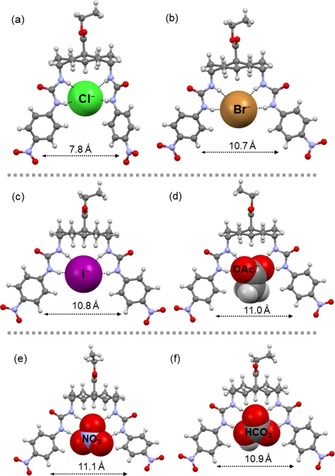
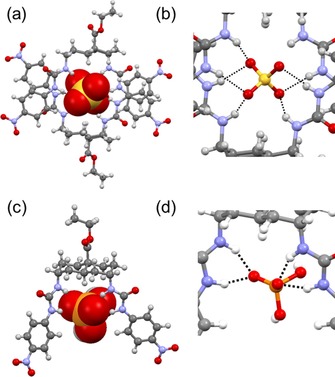
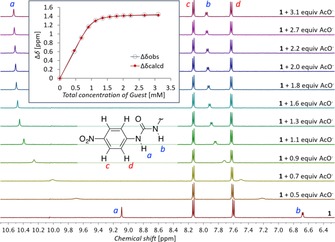
Recent work has identified a bis-(p-nitrophenyl)ureidodecalin anion carrier as a promising candidate for biomedical applications, showing good activity for chloride transport in cells yet almost no cytotoxicity. To underpin further development of this and related compounds, a detailed structural and binding investigation is reported. Crystal structures of the transporter as five solvates confirm the diaxial positioning of urea groups while revealing a degree of conformational flexibility. Structures of complexes with Cl , Br , NO , SO and AcO , supported by computational studies, show how the binding site can adapt to accommodate these anions. H NMR binding studies revealed exceptionally high affinities for anions in DMSO, decreasing in the order SO >H PO ≈HCO ≈AcO ≫HSO >Cl >Br >NO >I . Analysis of the binding results suggests that selectivity is determined mainly by the H-bond acceptor strength of different anions, but is also modulated by receptor geometry.
最近的工作确定了一种双-(对硝基苯基)尿烷癸烷阴离子载体,作为生物医学应用的有前途的候选物,对细胞中氯离子的转运表现出良好的活性,但几乎没有细胞毒性。为了进一步开发这种和相关化合物,报告了详细的结构和结合研究。作为五种溶剂化物的转运体的晶体结构证实了脲基团的双轴向定位,同时揭示了一定程度的构象灵活性。与 Cl 、 Br 、 NO 、 SO 和 AcO 的配合物的结构,得到了计算研究的支持,显示了结合位点如何适应容纳这些阴离子。 H NMR 结合研究表明,在 DMSO 中对阴离子具有极高的亲和力,按 SO >H PO ≈HCO ≈AcO ≫HSO >Cl >Br >NO >I 的顺序降低。对结合结果的分析表明,选择性主要由不同阴离子的氢键接受体强度决定,但也受受体几何形状的调节。