Pain Oliver, Dudbridge Frank, Cardno Alastair G, Freeman Daniel, Lu Yi, Lundstrom Sebastian, Lichtenstein Paul, Ronald Angelica
Department of Psychological Sciences, Birkbeck, University of London, London, United Kingdom.
Department of Non-Communicable Disease Epidemiology, London School of Hygiene and Tropical Medicine, London, United Kingdom.
Am J Med Genet B Neuropsychiatr Genet. 2018 Jun;177(4):416-425. doi: 10.1002/ajmg.b.32630. Epub 2018 Mar 31.
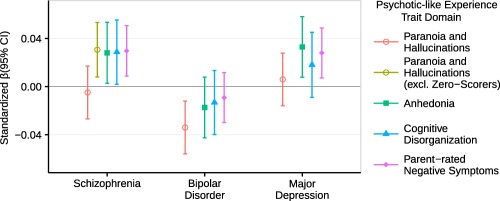
This study aimed to test for overlap in genetic influences between psychotic-like experience traits shown by adolescents in the community, and clinically-recognized psychiatric disorders in adulthood, specifically schizophrenia, bipolar disorder, and major depression. The full spectra of psychotic-like experience domains, both in terms of their severity and type (positive, cognitive, and negative), were assessed using self- and parent-ratings in three European community samples aged 15-19 years (Final N incl. siblings = 6,297-10,098). A mega-genome-wide association study (mega-GWAS) for each psychotic-like experience domain was performed. Single nucleotide polymorphism (SNP)-heritability of each psychotic-like experience domain was estimated using genomic-relatedness-based restricted maximum-likelihood (GREML) and linkage disequilibrium- (LD-) score regression. Genetic overlap between specific psychotic-like experience domains and schizophrenia, bipolar disorder, and major depression was assessed using polygenic risk score (PRS) and LD-score regression. GREML returned SNP-heritability estimates of 3-9% for psychotic-like experience trait domains, with higher estimates for less skewed traits (Anhedonia, Cognitive Disorganization) than for more skewed traits (Paranoia and Hallucinations, Parent-rated Negative Symptoms). Mega-GWAS analysis identified one genome-wide significant association for Anhedonia within IDO2 but which did not replicate in an independent sample. PRS analysis revealed that the schizophrenia PRS significantly predicted all adolescent psychotic-like experience trait domains (Paranoia and Hallucinations only in non-zero scorers). The major depression PRS significantly predicted Anhedonia and Parent-rated Negative Symptoms in adolescence. Psychotic-like experiences during adolescence in the community show additive genetic effects and partly share genetic influences with clinically-recognized psychiatric disorders, specifically schizophrenia and major depression.
本研究旨在检验社区中青少年表现出的类精神病体验特征与成年期临床确诊的精神疾病(特别是精神分裂症、双相情感障碍和重度抑郁症)之间的遗传影响重叠情况。使用自我评定和父母评定,在三个年龄为15 - 19岁的欧洲社区样本中(最终样本量包括兄弟姐妹 = 6297 - 10098),对类精神病体验领域的全谱,包括其严重程度和类型(阳性、认知和阴性)进行了评估。针对每个类精神病体验领域进行了一项大型全基因组关联研究(mega - GWAS)。使用基于基因组相关性的限制最大似然法(GREML)和连锁不平衡(LD)评分回归,估计了每个类精神病体验领域的单核苷酸多态性(SNP)遗传力。使用多基因风险评分(PRS)和LD评分回归,评估了特定类精神病体验领域与精神分裂症、双相情感障碍和重度抑郁症之间的遗传重叠。GREML得出类精神病体验特征领域的SNP遗传力估计值为3% - 9%,对于偏态性较小的特征(快感缺乏、认知紊乱)的估计值高于偏态性较大的特征(妄想和幻觉、父母评定的阴性症状)。Mega - GWAS分析在IDO2基因内发现了一个与快感缺乏相关的全基因组显著关联,但在独立样本中未得到重复验证。PRS分析表明,精神分裂症的PRS显著预测了所有青少年类精神病体验特征领域(仅在非零得分者中预测了妄想和幻觉)。重度抑郁症的PRS显著预测了青少年的快感缺乏和父母评定的阴性症状。社区中青少年期的类精神病体验显示出加性遗传效应,并且部分与临床确诊的精神疾病,特别是精神分裂症和重度抑郁症共享遗传影响。