Department of Physiology, Development and Neuroscience, University of Cambridge, Cambridge, UK.
Institute of Reproductive and Developmental Biology, Imperial College London, London, UK.
J Physiol. 2018 Dec;596(23):6105-6119. doi: 10.1113/JP275659. Epub 2018 Apr 29.
Fetal heart rate variability (FHRV) has long been recognised as a powerful predictor of fetal wellbeing, and a decrease in FHRV is associated with fetal compromise. However, the mechanisms by which FHRV is reduced in the chronically hypoxic fetus have yet to be established. The sympathetic and parasympathetic influences on heart rate mature at different rates throughout fetal life, and can be assessed by time domain and power spectral analysis of FHRV. In this study of chronically instrumented fetal sheep in late gestation, we analysed FHRV daily over a 16 day period towards term, and compared changes between fetuses of control and chronically hypoxic pregnancy. We show that FHRV in sheep is reduced by chronic hypoxia, predominantly due to dysregulation of the sympathetic control of the fetal heart rate. This presents a potential mechanism by which a reduction in indices of FHRV predicts fetuses at increased risk of neonatal morbidity and mortality in humans. Reduction in overall FHRV may therefore provide a biomarker that autonomic dysregulation of fetal heart rate control has taken place in a fetus where uteroplacental dysfunction is suspected.
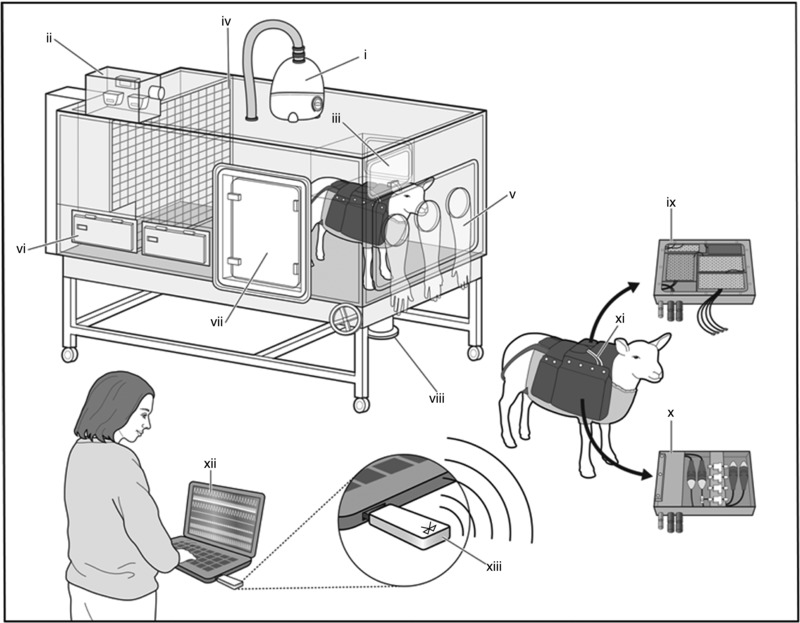
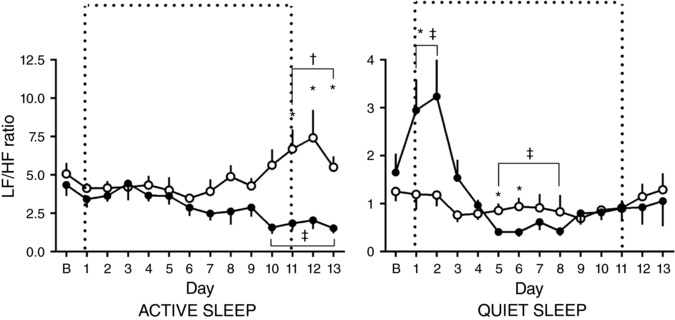
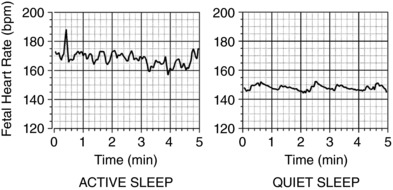
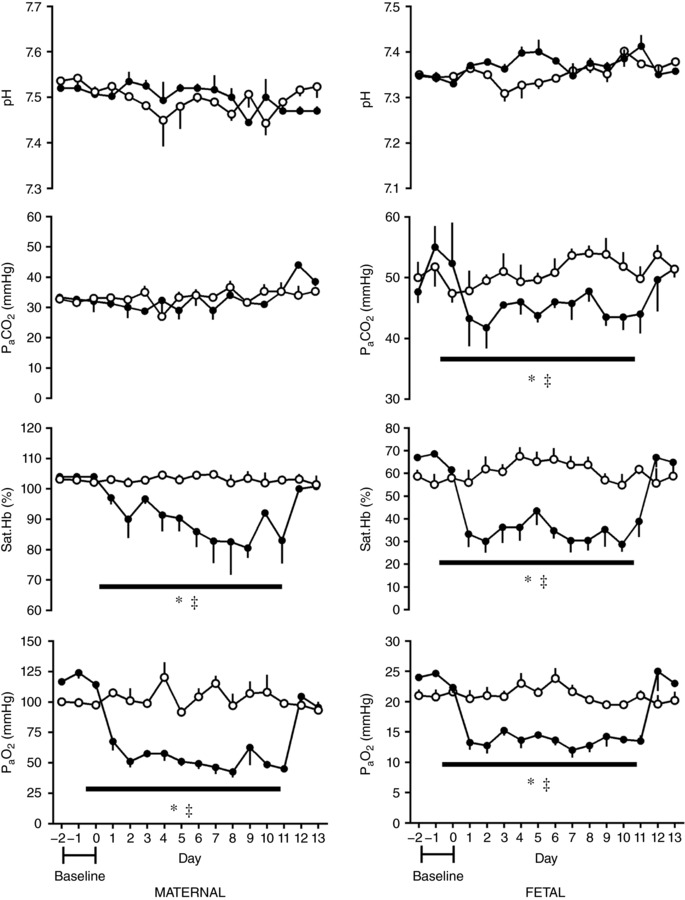
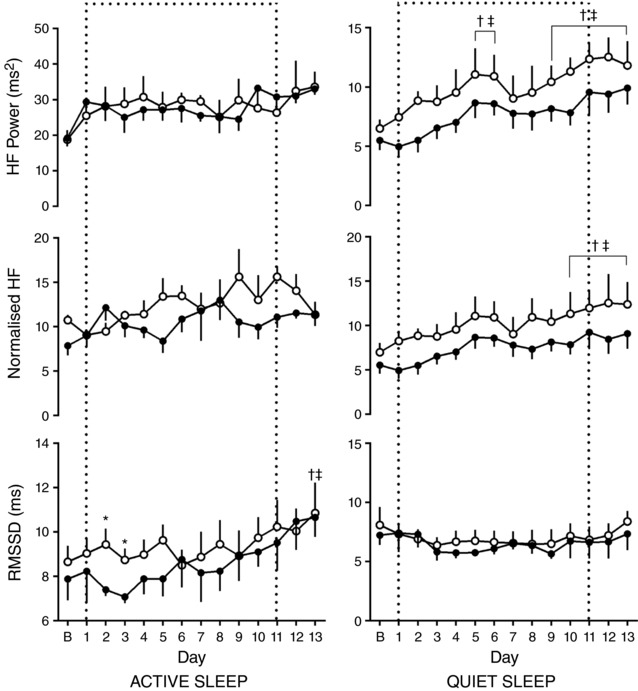
Although fetal heart rate variability (FHRV) has long been recognised as a powerful predictor of fetal wellbeing, the mechanisms by which it is reduced in the chronically hypoxic fetus have yet to be established. In particular, the physiological mechanism underlying the reduction of short term variation (STV) in fetal compromise remains unclear. In this study, we present a longitudinal study of the development of autonomic control of FHRV, assessed by indirect indices, time domain and power spectral analysis, in normoxic and chronically hypoxic, chronically catheterised, singleton fetal sheep over the last third of gestation. We used isobaric chambers able to maintain pregnant sheep for prolonged periods in hypoxic conditions (stable fetal femoral arterial 10-12 mmHg), and a customised wireless data acquisition system to record beat-to-beat variation in the fetal heart rate. We determined in vivo longitudinal changes in overall FHRV and the sympathetic and parasympathetic contribution to FHRV in hypoxic (n = 6) and normoxic (n = 6) ovine fetuses with advancing gestational age. Normoxic fetuses show gestational age-related increases in overall indices of FHRV, and in the sympathetic nervous system contribution to FHRV (P < 0.001). Conversely, gestational age-related increases in overall FHRV were impaired by exposure to chronic hypoxia, and there was evidence of suppression of the sympathetic nervous system control of FHRV after 72 h of exposure to hypoxia (P < 0.001). This demonstrates that exposure to late gestation isolated chronic fetal hypoxia has the potential to alter the development of the autonomic nervous system control of FHRV in sheep. This presents a potential mechanism by which a reduction in indices of FHRV in human fetuses affected by uteroplacental dysfunction can predict fetuses at increased risk.
胎儿心率变异性(FHRV)长期以来一直被认为是胎儿健康的有力预测指标,FHRV 的降低与胎儿缺氧有关。然而,慢性缺氧胎儿中 FHRV 降低的机制尚未确定。胎儿在整个生命过程中心率的交感和副交感影响以不同的速度成熟,并且可以通过 FHRV 的时域和功率谱分析来评估。在这项对妊娠晚期慢性仪器化绵羊的研究中,我们在接近足月的 16 天内每天分析 FHRV,并比较对照组和慢性缺氧妊娠胎儿之间的变化。我们表明,绵羊的 FHRV 受到慢性缺氧的影响,主要是由于胎儿心率的交感控制失调。这为 FHRV 指数的降低预示着人类中新生儿发病率和死亡率增加的风险提供了一个潜在机制。因此,FHRV 的整体降低可能提供了一个生物标志物,表明在怀疑存在胎盘功能障碍的胎儿中,胎儿心率控制的自主神经调节已经发生。
尽管胎儿心率变异性(FHRV)长期以来一直被认为是胎儿健康的有力预测指标,但它在慢性缺氧胎儿中降低的机制尚未确定。特别是,胎儿缺氧导致短期变异(STV)降低的生理机制仍不清楚。在这项研究中,我们对正常和慢性缺氧的、慢性导管化的、妊娠晚期的单胎绵羊的 FHRV 自主神经控制的发展进行了纵向研究,通过间接指标、时域和功率谱分析进行评估。我们使用了能够在缺氧条件下(稳定的胎儿股动脉 10-12mmHg)长时间维持妊娠绵羊的等压室,以及一个定制的无线数据采集系统来记录胎儿心率的逐拍变化。我们在妊娠晚期的缺氧(n=6)和正常氧(n=6)绵羊胎儿中确定了整体 FHRV 以及 FHRV 的交感神经和副交感神经贡献的体内纵向变化。正常氧胎儿的整体 FHRV 以及交感神经对 FHRV 的贡献随着胎龄的增加而增加(P<0.001)。相反,与胎龄相关的整体 FHRV 增加在暴露于慢性缺氧时受到损害,并且在暴露于缺氧 72 小时后,有证据表明 FHRV 的交感神经控制受到抑制(P<0.001)。这表明,妊娠晚期胎儿慢性缺氧的暴露有可能改变绵羊胎儿 FHRV 自主神经控制的发育。这为由于胎盘功能障碍而降低的 FHRV 指数可以预测风险增加的胎儿提供了一个潜在机制。