• 文献检索
  • 文档翻译
  • 深度研究
  • 学术资讯
  • Suppr Zotero 插件Zotero 插件
  • 邀请有礼
  • 套餐&价格
  • 历史记录
应用&插件
Suppr Zotero 插件Zotero 插件浏览器插件Mac 客户端Windows 客户端微信小程序
定价
高级版会员购买积分包购买API积分包
服务
文献检索文档翻译深度研究API 文档MCP 服务
关于我们
关于 Suppr公司介绍联系我们用户协议隐私条款
关注我们

Suppr 超能文献

核心技术专利:CN118964589B侵权必究
粤ICP备2023148730 号-1Suppr @ 2026

文献检索

告别复杂PubMed语法,用中文像聊天一样搜索,搜遍4000万医学文献。AI智能推荐,让科研检索更轻松。

立即免费搜索

文件翻译

保留排版,准确专业,支持PDF/Word/PPT等文件格式,支持 12+语言互译。

免费翻译文档

深度研究

AI帮你快速写综述,25分钟生成高质量综述,智能提取关键信息,辅助科研写作。

立即免费体验

失语症的远程康复——一项实用、探索性、试点随机对照试验方案

Telerehabilitation for aphasia - protocol of a pragmatic, exploratory, pilot randomized controlled trial.

作者信息

Øra Hege Prag, Kirmess Melanie, Brady Marian C, Winsnes Ingvild Elisabeth, Hansen Silje Merethe, Becker Frank

机构信息

Sunnaas Rehabilitation Hospital, Bjørnemyrveien 11, 1450, Nesoddtangen, Norway.

Institute of Clinical Medicine, University of Oslo, PO Box 1171, Blindern, 0318, Oslo, Norway.

出版信息

Trials. 2018 Apr 2;19(1):208. doi: 10.1186/s13063-018-2588-5.

DOI:10.1186/s13063-018-2588-5
PMID:29606148
原文链接:https://pmc.ncbi.nlm.nih.gov/articles/PMC5880095/
Abstract

BACKGROUND

The Cochrane review on the effectiveness of speech and language therapy for aphasia following stroke suggests intensity of therapy is a key predictor for outcome. Current aphasia services cannot provide intervention at the intensity observed within trial contexts because of resource limitations. Telerehabilitation could widen access to speech-language pathologists (SLPs) in geographically remote contexts and reduce the time spent on travel by the therapist and patient. The current academic literature within this field is in its infancy, with few trials of speech and language therapy (SLT) delivered by videoconference. Our pilot randomized controlled trial (RCT) will explore feasibility aspects and effectiveness of telerehabilitation for aphasia in addition to standard SLT.

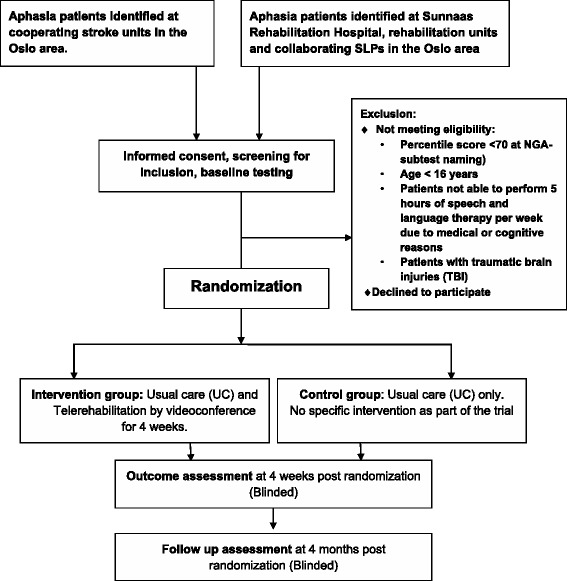
METHOD/DESIGN: Our study is a pragmatic, exploratory, pilot randomized controlled trial, where participants will be randomized to a telerehabilitation group or a control group. Both groups receive standard SLT (usual care) but the telerehabilitation group receives an additional 5 h of telerehabilitation per week over 4 weeks through videoconference. This additional telerehabilitation focuses on spoken language with an emphasis on word naming. We aim to include 40 patients in each group, with inclusion criteria being aphasia any time post stroke. Participants will be assessed blindly at pre-randomization (baseline), and 4 weeks and 4 months after randomization. The primary endpoint is naming ability 3 months after the completed intervention, measured by the Norwegian Basic Aphasia Assessment (NGA) naming subtest. Secondary endpoints include other subtests of the NGA, the VAST (Verb and Sentence Test) subtest sentence production, Communicative Effectiveness Index (CETI) and the Stroke and Aphasia Quality of Life scale (SAQOL-39). Experiences of patients and SLPs with telerehabilitation are assessed using questionnaires and semi-structured interviews. Statistical between group comparisons will be in line with an intention-to-treat analysis.

DISCUSSION

This pilot RCT of intensive language training by videoconference will contribute new scientific evidence to the field of aphasia telerehabilitation. Here, we describe our trial which will explore the feasibility of telerehabilitation for aphasia as an intervention, our choice of primary and secondary outcome measures and proposed analyses. Our trial will provide information for the development and delivery of future definitive RCTs.

TRIAL REGISTRATION

ClinicalTrials.gov, ID: NCT02768922 . Registered on 11 May 2016. Last updated on 17 November 2017.

摘要

背景

Cochrane关于中风后失语症言语和语言治疗有效性的综述表明,治疗强度是结果的关键预测因素。由于资源限制,目前的失语症服务无法在试验环境中观察到的强度下提供干预。远程康复可以扩大地理偏远地区获得言语治疗师(SLP)服务的机会,并减少治疗师和患者的出行时间。该领域目前的学术文献尚处于起步阶段,通过视频会议进行言语和语言治疗(SLT)的试验很少。我们的试点随机对照试验(RCT)除了标准的言语和语言治疗外,还将探索失语症远程康复的可行性和有效性。

方法/设计:我们的研究是一项务实、探索性的试点随机对照试验,参与者将被随机分配到远程康复组或对照组。两组均接受标准的言语和语言治疗(常规护理),但远程康复组在4周内每周通过视频会议额外接受5小时的远程康复治疗。这种额外的远程康复侧重于口语,重点是单词命名。我们的目标是每组纳入40名患者,纳入标准为中风后任何时间出现失语症。参与者将在随机分组前(基线)、随机分组后4周和4个月进行盲法评估。主要终点是完成干预3个月后的命名能力,通过挪威基本失语症评估(NGA)命名子测试进行测量。次要终点包括NGA的其他子测试、VAST(动词和句子测试)子测试句子生成、沟通有效性指数(CETI)和中风与失语症生活质量量表(SAQOL-39)。使用问卷和半结构化访谈评估患者和言语治疗师对远程康复的体验。组间统计比较将符合意向性分析。

讨论

这项通过视频会议进行强化语言训练的试点随机对照试验将为失语症远程康复领域提供新的科学证据。在此,我们描述了我们的试验,该试验将探索失语症远程康复作为一种干预措施的可行性、我们对主要和次要结局指标的选择以及拟议的分析方法。我们的试验将为未来确定性随机对照试验的开展和实施提供信息。

试验注册

ClinicalTrials.gov,ID:NCT02768922。于2016年5月11日注册。最后更新于2017年11月17日。
https://cdn.ncbi.nlm.nih.gov/pmc/blobs/31d3/5880095/ce5f8adfda81/13063_2018_2588_Fig1_HTML.jpg

相似文献

1
Telerehabilitation for aphasia - protocol of a pragmatic, exploratory, pilot randomized controlled trial.失语症的远程康复——一项实用、探索性、试点随机对照试验方案
Trials. 2018 Apr 2;19(1):208. doi: 10.1186/s13063-018-2588-5.
2
The effect of augmented speech-language therapy delivered by telerehabilitation on poststroke aphasia-a pilot randomized controlled trial.远程康复提供的强化言语治疗对脑卒中后失语症的影响——一项前瞻性随机对照试验
Clin Rehabil. 2020 Mar;34(3):369-381. doi: 10.1177/0269215519896616. Epub 2020 Jan 5.
3
FCET2EC (From controlled experimental trial to = 2 everyday communication): How effective is intensive integrative therapy for stroke-induced chronic aphasia under routine clinical conditions? A study protocol for a randomized controlled trial.FCET2EC(从对照实验性试验到日常交流):在常规临床条件下,强化综合疗法对中风所致慢性失语症的效果如何?一项随机对照试验的研究方案
Trials. 2013 Sep 23;14:308. doi: 10.1186/1745-6215-14-308.
4
Augmentative and alternative communication intervention for in-patient individuals with post-stroke aphasia: study protocol of a parallel-group, pragmatic randomized controlled trial.增强和替代沟通干预对卒中后失语症住院患者的影响:一项平行组、实用随机对照试验的研究方案。
Trials. 2021 Nov 24;22(1):837. doi: 10.1186/s13063-021-05799-0.
5
Technical Features, Feasibility, and Acceptability of Augmented Telerehabilitation in Post-stroke Aphasia-Experiences From a Randomized Controlled Trial.增强型远程康复用于中风后失语症的技术特征、可行性及可接受性——来自一项随机对照试验的经验
Front Neurol. 2020 Jul 31;11:671. doi: 10.3389/fneur.2020.00671. eCollection 2020.
6
A randomized controlled trial of very early rehabilitation in speech after stroke.一项关于中风后言语极早期康复的随机对照试验。
Int J Stroke. 2016 Jul;11(5):586-92. doi: 10.1177/1747493016641116. Epub 2016 May 5.
7
Intensive speech and language therapy in patients with chronic aphasia after stroke: a randomised, open-label, blinded-endpoint, controlled trial in a health-care setting.在脑卒中后慢性失语症患者中进行强化语言治疗:一项在医疗保健环境中进行的随机、开放标签、盲终点、对照试验。
Lancet. 2017 Apr 15;389(10078):1528-1538. doi: 10.1016/S0140-6736(17)30067-3. Epub 2017 Mar 1.
8
Self-managed, computerised speech and language therapy for patients with chronic aphasia post-stroke compared with usual care or attention control (Big CACTUS): a multicentre, single-blinded, randomised controlled trial.自我管理、计算机化的言语和语言治疗用于慢性卒中后失语症患者与常规护理或对照(Big CACTUS):一项多中心、单盲、随机对照试验。
Lancet Neurol. 2019 Sep;18(9):821-833. doi: 10.1016/S1474-4422(19)30192-9.
9
Singing for people with aphasia (SPA): a protocol for a pilot randomised controlled trial of a group singing intervention to improve well-being.针对失语症患者的歌唱疗法(SPA):一项群组歌唱干预以提升幸福感的先导随机对照试验方案。
BMJ Open. 2018 Sep 10;8(9):e025167. doi: 10.1136/bmjopen-2018-025167.
10
Design and methods of a randomized controlled trial on early speech and language therapy in patients with acute stroke and aphasia.急性中风失语患者早期言语和语言治疗的随机对照试验的设计与方法
Top Stroke Rehabil. 2008 May-Jun;15(3):256-61. doi: 10.1310/tsr1503-256.

引用本文的文献

1
Augmentative and alternative communication intervention for in-patient individuals with post-stroke aphasia: study protocol of a parallel-group, pragmatic randomized controlled trial.增强和替代沟通干预对卒中后失语症住院患者的影响:一项平行组、实用随机对照试验的研究方案。
Trials. 2021 Nov 24;22(1):837. doi: 10.1186/s13063-021-05799-0.
2
Technical Features, Feasibility, and Acceptability of Augmented Telerehabilitation in Post-stroke Aphasia-Experiences From a Randomized Controlled Trial.增强型远程康复用于中风后失语症的技术特征、可行性及可接受性——来自一项随机对照试验的经验
Front Neurol. 2020 Jul 31;11:671. doi: 10.3389/fneur.2020.00671. eCollection 2020.
3

本文引用的文献

1
Intensive speech and language therapy in patients with chronic aphasia after stroke: a randomised, open-label, blinded-endpoint, controlled trial in a health-care setting.在脑卒中后慢性失语症患者中进行强化语言治疗:一项在医疗保健环境中进行的随机、开放标签、盲终点、对照试验。
Lancet. 2017 Apr 15;389(10078):1528-1538. doi: 10.1016/S0140-6736(17)30067-3. Epub 2017 Mar 1.
2
CONSORT 2010 statement: extension to randomised pilot and feasibility trials.《CONSORT 2010声明:随机试点和可行性试验的扩展》
BMJ. 2016 Oct 24;355:i5239. doi: 10.1136/bmj.i5239.
3
Speech and language therapy for aphasia following stroke.
[Review on the improvements in communication skills among aphasic patients through the use of portable technology.].
[关于通过使用便携式技术提高失语症患者沟通能力的综述。]
Rev Esp Salud Publica. 2020 Jun 10;94:e202006044.
4
Telerehabilitation services for stroke.中风的远程康复服务
Cochrane Database Syst Rev. 2020 Jan 31;1(1):CD010255. doi: 10.1002/14651858.CD010255.pub3.
5
The clinical management and rehabilitation of post stroke aphasia in Italy: evidences from the literature and clinical experience.意大利卒中后失语症的临床管理和康复:来自文献和临床经验的证据。
Neurol Sci. 2019 Jul;40(7):1329-1334. doi: 10.1007/s10072-019-03844-0. Epub 2019 Mar 21.
6
Hospital based care at home; study protocol for a mixed epidemiological and randomized controlled trial.基于医院的居家护理;一项混合流行病学和随机对照试验的研究方案。
Trials. 2019 Jan 24;20(1):77. doi: 10.1186/s13063-019-3185-y.
中风后失语症的言语和语言治疗
Cochrane Database Syst Rev. 2016 Jun 1;2016(6):CD000425. doi: 10.1002/14651858.CD000425.pub4.
4
A blueprint for telerehabilitation guidelines.远程康复指南蓝图。
Int J Telerehabil. 2010 Oct 27;2(2):31-4. doi: 10.5195/ijt.2010.6063. eCollection 2010 Fall.
5
A comparison of remote therapy, face to face therapy and an attention control intervention for people with aphasia: a quasi-randomised controlled feasibility study.失语症患者远程治疗、面对面治疗与注意力控制干预的比较:一项半随机对照可行性研究。
Clin Rehabil. 2016 Apr;30(4):359-73. doi: 10.1177/0269215515582074. Epub 2015 Apr 24.
6
Better reporting of interventions: template for intervention description and replication (TIDieR) checklist and guide.更好的干预措施报告:干预描述和复制(TIDieR)清单和指南模板。
BMJ. 2014 Mar 7;348:g1687. doi: 10.1136/bmj.g1687.
7
Telerehabilitation services for stroke.中风的远程康复服务。
Cochrane Database Syst Rev. 2013 Dec 16;2013(12):CD010255. doi: 10.1002/14651858.CD010255.pub2.
8
Third-party disability in family members of people with aphasia: a systematic review.失语症患者家庭成员中的第三方残疾:系统评价。
Disabil Rehabil. 2013 Aug;35(16):1324-41. doi: 10.3109/09638288.2012.735341.
9
The impact of stroke: are people with aphasia different to those without?中风的影响:失语症患者与非失语症患者有何不同?
Disabil Rehabil. 2011;33(3):211-8. doi: 10.3109/09638288.2010.508829. Epub 2010 Aug 16.
10
Overview of telehealth activities in speech-language pathology.言语病理学中的远程医疗活动概述。
Telemed J E Health. 2008 Dec;14(10):1101-17. doi: 10.1089/tmj.2008.0080.