Institute of Health and Environment, Seoul National University, Graduate School of Public Health, Seoul, Republic of Korea.
Institute of Health and Environment, Seoul National University, Graduate School of Public Health, Seoul, Republic of Korea; Department of Environmental Health Sciences, Seoul National University, Graduate School of Public Health, Seoul, Republic of Korea.
J Hosp Infect. 2018 Sep;100(1):92-98. doi: 10.1016/j.jhin.2018.03.031. Epub 2018 Mar 30.
Emergency departments (EDs) carry a high risk of infectious disease transmission and have also been implicated in tuberculosis (TB) outbreaks.
To determine if patients who visit EDs have an increased risk of TB infection. Using South Korean inpatient sample data (2012), the risk of TB occurrence during 90 days after hospitalization for patients admitted via EDs was compared with that for patients admitted via outpatient clinics.
The data of the 2012 Health Insurance Review and Assessment Service - National Inpatient Sample were used. TB diagnosis was based on International Classification of Diseases Version 10 [all TB (A15-A19), pulmonary TB (A15-A16) and extrapulmonary TB (A17-A18)].
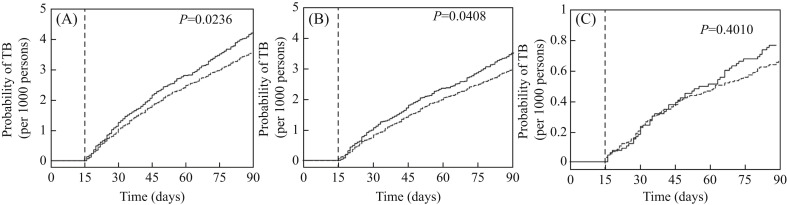
After propensity score matching using the demographic and clinical characteristics of the patients, 191,997 patients (64,017 patients admitted via EDs and 127,908 patients admitted via outpatient clinics) were included in this study. There was no significant difference in baseline patient characteristics between the two groups. The percentage of patients with TB admitted via EDs was higher than that of patients admitted via outpatient clinics. The likelihood of active TB occurrence was 30% higher for all TB [hazard ratio (HR) 1.30; 95% confidence interval (CI) 1.12-1.52] and pulmonary TB (HR 1.30; 95% CI 1.10-1.53) in patients admitted via EDs compared with patients admitted via outpatient clinics; this difference was significant. However, no difference in the occurrence of extrapulmonary TB was observed between the two groups.
The likelihood of TB infection was greater in patients admitted via EDs than in patients admitted via outpatient clinics.
急诊科(ED)存在较高的传染病传播风险,也与结核病(TB)爆发有关。
确定急诊就诊患者是否有更高的 TB 感染风险。利用韩国住院患者样本数据(2012 年),比较了通过急诊和门诊入院的患者在住院后 90 天内发生 TB 的风险。
使用 2012 年健康保险审查和评估服务-国家住院样本数据。TB 诊断基于国际疾病分类第 10 版(所有 TB(A15-A19)、肺 TB(A15-A16)和肺外 TB(A17-A18))。
在使用患者人口统计学和临床特征进行倾向评分匹配后,纳入了 191997 名患者(64017 名通过急诊入院,127908 名通过门诊入院)。两组患者的基线特征无显著差异。通过急诊入院的患者中 TB 患者的比例高于通过门诊入院的患者。与通过门诊入院的患者相比,通过急诊入院的所有 TB(危险比 [HR] 1.30;95%置信区间 [CI] 1.12-1.52)和肺 TB(HR 1.30;95% CI 1.10-1.53)患者发生活动性 TB 的可能性高 30%,差异具有统计学意义。然而,两组间肺外 TB 的发生无差异。
通过急诊入院的患者比通过门诊入院的患者发生 TB 感染的可能性更大。