Ripollés-Melchor Javier, Fuenmayor-Varela María Luisa de, Camargo Susana Criado, Fernández Pablo Jerez, Barrio Álvaro Contreras Del, Martínez-Hurtado Eugenio, Casans-Francés Rubén, Abad-Gurumeta Alfredo, Ramírez-Rodríguez José Manuel, Calvo-Vecino José María
Universidad Complutense de Madrid, Madri, Espanha; Hospital Universitario Infanta Leonor, Departamento de Anestesia, Madri, Espanha; Grupo Español de Rehabilitación Multimodal (GERM), Zaragoza, Espanha.
Hospital Universitario Infanta Leonor, Departamento de Cirugía General, Madri, Espanha.
Braz J Anesthesiol. 2018 Jul-Aug;68(4):358-368. doi: 10.1016/j.bjan.2018.01.003. Epub 2018 Mar 31.
Enhanced recovery after surgery (ERAS) protocols consist of a set of perioperative measures aimed at improving patient recovery and decreasing length of stay and postoperative complications. We assess the implementation and outcomes of an ERAS program for colorectal surgery.
Single center observational study. Data were collected from consecutive patients undergoing open or laparoscopic colorectal surgery during 2 time periods, 3 years before (Pre-ERAS) and 2 years after (Post-ERAS) the implementation of an ERAS protocol. Baseline characteristics of both groups were compared. The primary outcome was the number of patients with 180 days follow-up with moderate or severe complications; secondary outcomes were postoperative length of stay, and specific complications. Data were extracted from patient records.
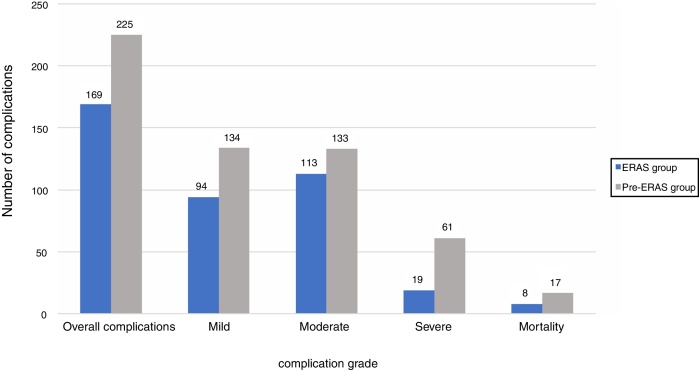
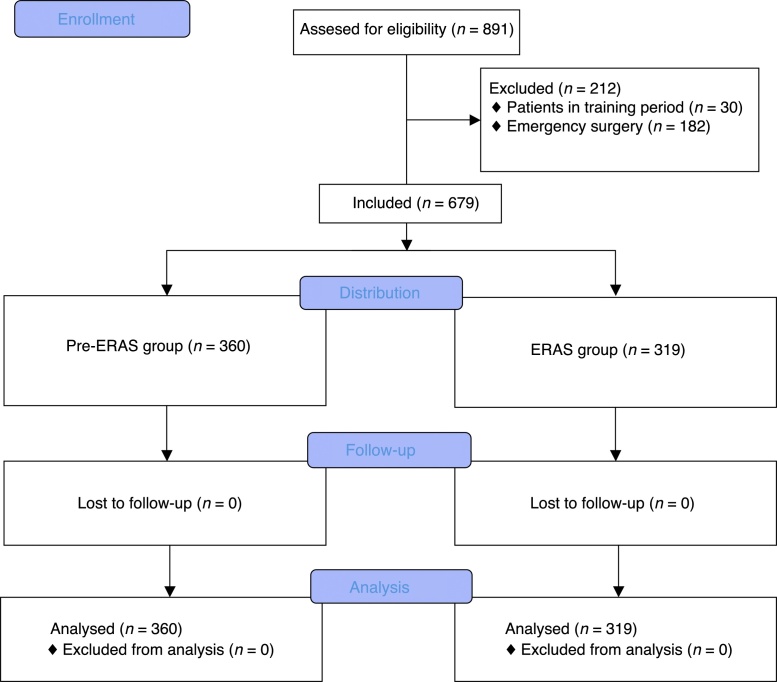
There were 360 patients in the Pre-ERAS group and 319 patients in the Post-ERAS Group. 214 (59.8%) patients developed at least one complication in the pre ERAS group, versus 163 patients in the Post-ERAS group (51.10%). More patients in the Pre-ERAS group developed moderate or severe complications (31.9% vs. 22.26%, = 0.009); and severe complications (15.5% vs. 5.3%; < 0.0001). The median length of stay was 13 (17) days in Pre-ERAS Group and 11 (10) days in the Post-ERAS Group ( = 0.034). No differences were found on mortality rates (4.7% vs. 2.5%; = 0.154), or readmission (6.39% vs. 4.39%; = 0.31). Overall ERAS protocol compliance in the Post-ERAS cohort was 88%.
The implementation of ERAS protocol for colorectal surgery was associated with a significantly reduction of postoperative complications and length of stay.
术后加速康复(ERAS)方案由一系列围手术期措施组成,旨在促进患者康复,缩短住院时间并减少术后并发症。我们评估了一项针对结直肠手术的ERAS计划的实施情况和结果。
单中心观察性研究。收集了在实施ERAS方案前3年(ERAS前)和实施后2年(ERAS后)两个时间段内连续接受开放或腹腔镜结直肠手术患者的数据。比较了两组的基线特征。主要结局是随访180天出现中度或重度并发症的患者数量;次要结局是术后住院时间和特定并发症。数据从患者记录中提取。
ERAS前组有360例患者,ERAS后组有319例患者。ERAS前组有214例(59.8%)患者至少出现一种并发症,而ERAS后组有163例患者(51.10%)。ERAS前组出现中度或重度并发症的患者更多(31.9%对22.26%,P = 0.009);以及重度并发症(15.5%对5.3%;P < 0.0001)。ERAS前组的中位住院时间为13(17)天,ERAS后组为11(10)天(P = 0.034)。在死亡率(4.7%对2.5%;P = 0.154)或再入院率(6.39%对4.39%;P =