Behavioral Science Department, Emek Yesreel College, Emek Yesreel, Israel.
2Pre-School Psychiatry Unit, Soroka University Medical Center, Beer Sheva, Israel.
Mol Autism. 2018 Mar 27;9:22. doi: 10.1186/s13229-018-0206-8. eCollection 2018.
Sensory abnormalities and sleep disturbances are highly prevalent in children with autism, but the potential relationship between these two domains has rarely been explored. Understanding such relationships is important for identifying children with autism who exhibit more homogeneous symptoms.
Here, we examined this relationship using the Caregiver Sensory Profile and the Children's Sleep Habits Questionnaire, which were completed by parents of 69 children with autism and 62 age-matched controls.
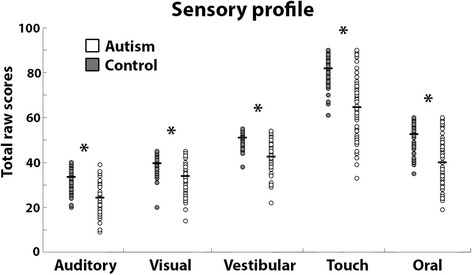
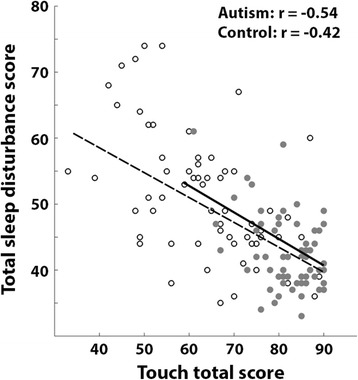
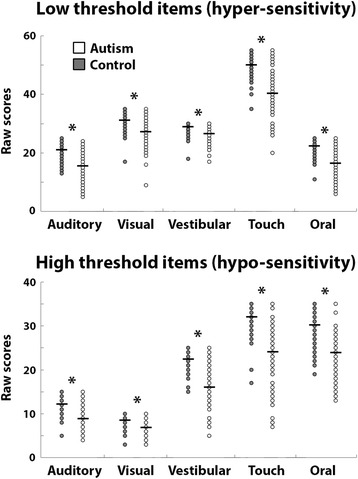
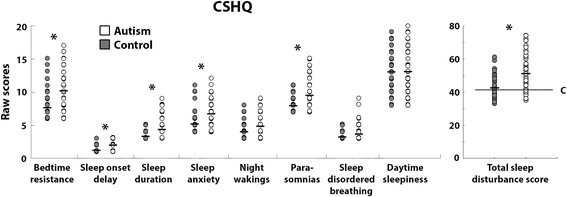
In line with previous studies, children with autism exhibited more severe sensory abnormalities and sleep disturbances than age-matched controls. The sleep disturbance scores were moderately associated with touch and oral sensitivities in the autism group and with touch and vestibular sensitivities in the control group. Hypersensitivity towards touch, in particular, exhibited the strongest relationship with sleep disturbances in the autism group and single-handedly explained 24% of the variance in total sleep disturbance scores. In contrast, sensitivity in other sensory domains such as vision and audition was not associated with sleep quality in either group.
While it is often assumed that sensitivities in all sensory domains are similarly associated with sleep problems, our results suggest that hypersensitivity towards touch exhibits the strongest relationship with sleep disturbances when examining children autism. We speculate that hypersensitivity towards touch interferes with sleep onset and maintenance in a considerable number of children with autism who exhibit severe sleep disturbances. This may indicate the existence of a specific sleep disturbance mechanism that is associated with sensitivity to touch, which may be important to consider in future scientific and clinical studies.
自闭症儿童普遍存在感觉异常和睡眠障碍,但这两个领域之间的潜在关系很少被探索。了解这种关系对于识别表现出更同质症状的自闭症儿童很重要。
在这里,我们使用照顾者感觉量表和儿童睡眠习惯问卷来检查这种关系,这两个问卷由 69 名自闭症儿童和 62 名年龄匹配的对照组的父母完成。
与之前的研究一致,自闭症儿童的感觉异常和睡眠障碍比年龄匹配的对照组更为严重。睡眠障碍评分与自闭症组的触觉和口腔敏感性以及对照组的触觉和前庭敏感性中度相关。触觉过敏与自闭症组的睡眠障碍之间表现出最强的关系,单独解释了总睡眠障碍评分的 24%的变异。相比之下,视觉和听觉等其他感觉领域的敏感性与两组的睡眠质量均无关。
虽然人们通常认为所有感觉领域的敏感性都与睡眠问题有关,但我们的结果表明,当检查自闭症儿童时,触觉过敏与睡眠障碍之间表现出最强的关系。我们推测,触觉过敏会干扰相当数量严重睡眠障碍的自闭症儿童的入睡和维持睡眠。这可能表明存在一种与触觉敏感性相关的特定睡眠障碍机制,这在未来的科学和临床研究中可能很重要。