Edward J. Bloustein School of Planning and Public Policy, Rutgers, The State University of New Jersey, 33 Livingston Avenue, New Brunswick, NJ, 08901, USA.
Institute for Health, Health Care Policy, and Aging Research, Rutgers, The State University of New Jersey, New Brunswick, NJ, USA.
J Immigr Minor Health. 2019 Apr;21(2):393-400. doi: 10.1007/s10903-018-0735-4.
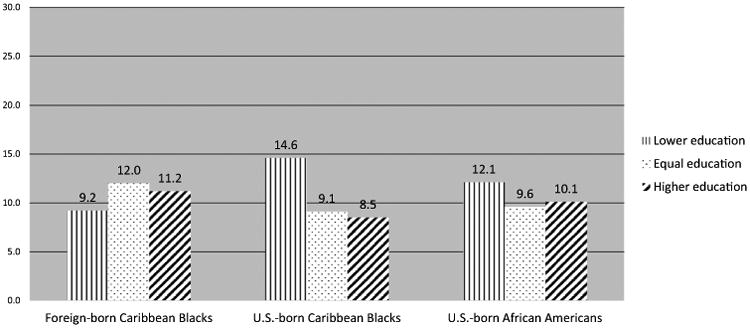
Goal-striving stress refers to the psychological consequences of seeking but failing to reach upward mobility and is more common among low-income and people of color. Intergenerational mobility-or improved socioeconomic standing relative to one's parents-may be an important predictor of goal-striving stress for Blacks. We used the National Survey of American Life to investigate the association between intergenerational mobility and goal-striving stress among U.S.-born African Americans, U.S.-born Caribbean Blacks, and foreign-born Caribbean Blacks. Intergenerational mobility was associated with lower goal-striving stress and U.S.-born African Americans and Caribbean Blacks reported lower goal-striving stress than foreign-born Caribbean Blacks. Goal-striving stress was relatively high among foreign-born Blacks, regardless of level of intergenerational mobility attained. Goal-striving is an important stressor for foreign-born Caribbean Blacks, regardless of their level of educational success. Given increasing Black migration, future studies should disaggregate the Black racial category based on ethnicity and nativity.
目标追求压力是指追求但未能实现向上流动所带来的心理后果,在低收入人群和少数族裔中更为常见。代际流动——相对于父母而言社会经济地位的提高——可能是黑人目标追求压力的一个重要预测因素。我们使用美国生活全国调查(National Survey of American Life)来研究美国出生的非裔美国人、美国出生的加勒比裔黑人和外国出生的加勒比裔黑人之间的代际流动与目标追求压力之间的关系。代际流动与较低的目标追求压力相关,美国出生的非裔美国人和加勒比裔黑人的目标追求压力低于外国出生的加勒比裔黑人。无论代际流动程度如何,外国出生的黑人的目标追求压力都相对较高。对于外国出生的加勒比裔黑人来说,目标追求是一个重要的压力源,无论他们的教育成功程度如何。鉴于黑人移民的增加,未来的研究应该根据族裔和出生地来细分黑人种族类别。