Almeida Joanna, Biello Katie B, Pedraza Francisco, Wintner Suzanne, Viruell-Fuentes Edna
Simmons School of Social Work, 300 The Fenway, Office P412-B, Boston, MA 02115, USA.
Departments of Behavioral & Social Sciences and Epidemiology, Institute for Community Health Promotion, Brown University School of Public Health, Providence, RI, USA.
SSM Popul Health. 2016 Nov 21;2:897-903. doi: 10.1016/j.ssmph.2016.11.003. eCollection 2016 Dec.
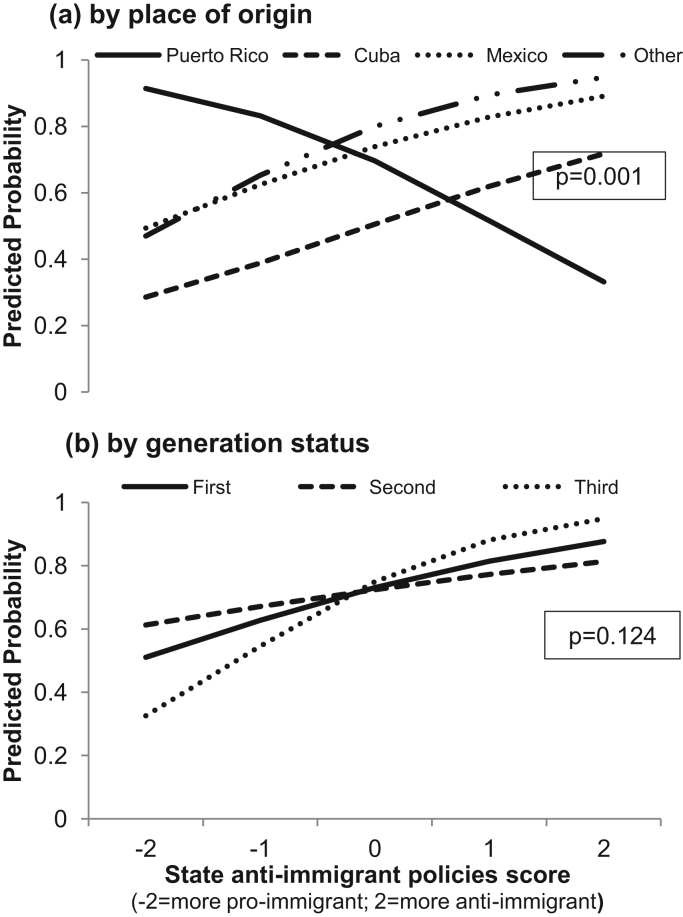
Research has found a strong inverse association between discrimination and health and well-being. Most of these studies have been conducted among African-Americans, and have examined the relationship at the individual-level. To fill these gaps in knowledge we estimated the prevalence of perceived discrimination among a nationally representative sample of Latino adults in the US, and investigated the association between state-level anti-immigrant policies and perceived discrimination. We merged survey data with a state-level anti-immigrant policy index. First, we fit hierarchical logistic regression models to test the crude and adjusted association between anti-immigrant policies and perceived discrimination. Second, we specified cross-level interaction terms to test whether this association differed by relevant individual characteristics. Almost 70% of respondents reported discrimination (68.4%). More anti-immigrant policies were associated with higher levels of discrimination (OR=1.62, 95% CI 1.16, 2.24, p=0.01). The association between anti-immigrant policies and discrimination differed by place of origin (p=0.001) and was marginally moderated by generation status (p=0.124). Anti-immigrant policies stigmatize both foreign and US-born Latinos by creating a hostile social environment which affects their experiences of discrimination. These non-health policies can adversely affect Latino health, in part through exposure to discrimination, and may help explain health patterns among Latinos in the US.
研究发现,歧视与健康及幸福之间存在着强烈的负相关关系。这些研究大多是在非裔美国人中进行的,并且是在个体层面上考察这种关系。为了填补这些知识空白,我们估计了美国具有全国代表性的拉丁裔成年人样本中感知到的歧视的患病率,并调查了州一级的反移民政策与感知到的歧视之间的关联。我们将调查数据与州一级的反移民政策指数进行了合并。首先,我们拟合了分层逻辑回归模型,以检验反移民政策与感知到的歧视之间的原始关联和调整后的关联。其次,我们设定了跨层次交互项,以检验这种关联是否因相关个体特征而异。近70%的受访者报告遭受了歧视(68.4%)。更多的反移民政策与更高程度的歧视相关(OR=1.62,95%CI 1.16,2.24,p=0.01)。反移民政策与歧视之间的关联因出生地而异(p=0.001),并且在一定程度上受到代际身份的调节(p=0.124)。反移民政策通过营造一个充满敌意的社会环境,使外国出生和美国出生的拉丁裔都受到污名化,这影响了他们遭受歧视的经历。这些非健康政策可能会对拉丁裔的健康产生不利影响,部分原因是他们遭受了歧视,这或许有助于解释美国拉丁裔的健康模式。