Department of Spine Surgery, Jining First People's Hospital, Jining, Shandong, China (mainland).
Department of Emergency, Guangxi Medical College, Nanning, Guangxi, China (mainland).
Med Sci Monit. 2018 Apr 3;24:1962-1969. doi: 10.12659/msm.903243.
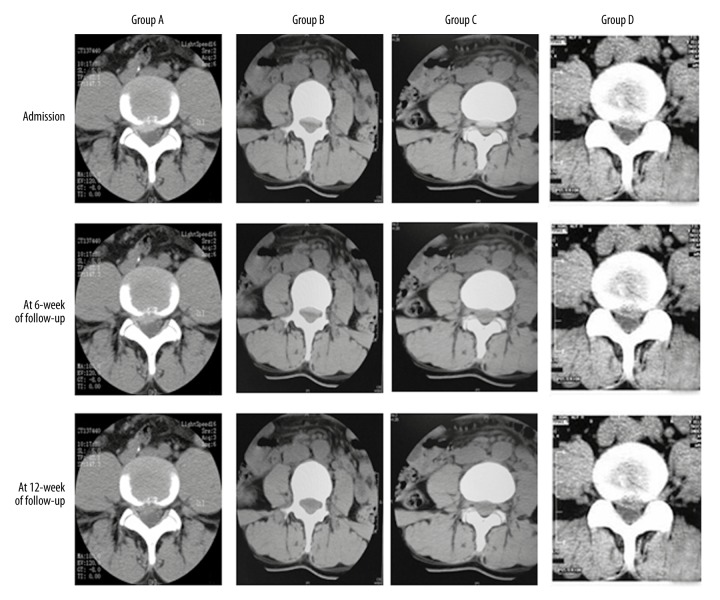
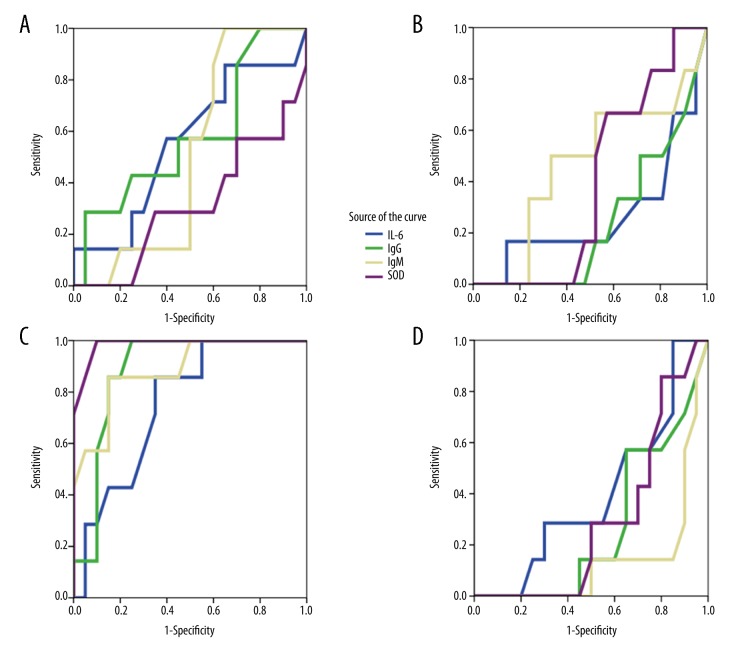
BACKGROUND This study aimed to investigate the therapeutic effect of low, medium, and high concentrations of medical ozone on trauma-induced lumbar disc herniation. MATERIAL AND METHODS A total of 80 patients were included and were grouped into a control group, a low medical ozone (20 μg/ml) group, a medium medical ozone (40 μg/ml) group, and a high medical ozone (60 μg/ml) group. The CT scan and enzyme-linked immunosorbent assay (ELISA) were used to detect IL-6 level, SOD activity, IgM, and IgG levels upon admission and at 6 and 12 months after follow-up. The area under the ROC curve (AUC) was calculated for visual analogue scale (VAS) and efficiency rate. RESULTS All patients showed disc retraction at 6- and 12-month follow-up; while patients in the medium medical ozone (40 μg/ml) group showed the greatest disc retraction rate. The IL-6, IgM, IgG, and VAS levels significantly decreased while SOD activity increased among all groups over time (p<0.05). The AUCIL-6, AUCIgG, AUCIgM, and AUCSOD was closest to 1 in the medium medical ozone (40 μg/ml) group compared with other groups (p<0.01), with the highest efficacy at 6 (35%) and 12 (85%) months during follow-up. CONCLUSIONS Low concentrations of medical ozone (20 μg/ml and 40 μg/ml) reduced the serum IL-6, IgG, and IgM expression, presenting as analgesic and anti-inflammatory effects, while high concentrations of medical ozone (60 μg/ml) increased the serum IL-6, IgG, IgM expression, presenting as pain and pro-inflammatory effects. The medical ozone concentration of 40 μg/ml showed the optimal treatment efficacy.
本研究旨在探讨低、中、高浓度医用臭氧治疗创伤性腰椎间盘突出症的疗效。
共纳入 80 例患者,分为对照组、低浓度医用臭氧(20μg/ml)组、中浓度医用臭氧(40μg/ml)组和高浓度医用臭氧(60μg/ml)组。入院时及随访 6、12 个月时,采用 CT 扫描和酶联免疫吸附试验(ELISA)检测白细胞介素-6(IL-6)水平、超氧化物歧化酶(SOD)活性、IgM 和 IgG 水平。计算视觉模拟评分(VAS)和有效率的受试者工作特征曲线(ROC)下面积(AUC)。
所有患者在随访 6、12 个月时均显示椎间盘回缩;而中浓度医用臭氧(40μg/ml)组患者的椎间盘回缩率最大。随着时间的推移,所有组的 IL-6、IgM、IgG 和 VAS 水平均显著降低,而 SOD 活性均升高(p<0.05)。与其他组相比,中浓度医用臭氧(40μg/ml)组的 AUCIL-6、AUCIgG、AUCIgM 和 AUCSOD 最接近 1,在随访 6(35%)和 12(85%)个月时的疗效最高。
低浓度(20μg/ml 和 40μg/ml)医用臭氧降低了血清 IL-6、IgG 和 IgM 的表达,呈现出镇痛和抗炎作用,而高浓度(60μg/ml)医用臭氧增加了血清 IL-6、IgG、IgM 的表达,呈现出疼痛和促炎作用。40μg/ml 的医用臭氧浓度显示出最佳的治疗效果。